
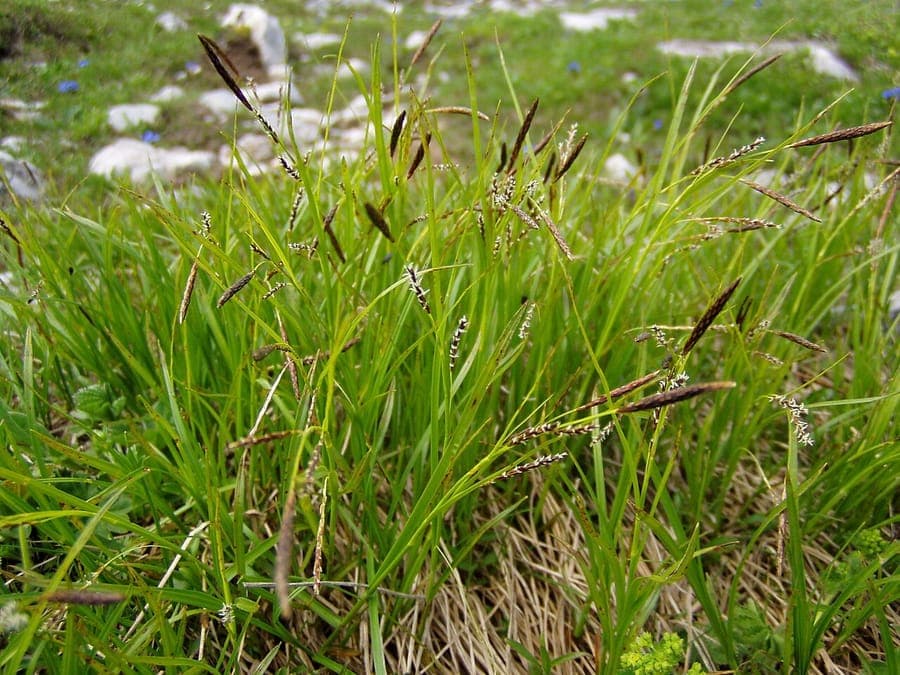
de:Benutzer:Griensteidl / CC BY-SA 3.0, via Wikimedia Commons
Evergreen Sedge: Alpine Guide & Year-Round Structure
Carex sempervirens
¿Quieres ver Evergreen Sedge: Alpine Guide & Year-Round Structure en tu jardín?
1 minuto, sin tarjeta de crédito
Overview
Evergreen sedge (Carex sempervirens) is a compact, evergreen grasslike plant from the Cyperaceae family, naturally distributed throughout European mountain regions. This delicate plant remains green year-round and forms dense tufts of fine foliage that hangs gracefully. Because it is frost-hardy and extremely low-maintenance, it is widely used in alpine gardens, scree gardens, and as underplanting for larger shrubs where structure without fuss is desired.
Appearance & Growth
Evergreen sedge grows in compact, hemispherical tufts of 20-30 cm diameter. Foliage consists of thin, needle-like structures of 15-25 cm length, bright green to grey-green. They grow densely packed, creating a very fine-textured appearance. Flowers are inconspicuous: small spikelets in May-June, brown or yellowish-green. After flowering, small amber-coloured seed capsules form. The plant remains in full colour year-round without browning or withering.
Ideal Location
Evergreen sedge thrives in USDA zones 4-8 (to -30°C). It grows in full sun to half-shade (3-5 hours sun) on well-drained mountainous sites. In private gardens it looks magnificent between rocks, in alpine troughs, or along stone walls. The plant tolerates windy locations well and does not obstruct sightlines. Plant in groups of 3-5 specimens to heighten visual impact.
Soil Requirements
Evergreen sedge prefers well-drained, moderately fertile mineral soil with pH 6.0-7.5. Heavy clay soils are disastrous; amend with 50% grit or coarse gravel. It grows in poor soils but prefers moderately nutrient-rich grit. Severe compaction must be avoided. A 5-10 cm bed of prepared soil in the planting hole aids establishment. Mulch with stone chippings (not organic matter) in alpine settings.
Watering
Evergreen sedge is a drought-tolerant plant that after establishment becomes remarkably self-sufficient. During establishment (first growing season, April-October), water regularly until plant roots develop (approximately 6-8 weeks). Thereafter, supplementary watering only in very dry spells (rainless periods exceeding 10 days). Mature plants are practically self-supporting except during extreme drought. Winter watering is unnecessary; natural precipitation suffices.
Diseño gratis
¿Quieres ver Evergreen Sedge: Alpine Guide & Year-Round Structure en tu jardín? Crea un diseño gratis ahora.
Pruning
Actual pruning is not needed. Dead foliage may be gently combed away with fingers in March before new growth emerges. Faded seed-head fruit may remain as it is ornamental. Occasional removal of sick or discoloured leaf (rarely occurs) is manual. No formal pruning recommended.
Maintenance Calendar
April: Growth starts; check soil moisture. May-June: Flowering begins; no feeding needed. July-August: Seed setting; seed matures slowly. September-October: Seed ripens; collect for propagation if desired. November-March: Winter dormancy; plant remains green. In very snowy regions, heavy snow cover may occur but plants recover after melt.
Winter Hardiness
Carex sempervirens is completely winter-hardy to zone 3b (-35°C). No protection is needed in Alpine regions, northern countries, or at elevation. Under extreme conditions (wind and frost combined), leaf tips may occasionally brown, but the central growth remains green and recovers.
Companion Plants
Evergreen sedge works splendidly with other alpine plants: houseleeks (Sempervivum), creeping phlox (Phlox subulata), and alpine poppy (Papaver alpinum). Combined in larger border compositions with stone roses and dwarf conifers, it creates multilayered textural landscapes. Do not pair with vigorous growers like Hedera or Liriope - these will overwhelm carex. Discover more alpine designer combinations on gardenworld.app.
Propagation
Evergreen sedge propagates via seed or division. Collect seed in September, dry for 2 weeks, then sow in sandy seed compost. Germination occurs April-May. Division is easier: carefully split existing clumps into 2-3 portions in March, replant immediately. Growth to full size takes 1-2 seasons.
Conclusion
Evergreen sedge is ideal for gardeners desiring year-round structure and evergreen effect without heavy maintenance obligation. The plant excels in exceptional durability and frost-hardiness. For more ideas on alpine plant composition and scree garden design, visit gardenworld.app where experts design mountain landscapes with native alpine species.
¿Quieres ver Evergreen Sedge: Alpine Guide & Year-Round Structure en tu jardín? Crea un diseño gratis ahora.
Sube una foto, elige un estilo y obtén un diseño fotorrealista con lista de plantas en menos de un minuto.
Más de 10.000 jardines diseñados
Sin tarjeta de crédito


Plantas similares
Flat-stemmed club-rush: complete guide
Bolboschoenus planiculmis
Everything about Bolboschoenus planiculmis: growing conditions, watering, care, and use as a pond margin or wetland plant in garden design.
Great Plains flatsedge: complete guide
Cyperus lupulinus
Everything about Great Plains flatsedge (Cyperus lupulinus): growing conditions, care, garden uses, and ecological value. Tips for pond margins and dry sandy soils.
Golden beak sedge: complete guide
Rhynchospora corymbosa
Everything about golden beak sedge (Rhynchospora corymbosa): a dramatic tropical marginal for pond edges, bog gardens, and wet habitats.