
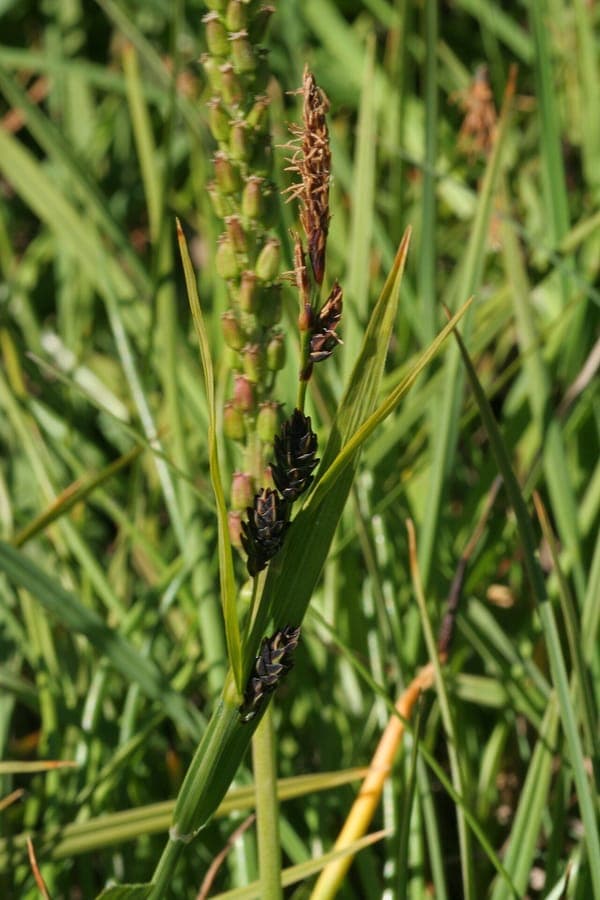
Ragnhild&Neil Crawford from Sweden / CC BY-SA 2.0, via Wikimedia Commons
Carex salina: complete guide
Carex salina
¿Quieres ver Carex salina: complete guide en tu jardín?
1 minuto, sin tarjeta de crédito
Overview
Carex salina, commonly called saltmarsh sedge, is a boreal-arctic sedge with a unique distribution spanning northern and northeastern Europe to subarctic North America and Canada. The name "salina" refers to its remarkable ability to tolerate salt and brackish water conditions.
This is a valuable plant for bank stabilization, natural water features, and tidal zones. With its tolerance for extreme moisture conditions and saline soils, it fills a niche where few other plants thrive.
Appearance and Bloom
Carex salina grows as a mid-sized, upright sedge 30-60 centimeters tall. Leaves are linear, gray-green to olive-green in color. This gives the plant its characteristic appearance in natural waterside settings.
Flower spikes appear June-August. What makes this species remarkable is its ability to grow in both freshwater environments and slightly brackish water. The fruiting spikes are green-brown and remain decorative into autumn.
The plant forms dense colonies in its natural habitat along beaches and tidal zones, demonstrating its strength in erosion control.
Ideal Location
Carex salina thrives along water margins, stream banks, tidal flats, and other low-lying moist areas. In gardens: waterside plantings, rain gardens, wetland restoration, and sunken garden areas.
The plant tolerates full sun to light shade. It withstands strong coastal winds, making it valuable for seaside gardens. Not suitable for dry locations.
Soil
Carex salina grows in wet, clay-rich to silty substrates with high water-holding capacity. Its ability to grow in saline soils and brackish environments is distinctive. pH range: 6.0-7.5 (neutral to slightly alkaline).
The plant tolerates heavy moisture buildup and even regular water stagnation. Adding organic matter improves water retention, but it's not essential; this sedge grows even in skeletal soils.
Watering
Abundant moisture is essential. Water must remain readily available, especially April through October. In dry periods, daily watering may be necessary. Never allow the soil to dry completely.
In tidal zones or along water features where the sedge is periodically submerged, supplemental watering is unnecessary. The plant actually tolerates prolonged inundation.
Diseño gratis
¿Quieres ver Carex salina: complete guide en tu jardín? Crea un diseño gratis ahora.
Pruning
Minimal pruning required. In early spring (March-April), remove dead winter foliage. The plant spreads naturally via underground rhizomes; pruning is not needed for form management.
After spikes have dried (August-September), some dead material can be removed, but it's not strictly necessary.
Maintenance Calendar
- January-February: Observation; plant is semi-active.
- March-April: Remove dead foliage; initiate moisture regime.
- May-June: Growth accelerates; maintain abundant water.
- July-August: Flowering and fruiting period; continue moisture management.
- September-October: Growth slows; water still important.
- November-December: Winter preparation; less water, less care.
Winter Hardiness
Carex salina is fully hardy throughout Europe and North America. The plant doesn't die back in winter; foliage remains partially green. Temperatures to -25C pose no threat. Underground rhizomes overwinter reliably.
In tidal zones where the plant regularly experiences sea inundation and strong winds, it demonstrates remarkable robustness.
Companion Plants
Carex salina combines well with other water and tidal-tolerant plants:
- Juncus acutiflorus (sharp-flowered rush)
- Iris laevigata (Japanese water iris)
- Caltha palustris (kingcup)
- Mentha aquatica (water mint)
- Filipendula (meadowsweet species)
- Sparganium (bur-reed species)
- Acorus gramineus (sweet flag)
In tidal areas: plant with other sedges for diverse texture and height variation.
Conclusion
Carex salina offers gardeners a valuable solution for difficult, wet garden areas with potential saline conditions. Its ability to grow in tidal zones and along beaches makes it indispensable for coastal gardens and water features with fluctuating water levels. Find it through specialized aquatic and coastal garden centers. Visit www.gardenworld.app for more ideas on water gardens and tidal plantings.
With its arctic heritage and proven performance in extreme moisture conditions, this sedge offers genuinely unique possibilities for garden design.
¿Quieres ver Carex salina: complete guide en tu jardín? Crea un diseño gratis ahora.
Sube una foto, elige un estilo y obtén un diseño fotorrealista con lista de plantas en menos de un minuto.
Más de 10.000 jardines diseñados
Sin tarjeta de crédito


Plantas similares
Flat-stemmed club-rush: complete guide
Bolboschoenus planiculmis
Everything about Bolboschoenus planiculmis: growing conditions, watering, care, and use as a pond margin or wetland plant in garden design.
Great Plains flatsedge: complete guide
Cyperus lupulinus
Everything about Great Plains flatsedge (Cyperus lupulinus): growing conditions, care, garden uses, and ecological value. Tips for pond margins and dry sandy soils.
Golden beak sedge: complete guide
Rhynchospora corymbosa
Everything about golden beak sedge (Rhynchospora corymbosa): a dramatic tropical marginal for pond edges, bog gardens, and wet habitats.