
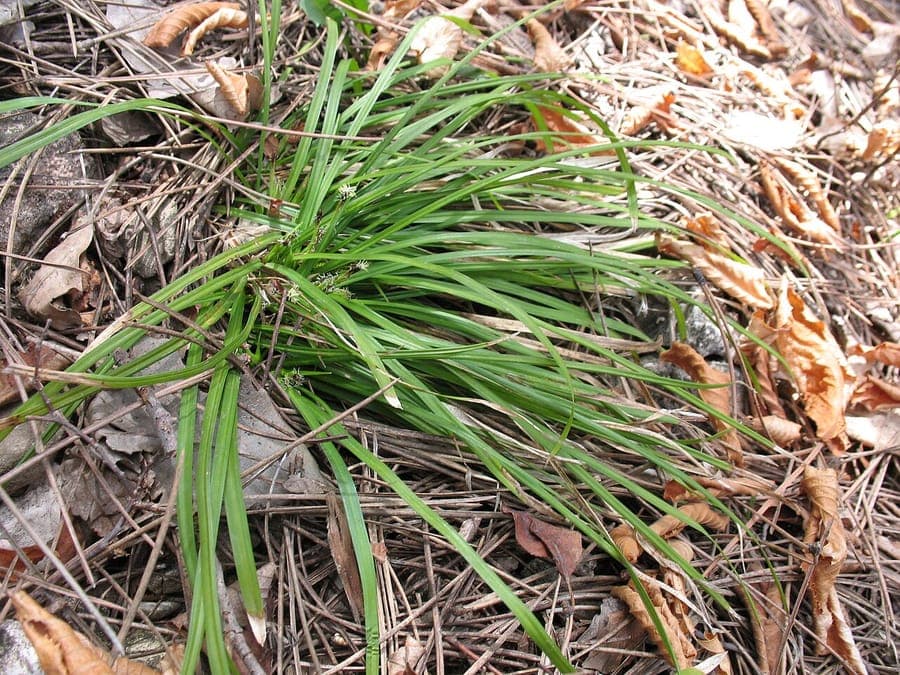
Cheryl Mayer, Black Hills National Forest / Public domain, via Wikimedia Commons
Longstalk Sedge: complete guide
Carex pedunculata
¿Quieres ver Longstalk Sedge: complete guide en tu jardín?
1 minuto, sin tarjeta de crédito
Overview
Longstalk Sedge (Carex pedunculata) is a refined grass-like sedge native to North America. This moisture-loving plant is renowned for its elegant, long stems bearing small seed heads. It is a perfect groundcover candidate for dark, wet locations where other plants struggle. The plant grows slowly but eventually forms beautiful, dense mats of grass-like foliage.
Appearance and Bloom
Carex pedunculata grows low, approximately 15-20 cm tall, with a broad spreading growth pattern working as a groundcover. The leaves are exceptionally fine-textured and delicately wavy, dark green in color. In May-June, long, thin, elegantly arching stems appear with small green female flowers at the tips. This characteristic feature gives the plant its English name. The seed heads are small and inconspicuous brownish-green.
Ideal Location
Carex pedunculata is exclusively suited to shade to dappled shade and moist soils. In full sun, the foliage discolors and the plant grows only very slowly. It is ideal beneath large trees, along wet streams, in marshes, and under shrubs where little else grows. The plant appreciates sheltered locations where its delicate stems are not constantly damaged.
Soil
The plant thrives best in wet to very wet soils, preferably heavy clay or peat. pH 5.0 to 6.5 is ideal. Do not add compost, as it prefers natural, nutrient-poor conditions. The plant grows better in pure, undisturbed ground conditions. Drainage is less important than for other sedges, since Longstalk Sedge is a true wetland plant.
Watering
Ensure the growing medium remains constantly very moist to wet throughout the growing season (March through October). In very wet locations (marshes, pond edges), supplemental watering is virtually never needed. In normal moist gardens, deep watering weekly is necessary, especially in July-August. Avoid complete drying out - the plant tolerates drought very poorly and does not recover easily.
Diseño gratis
¿Quieres ver Longstalk Sedge: complete guide en tu jardín? Crea un diseño gratis ahora.
Pruning
Carex pedunculata requires minimal pruning. In March, gently remove dead foliage from the previous year using hands or a soft comb. Do not cut the long stems in October-November as they remain ornamental through winter. Large tufts can be carefully divided every 4-5 years after the growing season, although division is not always necessary as the plant eventually forms a nice mat.
Maintenance Calendar
March: Remove dead foliage from last year; April-May: Growth period, water regularly; June-July: Long stems appear, maintain moisture; August-September: Seed development, keep plant well-watered; October-November: Ornamental seed stems remain standing, reduce watering somewhat; December-February: Rest period, minimal water, can be drier than other seasons.
Winter Hardiness
Carex pedunculata is hardy to USDA zone 3a (-35 to -40C), very suitable for the UK, Ireland, and northern France. The plant remains largely evergreen and provides structure in wet winter gardens. Freezing of wet areas causes no damage.
Companion Plants
Combine Longstalk Sedge with other shade-loving moisture plants: Astilbe minor (small red plumes), Carex oshimensis Evergold (yellow foliage), Dryopteris erythrosora (red fern), Hosta species (foliage variety), Osmunda regalis (royal fern). In wetter sections: Iris versicolor (blue swamp iris), Acorus gramineus (grasslike). Ideal in woodland edges and wet shadowed situations.
Closing
Carex pedunculata is a highly refined and elegant sedge for the most challenging, wet, dark garden corners. Its slow growth is completely justified by its elegance. For online ordering, seek specialized sedge nurseries or native plant suppliers. Gardenworld.app helps you integrate this special plant effectively into your woodland edge or marsh garden development.
¿Quieres ver Longstalk Sedge: complete guide en tu jardín? Crea un diseño gratis ahora.
Sube una foto, elige un estilo y obtén un diseño fotorrealista con lista de plantas en menos de un minuto.
Más de 10.000 jardines diseñados
Sin tarjeta de crédito


Plantas similares
Flat-stemmed club-rush: complete guide
Bolboschoenus planiculmis
Everything about Bolboschoenus planiculmis: growing conditions, watering, care, and use as a pond margin or wetland plant in garden design.
Great Plains flatsedge: complete guide
Cyperus lupulinus
Everything about Great Plains flatsedge (Cyperus lupulinus): growing conditions, care, garden uses, and ecological value. Tips for pond margins and dry sandy soils.
Golden beak sedge: complete guide
Rhynchospora corymbosa
Everything about golden beak sedge (Rhynchospora corymbosa): a dramatic tropical marginal for pond edges, bog gardens, and wet habitats.