
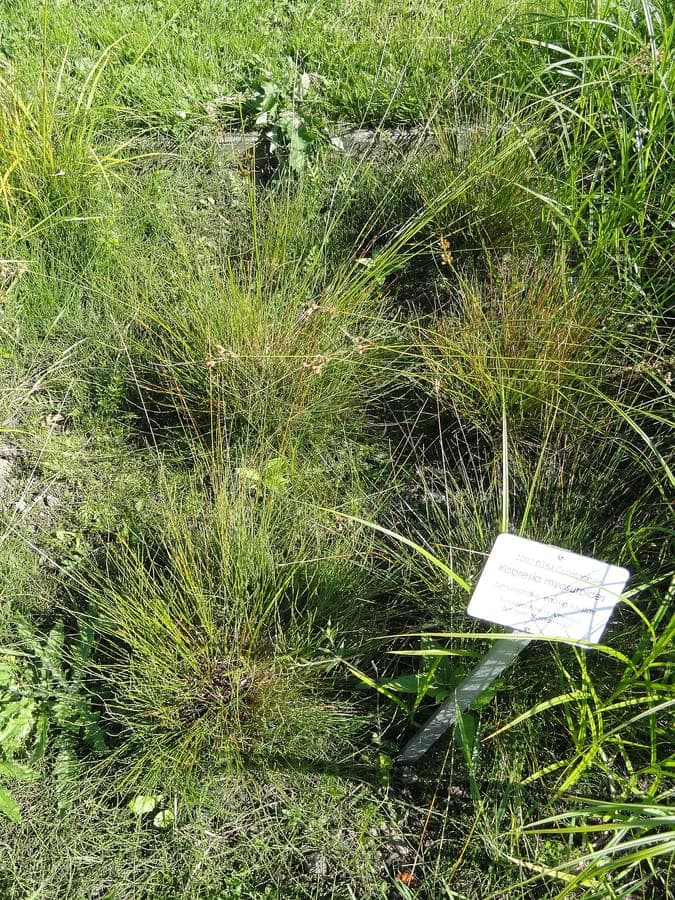
Daderot / CC0, via Wikimedia Commons
Mouse-tail bog sedge: complete guide
Carex myosuroides
¿Quieres ver Mouse-tail bog sedge: complete guide en tu jardín?
1 minuto, sin tarjeta de crédito
Overview
Mouse-tail bog sedge (Carex myosuroides) is a grass-like plant from the Cyperaceae family with distribution across the temperate northern hemisphere, including Europe, North America, and Asia. This alpine sedge is known for its unique, mouse-tail-like fruit structures and is particularly valuable in alpine gardens.
Appearance and Bloom
Mouse-tail bog sedge grows as a compact, clump-forming plant with narrow, greenish foliage. The plant is small in stature and forms dense rosette groupings. The most striking feature are the characteristic, mouse-tail-like fruits that extend like tiny tails. Blooming occurs in summer with subtle brownish spikelets.
Ideal Location
Mouse-tail bog sedge thrives best in alpine and subarctic environments with full sun to partial shade. Plant it on mountain slopes, alpine meadows, and in rock gardens where cold temperatures prevail. This is an essential plant for extreme mountain gardens and high-altitude designs.
Soil
This sedge grows on poor, acidic, well-draining soils. The plant is at home on stony and rocky substrates with limited nutrients. Poorly draining soils can cause damage, so ensure the substrate drains excellently.
Diseño gratis
¿Quieres ver Mouse-tail bog sedge: complete guide en tu jardín? Crea un diseño gratis ahora.
Watering
Once established, Mouse-tail bog sedge can tolerate drought. In alpine environments, moisture availability from snowmelt and mountain streams is usually sufficient. During very dry periods, some supplemental watering may be needed.
Pruning
Minimal pruning is needed. Dead leaves can be carefully removed in spring. The plant maintains its compact form without special care.
Maintenance Calendar
Spring: Check for dead leaves. Summer: Minimal maintenance. Fall: Winter preparation is not needed. Winter: The plant thrives in cold environments.
Winter Hardiness
Carex myosuroides is extremely cold-hardy and thrives in zones 2-5. The plant tolerates extreme cold and can grow exposed to snow and wind.
Companion Plants
Mouse-tail bog sedge combines well with other alpine plants such as Silene acaulis, Minuartia, small Sempervivum species, and other extreme alpine flowers. These combinations create authentic alpine communities.
Closing
Mouse-tail bog sedge is a fascinating plant for alpine and extreme mountain gardens. With its unique mouse-tail fruits and exceptional cold-hardiness, it provides year-round structure and botanical interest. Explore more plant species on gardenworld.app and discover how to create a spectacular alpine garden in your front yard.
¿Quieres ver Mouse-tail bog sedge: complete guide en tu jardín? Crea un diseño gratis ahora.
Sube una foto, elige un estilo y obtén un diseño fotorrealista con lista de plantas en menos de un minuto.
Más de 10.000 jardines diseñados
Sin tarjeta de crédito


Plantas similares
Flat-stemmed club-rush: complete guide
Bolboschoenus planiculmis
Everything about Bolboschoenus planiculmis: growing conditions, watering, care, and use as a pond margin or wetland plant in garden design.
Great Plains flatsedge: complete guide
Cyperus lupulinus
Everything about Great Plains flatsedge (Cyperus lupulinus): growing conditions, care, garden uses, and ecological value. Tips for pond margins and dry sandy soils.
Golden beak sedge: complete guide
Rhynchospora corymbosa
Everything about golden beak sedge (Rhynchospora corymbosa): a dramatic tropical marginal for pond edges, bog gardens, and wet habitats.