
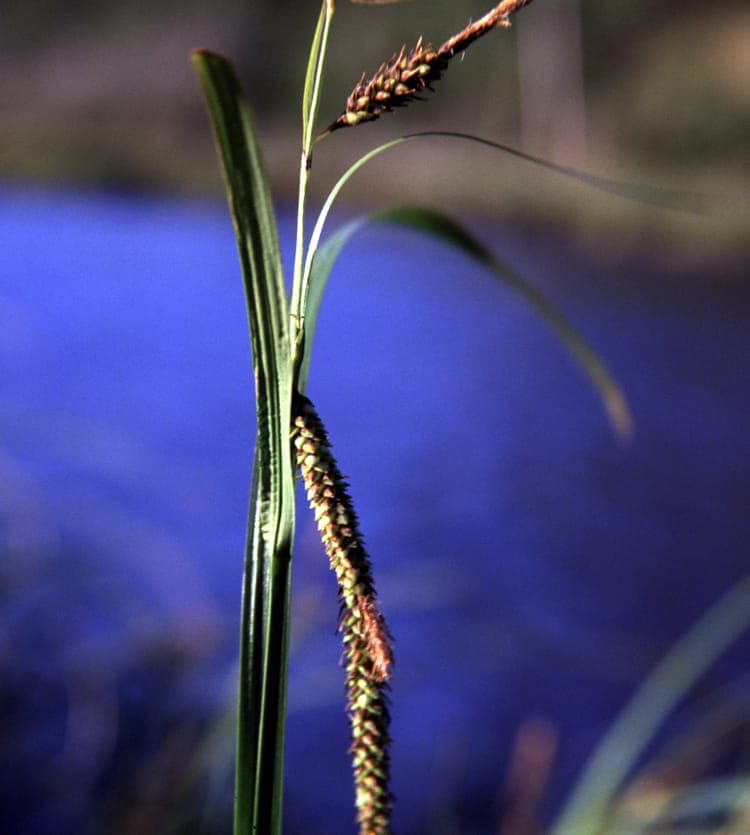
Gordon Leppig & Andrea J. Pickart / Public domain, via Wikimedia Commons
Carex lyngbyei: complete guide
Carex lyngbyei
¿Quieres ver Carex lyngbyei: complete guide en tu jardín?
1 minuto, sin tarjeta de crédito
Overview
Carex lyngbyei, known as Lyngbye's sedge, is a robust northern sedge that thrives in extreme water conditions. Native to Greenland, northern Europe, and cold regions of Asia, this plant feels at home in wet, saline, and cold soils. With its powerful root system and resilient growth, this sedge becomes an indispensable plant for gardens with wetlands or waterfronts.
The plant grows in dense, spreading clusters reaching 30 to 90 centimeters tall. The leaves are broad and sturdy, providing contrast to finer sedges. This makes it suitable for large shoreline situations and marshes where other plants may fail.
Appearance and bloom
Lyngbye's sedge has strong, broad leaves growing in compact tufts. Leaf color is mid-green to dark green, feeling rough due to blade structure. The plant can reach 90 centimeters tall during the growing season.
Bloom is subtle, consisting of small spikes forming near the plant. Flowers are not very conspicuous, but form useful seed pods for bird-mediated seed distribution. The flowering period runs from May to August.
Ideal location
Plant this sedge at pond margins, ditches, lakes, and other wet habitats. It prefers full sun to partial shade. In very hot climates, partial shade offers benefits by preventing excessive evaporation.
Use the plant for erosion control along steep banks. The roots stabilize soil and prevent washaway. This makes Lyngbye's sedge valuable in water and nature management.
Soil
This sedge grows well in very wet, even submerged soils. Saline and nutrient-rich soils are most suitable. The plant can even survive in tidal areas where fresh and saltwater mix.
Don't add much organic material; the plant actually grows better in natural, sometimes poor soils. This helps prevent excessive plant growth.
Diseño gratis
¿Quieres ver Carex lyngbyei: complete guide en tu jardín? Crea un diseño gratis ahora.
Watering
Lyngbye's sedge requires virtually permanent water. Place this plant at water edges, in shallow water gardens, or in very wet soils. The plant will not tolerate excessive drought.
In artificial conditions, ensure through automatic monitoring or regular checking that soil stays constantly saturated.
Pruning
Minimal pruning work is required. In spring (April), you can remove previous year's dead leaves and growth. This helps keep the plant clean and healthy.
Avoid excessive pruning, as this can weaken the plant. The plant assumes its natural form and this is usually most effective.
Maintenance calendar
April-May: Remove dead leaves, check water level June-July: Monitor growth, ensure adequate water August-September: No intervention needed October-March: Minimal maintenance
Winter hardiness
Lyngbye's sedge is extremely frost hardy. This plant survives winters to -30 degrees Celsius and grows even in permafrost regions. No extra protection needed, even in severe winters.
Companion plants
Pairs well with:
- Phragmites australis (reed)
- Typha spp. (cattail)
- Iris laevigata (Japanese iris)
- Glyceria maxima (sweet grass)
- Acorus gramineus (sweetflag grass)
Conclusion
For gardeners with waterside locations or wet soil conditions, Lyngbye's sedge provides an indispensable plant. With its strong roots, frost hardiness, and preference for extreme conditions, this sedge is ideal for erosion control and nature management. Add this robust plant to your water garden project.
For Dutch version, visit gardenworld.app/nl For French version, visit gardenworld.app/fr
¿Quieres ver Carex lyngbyei: complete guide en tu jardín? Crea un diseño gratis ahora.
Sube una foto, elige un estilo y obtén un diseño fotorrealista con lista de plantas en menos de un minuto.
Más de 10.000 jardines diseñados
Sin tarjeta de crédito


Plantas similares
Flat-stemmed club-rush: complete guide
Bolboschoenus planiculmis
Everything about Bolboschoenus planiculmis: growing conditions, watering, care, and use as a pond margin or wetland plant in garden design.
Great Plains flatsedge: complete guide
Cyperus lupulinus
Everything about Great Plains flatsedge (Cyperus lupulinus): growing conditions, care, garden uses, and ecological value. Tips for pond margins and dry sandy soils.
Golden beak sedge: complete guide
Rhynchospora corymbosa
Everything about golden beak sedge (Rhynchospora corymbosa): a dramatic tropical marginal for pond edges, bog gardens, and wet habitats.