
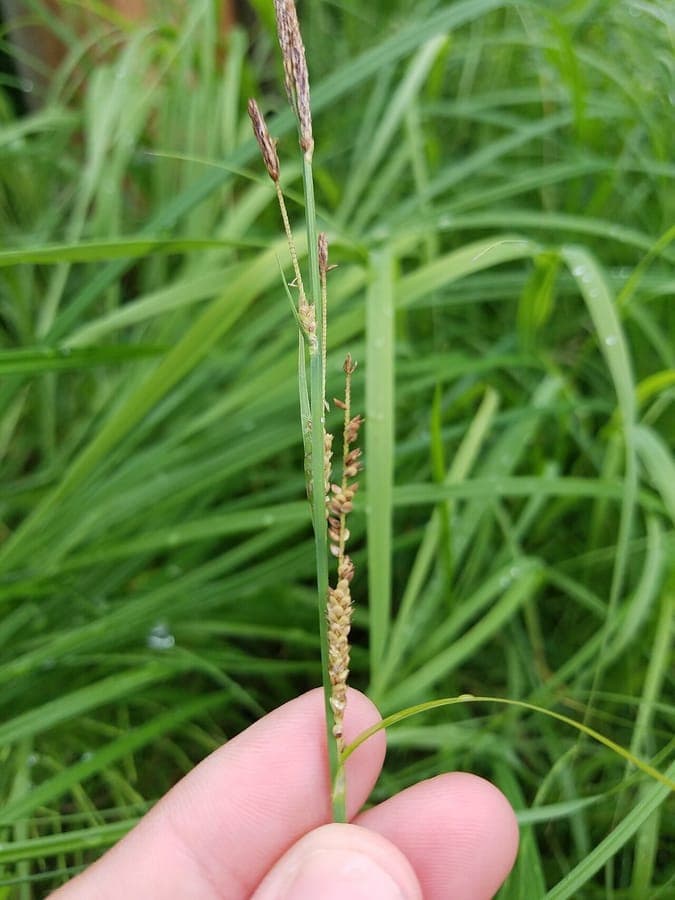
cassi saari / CC BY-SA 4.0, via Wikimedia Commons
Emory's sedge: complete guide
Carex emoryi
¿Quieres ver Emory's sedge: complete guide en tu jardín?
1 minuto, sin tarjeta de crédito
Emory's sedge (Carex emoryi) is an attractive and resilient sedge native to North and Central America, where it naturally inhabits riverbanks and wetland margins. This sedge belongs to the extensive Carex family and is particularly valued for gardens with wet or boggy soils where many conventional plants struggle.
Emory's sedge is an excellent choice if you seek a low-maintenance plant capable of beautifying waterfronts and wetland gardens. Its fine, graceful foliage creates an airy and decorative appearance that remains visually interesting throughout the year.
This plant grows in tufts with moderate growth rate. It develops fine leaf texture that is highly attractive in landscape designs. The plant is widely used for erosion control along waterbanks and in natural garden designs.
Emory's sedge is fully winter hardy and tolerates outdoor conditions in Europe without protection. The plant is tolerant of both acidic (pH 4) and neutral soils (pH 7.5), making it a flexible choice for almost any garden soil.
Appearance and Bloom The plant reaches heights of approximately 30-60 cm and forms attractive green, fine-textured foliage. The flowering is inconspicuous and occurs in early spring. The sedge is primarily interesting for its delicate, wispy green tops.
Ideal Location Emory's sedge thrives best in locations with moist to wet soils, such as along water features, in bog gardens, or in depressions where water collects. The plant flourishes in partial shade but prefers full sun to half-shade for optimal growth.
Soil The plant prefers moist, humus-rich soils. It is not particular about soil type and grows in both sandy and clayey soils. In dry conditions, the plant will perform less vigorously.
Watering Regular watering is essential, especially during dry periods. Ensure the soil never dries out completely. During rainy seasons, you may need less supplemental watering.
Pruning and Maintenance Emory's sedge requires minimal pruning. You can remove dead foliage in early spring before new growth begins. Regularly remove dead material to keep the plant healthy and neat.
Maintenance Calendar Spring (March-May): Beginning of growing season, start regular watering Summer (June-August): Regular watering, especially during dry periods Autumn (September-October): Preparation for winter, remove dead material Winter (November-February): Dormant period, minimal maintenance needed
Winter Hardiness The plant is fully winter hardy to USDA zone 4 (down to -30 degrees Celsius). It can overwinter outdoors without protection throughout the United Kingdom, Scandinavia, and Central Europe.
Companion Plants Emory's sedge pairs well with other moisture-loving plants such as:
- Other sedge species (Carex pendula, Carex elata)
- Marsh irises (Iris pseudacorus)
- Water mint (Mentha aquatica)
- Bog pimpernel (Narthecium ossifragum)
Closing Remarks Emory's sedge is a wonderful choice for transforming wet corners of your garden. With minimal maintenance requirements and strong winter hardiness, this plant will remain decorative for years. The plant is available at leading garden centres.
Want to learn more about sedge species? Visit gardenworld.app for more plant guides and garden design inspiration. Discover other Carex species in our plant collection.
¿Quieres ver Emory's sedge: complete guide en tu jardín? Crea un diseño gratis ahora.
Sube una foto, elige un estilo y obtén un diseño fotorrealista con lista de plantas en menos de un minuto.
Más de 10.000 jardines diseñados
Sin tarjeta de crédito


Plantas similares
Flat-stemmed club-rush: complete guide
Bolboschoenus planiculmis
Everything about Bolboschoenus planiculmis: growing conditions, watering, care, and use as a pond margin or wetland plant in garden design.
Great Plains flatsedge: complete guide
Cyperus lupulinus
Everything about Great Plains flatsedge (Cyperus lupulinus): growing conditions, care, garden uses, and ecological value. Tips for pond margins and dry sandy soils.
Golden beak sedge: complete guide
Rhynchospora corymbosa
Everything about golden beak sedge (Rhynchospora corymbosa): a dramatic tropical marginal for pond edges, bog gardens, and wet habitats.