
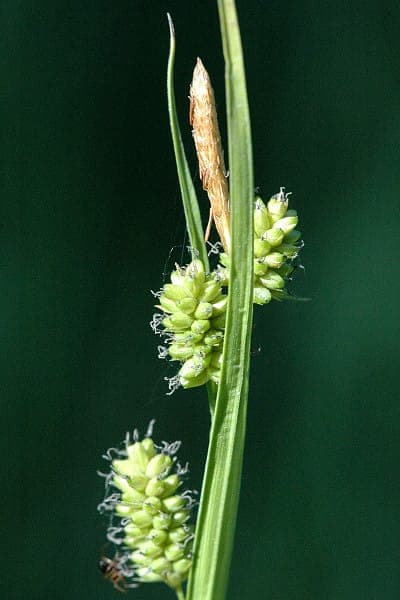
James K. Lindsey / CC BY-SA 3.0, via Wikimedia Commons
Lowland sedge: complete guide
Carex demissa
¿Quieres ver Lowland sedge: complete guide en tu jardín?
1 minuto, sin tarjeta de crédito
Overview
Carex demissa, commonly known as lowland sedge, is a remarkable grass-like plant from the Cyperaceae family. This compact sedge originates from Europe to the West Himalayas and naturally inhabits moist, nutrient-rich environments. Gardeners value this sedge for its elegant growth habit and ability to fill challenging, wet areas in gardens. With its distinctive yellow-green coloration, Carex demissa adds subtle colour accents to borders and waterside plantings. This sedge is exceptionally frost-hardy and tolerates moderately acidic soils with remarkable grace.
Appearance & Bloom
Lowland sedge grows as a compact, form-holding grass-like plant reaching 20-40 cm in height. Narrow, linear leaves display fine texture and characteristic yellow-green tinting, especially noticeable in spring and early summer. Flowering occurs from June through July with inconspicuous, green flowers developing into typical sedge-like spikes. The plant material provides delicate ornamental value to borders even outside the flowering season. The sedge maintains structural integrity throughout the entire growing season.
Ideal Location
Lowland sedge flourishes in partial shade to full sun, performing best in environments with consistent moisture. This grass-like plant is ideal for wet areas, waterside plantings and marshy garden sections. Position this sedge where water regularly appears, such as pond or stream banks. The plant tolerates moderately acidic conditions (pH 5.0-5.5) but adapts to neutral soils as well. For optimal growth, select locations with moderate air humidity (8/10 by botanical standards).
Soil
Lowland sedge requires nutrient-rich, moisture-retentive soils for optimal growth. Keep the plant consistently moist without waterlogging. Moderately acidic soils (pH 5.0-5.5) are ideal, though the plant adapts to neutral values. Soils with moderate nutrient levels (score 3/10) are sufficient. Position this sedge in moisture-rich areas where organic matter regularly decomposes. Heavy, clay-based soils are acceptable provided waterlogging is prevented.
Watering
Keep Carex demissa consistently moist throughout the growing season. In natural environments, this sedge inhabits areas with regular rainfall and elevated groundwater levels. In gardens, provide supplementary watering during dry periods, especially in the first year. Ensure water doesn't stagnate around the crown, as this may cause rotting. In moist areas and along waterside plantings, the plant requires minimal additional water. Check regularly in spring and summer to ensure adequate soil moisture.
Diseño gratis
¿Quieres ver Lowland sedge: complete guide en tu jardín? Crea un diseño gratis ahora.
Pruning
Lowland sedge requires minimal maintenance regarding pruning. Remove dead or damaged leaves in spring when new growth begins. You may lightly cut back the plant in May-June to maintain a more compact form, though this isn't necessary. Leave old, dead leaves until late season - they provide winter protection and offer decorative value. Avoid aggressive pruning, as the plant grows slowly. Most sedges self-clean their dead material as they mature.
Maintenance Calendar
Spring: Remove dead leaves, check moisture levels. Summer: Provide supplementary watering during drought, monitor health. Autumn: Add organic mulch around the crown. Winter: Protect against extreme frost with extra mulch in cold regions. Clear space in March/April for new growth. This grass-like plant requires minimal annual maintenance.
Winter Hardiness
Carex demissa is exceptionally frost-hardy across all British and Northern European climate zones. The plant tolerates temperatures down to -20 degrees Celsius without damage. During severe winters, extra mulch around the crown helps, though it's usually unnecessary. The plant doesn't disappear completely underground - leaves remain partially present. Snow and ice pose no problems for this rugged sedge. In very cold regions, extra protection may prove beneficial.
Companion Plants
Lowland sedge combines beautifully with other moisture-loving grass-like plants and perennials. Try combinations with Primula japonica, Hosta varieties and other Carex species. Iris species and Filipendula form elegant partnerships. In waterside plantings, this sedge pairs well with Astilbe and moisture-loving ferns. This grass-like plant may also function as a solitary accent plant in borders with strong moisture control.
Closing
Lowland sedge is a reliable, decorative grass-like plant for moist garden areas. Ideal for gardeners seeking elegant, frost-hardy solutions for challenging, wet spots. This sedge requires minimal maintenance and offers years of ornamental value. Available at garden centres across the UK and Europe. Visit gardenworld.app/en for more inspiration. With its subtle growth and yellow-green colouration, Carex demissa adds pure elegance to any garden.
Explore more Carex species and moisture-loving planting schemes at gardenworld.app/en/flowers.
¿Quieres ver Lowland sedge: complete guide en tu jardín? Crea un diseño gratis ahora.
Sube una foto, elige un estilo y obtén un diseño fotorrealista con lista de plantas en menos de un minuto.
Más de 10.000 jardines diseñados
Sin tarjeta de crédito


Plantas similares
Stinking sedge: complete guide
Carex foetida
Stinking sedge (Carex foetida) is a distinctive alpine sedge from European mountains, characterized by unique aromatic properties. Master cultivation techniques for this rare, specialized sedge species.
Round-fruited sedge: complete guide
Carex globularis
Round-fruited sedge (Carex globularis) is a northern grass-like plant with distinctive globular fruits. Master cultivation techniques for this hardy, botanically interesting sedge species.
Glossy-fruited sedge: complete guide
Carex liparocarpos
Glossy-fruited sedge (Carex liparocarpos) displays distinctive shiny fruits across European mountains. Learn cultivation techniques for this elegant moisture-loving sedge species.