
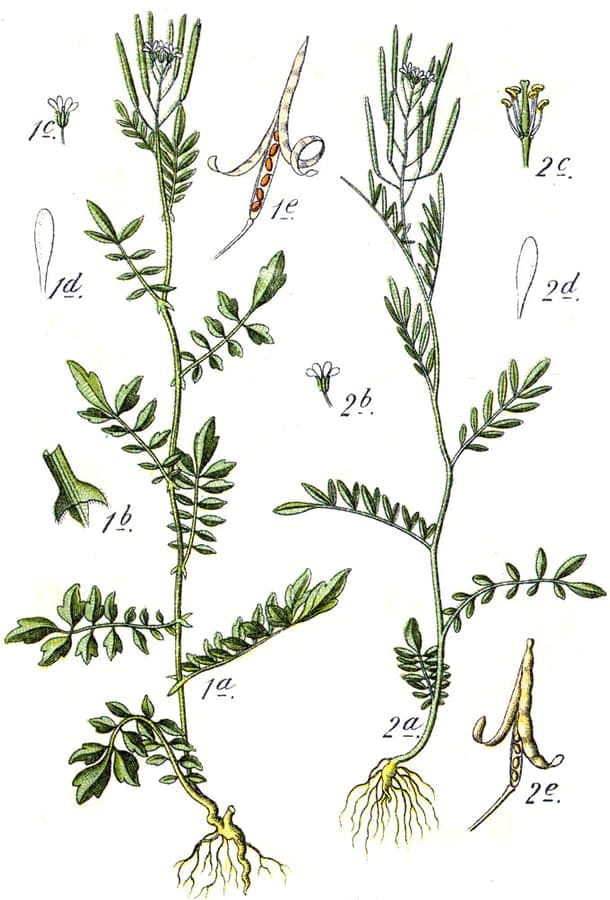
Johann Georg Sturm (Painter: Jacob Sturm) / Public domain, via Wikimedia Commons
Cardamine parviflora: complete guide
Cardamine parviflora
¿Quieres ver Cardamine parviflora: complete guide en tu jardín?
1 minuto, sin tarjeta de crédito
Overview
Cardamine parviflora, better known as sand bittercress or small-flowered bittercress, is a subtle wildflower from the Brassicaceae family. This rare and habitat-preferring plant grows in natural environments in cool, moist soils. The small-flowered bittercress is a modest plant that deserves much more attention from gardeners who love unusual and native species. Despite its small size, the little plant offers a delicate botanical value.
Appearance and Bloom
Sand bittercress forms a low, rosette-like growth form, usually not taller than 30 centimeters. The leaves are finely pinnate, highly branched, and have a delicate structure. The flowers are indeed very small, usually white or light pink, with four petals typical of the Brassicaceae family. These flowers appear in spring and early summer. The fruit capsules are elongated and narrow, containing small seeds.
Ideal Location
Cardamine parviflora naturally grows in cool, semi-shaded locations. In garden designs, it best suits shadier corners where other plants may grow less. The plant tolerates both full sun and partial shade, though semi-shade is optimal. In natural forms, it grows in open woodlands, along riverbanks, and on moist slopes. Protection from harsh wind is desirable.
Soil
This plant flourishes in slightly acidic to neutral soils that remain consistently moist. A soil with high organic content and good drainage is ideal. Heavier soils can be improved by adding sand and organic material. The plant prefers poor to moderate nutrition soils. Avoid excessive feeding which may lead to excessive leaf growth.
Diseño gratis
¿Quieres ver Cardamine parviflora: complete guide en tu jardín? Crea un diseño gratis ahora.
Watering
Sand bittercress requires regular watering, especially during dry periods. The soil should remain consistently moist but not wet. In natural conditions, it grows near rivers and springs. In gardens, adding mulch benefits moisture retention. Drip irrigation can be particularly beneficial during dry summers.
Pruning
Cardamine parviflora requires minimal pruning. Remove dried leaves and flower stems after bloom. The plant naturally declines after seed setting, so remove seed capsules to prevent self-seeding unless this is desired for stand renewal.
Maintenance Calendar
- March-April: Seedlings appear. Thin young plants to suitable distances.
- April-May: Flowering period. Water regularly during dry periods.
- June: Seed setting complete. Remove seed capsules if self-seeding not desired.
- July-August: Plant retreats. Keep water minimal.
- September-November: New seedlings may appear. Keep soil moist.
Winter Hardiness
Cardamine parviflora is quite winter-hardy in the Netherlands. The little plant may experience leaf loss during cold periods, but the roots remain intact. During severe frost periods, mulch provides extra protection. The plant regrows in spring.
Companion Plants
Sand bittercress grows well in company with other moisture-loving wildflowers such as asters, ajugas, and moist groundcovers. Marsh flowers and other Brassicaceae relatives can coexist well. Avoid dominant-growing plants that overshadow the delicate plant.
Closing Remarks
Cardamine parviflora offers gardeners the pleasure of a true wildflower with botanical authenticity. Although small and modest in appearance, this plant brings unique value to any natural or wild garden. With suitable placement and moisture management, sand bittercress grows for many years.
¿Quieres ver Cardamine parviflora: complete guide en tu jardín? Crea un diseño gratis ahora.
Sube una foto, elige un estilo y obtén un diseño fotorrealista con lista de plantas en menos de un minuto.
Más de 10.000 jardines diseñados
Sin tarjeta de crédito


Plantas similares
Brassica cretica: complete guide
Brassica cretica
Brassica cretica, the Cretan cabbage, grows wild on Aegean cliffs. Discover how to grow this drought-tolerant, yellow-flowered Mediterranean perennial.
Corsican cabbage: complete guide
Brassica insularis
Corsican cabbage is a rare Mediterranean rock cabbage with white flowers and blue-green leaves. Location, soil and winter protection.
Prostrate cabbage: complete guide
Brassica procumbens
Prostrate cabbage is a creeping North African cliff plant with yellow flowers. Discover location, soil type and winter protection.