
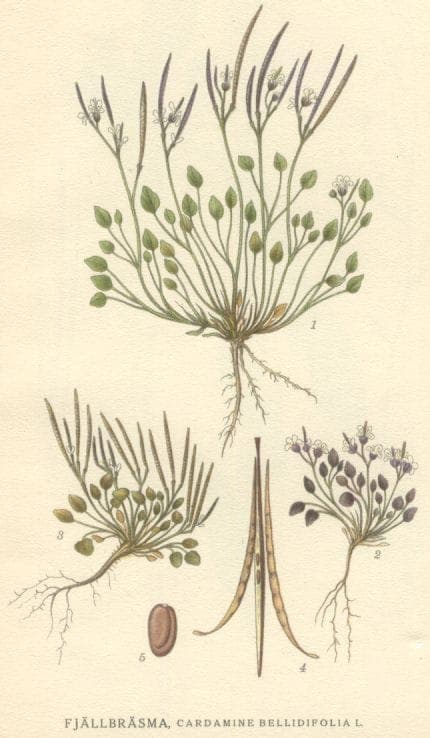
Carl Axel Magnus Lindman / Public domain, via Wikimedia Commons
Alpine Bittercress: complete guide
Cardamine bellidifolia
¿Quieres ver Alpine Bittercress: complete guide en tu jardín?
1 minuto, sin tarjeta de crédito
Overview
Cardamine bellidifolia, known as Alpine bittercress or Alpine cress, is a delicate and refined mountain plant occurring naturally in subarctic and arctic regions of northern and eastern Europe, Russia, and North America. This plant, belonging to the cabbage family (Brassicaceae), is underrepresented in most gardens but represents an essential choice for those creating authentic alpine or rocky garden settings.
The plant grows as a low carpet of soft green, spoon-shaped leaves, typically reaching just 5-15 cm in height. This modest stature makes it ideal for planting between stones, within rocky areas, or as foreground planting in alpine borders. The plant thrives in cold, moist, well-draining soils where many other plants struggle.
Appearance and Bloom
Cardamine bellidifolia is characterized by extremely fine, lance-shaped leaves growing in rosettes. The foliage is bright green with leaves measuring approximately 1-2 cm long, imparting a refined, delicate appearance. During the growing season, characteristic leaf rosettes form close to the ground.
The flowers are minimal yet elegant, displaying four white petals. They appear in June-July in loose racemes above the foliage, blooming for several weeks. Though brief, this flowering period proves exceptionally valuable for the alpine ecosystem, particularly for small pollinators.
Following bloom, slender seed pods form, ripening in July-August and dispersing seeds naturally.
Ideal Location
Cardamine bellidifolia thrives best in sun to partial shade, preferring 4-6 hours direct sunlight daily. The plant feels at home in well-ventilated environments with good moisture management.
The plant excels in:
- Rock and alpine gardens
- Between stones and stonework
- Cool understory beneath bare trees
- Screes and gravel beds
- Mountain groupings
- Well-draining borders
- Alpine trough plantings
The plant is ideal for those living in high, cold regions with abundant rain and moisture, where other plants succumb to root rot.
Soil
Cardamine bellidifolia thrives in well-draining, moisture-retentive soil with acidic to neutral pH (5.0 to 7.0). Ideal soil contains substantial organic material and silt with excellent drainage but never excessive dryness.
Amend with compost, peat, or leaf mold to add organic matter. Add gravel or sand for drainage if needed. The plant thrives in less fertile soils; overly rich soil can result in weak growth.
Diseño gratis
¿Quieres ver Alpine Bittercress: complete guide en tu jardín? Crea un diseño gratis ahora.
Watering
Cardamine bellidifolia thrives in moist environments. Water regularly, especially during dry periods, but prevent waterlogging absolutely. In nature, it grows on mountain slopes where water drains readily yet soil never completely dries.
In containers, water more frequently, especially in summer. Ensure drainage is excellent. In very warm climates, extra shade and increased water may prove necessary.
Pruning
Pruning is not truly necessary for Cardamine bellidifolia. The plant grows naturally compact and forms attractive rosettes. Remove only dead leaves and faded flower stems to maintain neatness.
Following bloom, faded stems can be removed to prevent excessive self-seeding if desired, or left standing for natural seed dispersal.
Maintenance Calendar
April-May: Growth begins. Regular watering. Monitor for disease in moist environments.
June-July: Blooming period! Full splendor. Water regularly. No fertilization needed.
August-September: Seed formation. Leave faded stems for self-seeding. Reduce water supply.
October-November: Plant dies back. Prepare for dormancy. Remove dead material.
December-March: Winter dormancy. Plant is fully hardy. Minimal maintenance required.
Winter Hardiness
Cardamine bellidifolia is exceptionally winter-hardy, tolerating temperatures well below -20degC without difficulty. It is fully suitable for all European climate zones. The plant actually prefers harsh winters to warm, dry seasons.
Winter cold and snow cover cause no harm; the plant is adapted to these conditions. Only warm, dry winters prove stressful.
Companion Plants
Cardamine bellidifolia pairs beautifully with:
- Saxifraga for yellow and red flower contrasts
- Androsace for pink flower accents
- Thymus alpinus for purple flowers
- Sedum alpestre for succulent texture
- Silene acaulis for pink flower carpets
- Chionographis for white contrast
- Festuca ovina var. glauca for blue-green grass
Conclusion
Cardamine bellidifolia is indispensable for authentic alpine gardens and rocky settings. With its delicate white flowers and perfectly adapted growth habits, it makes a beautiful and ecologically valuable addition.
Seek this plant from specialized alpine suppliers or plant nurseries. Once properly positioned in well-draining, moisture-retentive soil, it will thrive for years. For more inspiration about alpine and rocky gardens, visit gardenworld.app for professional garden advice tailored to your mountain location.
¿Quieres ver Alpine Bittercress: complete guide en tu jardín? Crea un diseño gratis ahora.
Sube una foto, elige un estilo y obtén un diseño fotorrealista con lista de plantas en menos de un minuto.
Más de 10.000 jardines diseñados
Sin tarjeta de crédito


Plantas similares
Brassica cretica: complete guide
Brassica cretica
Brassica cretica, the Cretan cabbage, grows wild on Aegean cliffs. Discover how to grow this drought-tolerant, yellow-flowered Mediterranean perennial.
Corsican cabbage: complete guide
Brassica insularis
Corsican cabbage is a rare Mediterranean rock cabbage with white flowers and blue-green leaves. Location, soil and winter protection.
Prostrate cabbage: complete guide
Brassica procumbens
Prostrate cabbage is a creeping North African cliff plant with yellow flowers. Discover location, soil type and winter protection.