
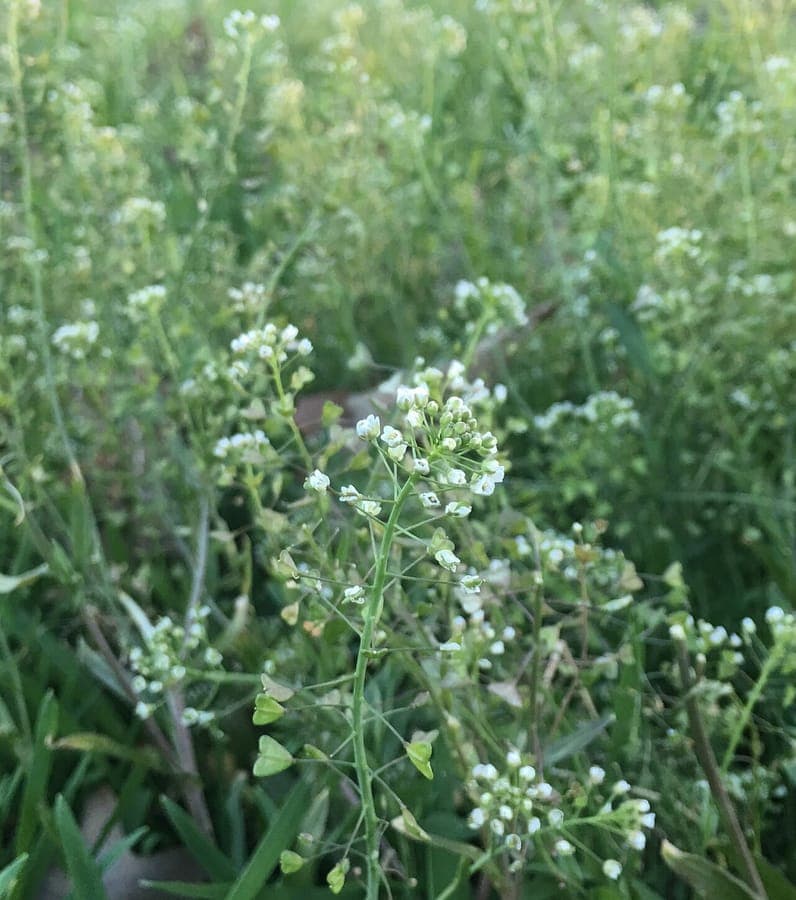
SaltySemanticSchmuck / CC BY-SA 4.0, via Wikimedia Commons
Shepherd's purse: complete guide
Capsella bursa-pastoris
¿Quieres ver Shepherd's purse: complete guide en tu jardín?
1 minuto, sin tarjeta de crédito
Overview
Shepherd's purse, botanically Capsella bursa-pastoris, is a versatile wildflower found worldwide in temperate climates and one of the most common weeds. This member of the Brassicaceae family (which includes cabbage and radish) is recognized by its characteristic heart-shaped seed pods, resembling small pouches once carried by shepherds. The plant is entirely edible and has been used for centuries in traditional medicine and as food.
On gardenworld.app, you can create garden designs that integrate edible plants and food herbs in refined ways.
Appearance & bloom cycle
Shepherd's purse forms a compact plant with a basal leaf rosette (10-50 cm tall) and a sturdy, branched flowering stem reaching up to 60 cm. Basal leaves are deeply lobed (feathery-shaped), while stem leaves are simplified. Flowers are small, white to pale pink, appearing March through October. Characteristic seed pods are heart-shaped to triangular, approximately 4-6 mm, making the plant immediately recognizable.
The plant can be annual, biennial, or short-lived perennial depending on growing conditions and climate.
Ideal location
Shepherd's purse grows practically anywhere: full sun, part-shade, and even under challenging conditions. The plant is extremely adaptable, thriving in disturbed soil, along pathways, in cracks and crevices. For garden purposes: full sun to part-shade, 4-6+ hours daily.
Soil requirements
Shepherd's purse thrives on virtually all soil types: sand, loam, heavy clay. The plant tolerates poor nutrition and low pH. Actually prefers nutrient-poor soils. No soil preparation needed; direct sow or allow natural colonization.
Diseño gratis
¿Quieres ver Shepherd's purse: complete guide en tu jardín? Crea un diseño gratis ahora.
Watering
Once established, shepherd's purse requires minimal supplemental watering. Young plants in dry conditions benefit from regular moisture. However, the plant is highly drought-tolerant and will thrive with natural rainfall.
Maintenance
Shepherd's purse requires virtually no maintenance. Remove leaves for culinary use as desired. For food, harvest only young leaves from the basal rosette. Allow some flowers to mature to seed for self-dispersal.
Maintenance calendar
February-March: Plant begins active growth. Start harvesting young leaves. April-May: Peak bloom. Continue leaf harvesting. June-August: Plant produces seed. Allow some to mature. September-October: Continues blooming but more slowly. Prepare for dormancy.
Winter hardiness
Shepherd's purse is hardy to USDA zone 2 and grows even in very cold climates. Biennial plants overwinter and bloom the following spring. In mild winters, the plant grows year-round.
Culinary & medicinal uses
Young shepherd's purse leaves are edible with a slightly peppery, cabbage-like flavor. They can be eaten raw in salads or cooked as a spinach-like green. In traditional medicine, it's used for blood clotting and as a tonic. Seeds can also be harvested for oil production (very small but nutritious).
Companion plants
Shepherd's purse pairs well with other wildflowers in food gardens, such as nettle, dandelion, and mallow. Allow them to grow together for a nutrient-rich natural food garden.
Where to buy
Seeds are readily available from suppliers selling wildflower seeds. Garden or herb centers throughout Europe stock seeds. Alternatively: simply allow natural plants to establish by dispersing seeds from nature.
Using gardenworld.app, design a food and herb garden where shepherd's purse is an important part of your self-sustaining, low-maintenance food production.
¿Quieres ver Shepherd's purse: complete guide en tu jardín? Crea un diseño gratis ahora.
Sube una foto, elige un estilo y obtén un diseño fotorrealista con lista de plantas en menos de un minuto.
Más de 10.000 jardines diseñados
Sin tarjeta de crédito


Plantas similares
Brassica cretica: complete guide
Brassica cretica
Brassica cretica, the Cretan cabbage, grows wild on Aegean cliffs. Discover how to grow this drought-tolerant, yellow-flowered Mediterranean perennial.
Corsican cabbage: complete guide
Brassica insularis
Corsican cabbage is a rare Mediterranean rock cabbage with white flowers and blue-green leaves. Location, soil and winter protection.
Prostrate cabbage: complete guide
Brassica procumbens
Prostrate cabbage is a creeping North African cliff plant with yellow flowers. Discover location, soil type and winter protection.