
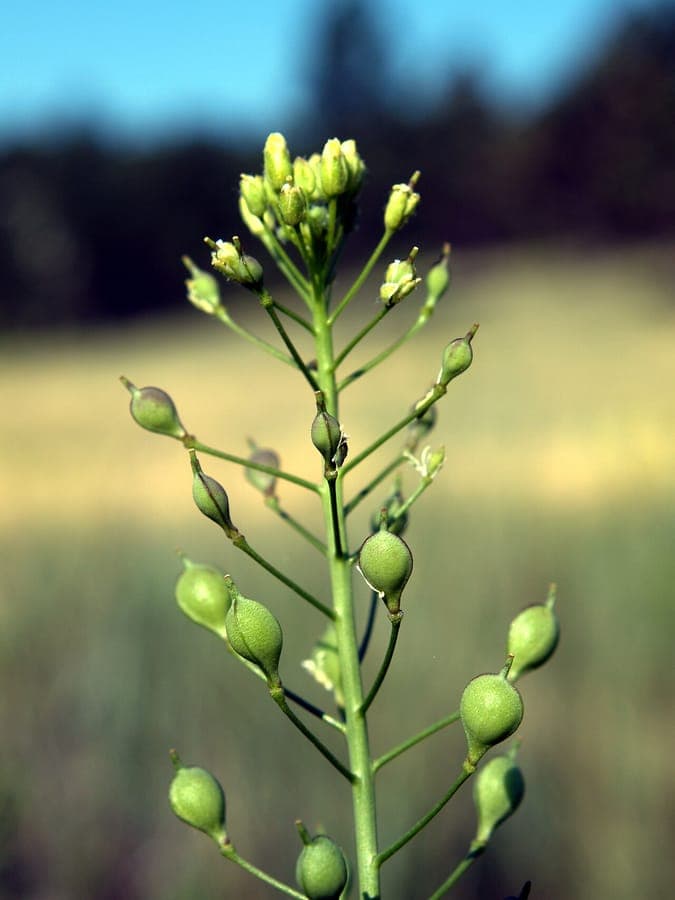
Jim Pisarowicz / Public domain, via Wikimedia Commons
Lesser gold-of-pleasure: complete guide
Camelina microcarpa
¿Quieres ver Lesser gold-of-pleasure: complete guide en tu jardín?
1 minuto, sin tarjeta de crédito
Overview
Lesser gold-of-pleasure, botanically Camelina microcarpa, is a delicate annual herb native to temperate regions of Eurasia and North Africa. This member of the Brassicaceae family (which includes cabbage and radish) is less well-known than its larger cousin Camelina sativa, but truly deserves attention for its fine foliage and abundant yellow flowers. The plant has historical significance as a wild precursor to cultivated oil plants.
On gardenworld.app, you can create garden designs that integrate herbs subtly and aesthetically.
Appearance & bloom cycle
Lesser gold-of-pleasure typically grows 30-60 cm tall with finely branched, gray-green leaves featuring characteristic hairy texture. The plant flowers from May through August with numerous small yellow flowers arranged in slender spikes. After pollination, distinctive pear-shaped seed pods form (approximately 5-8 mm). These pods mature brown and split in autumn, releasing hundreds of small brown seeds.
The fine architecture and abundant flowering make it attractive throughout its growing season.
Ideal location
Lesser gold-of-pleasure thrives in full sun to part-shade. Provide at least 5-6 hours of direct daily light. The plant is flexible regarding location and can thrive in less-than-ideal positions.
Soil requirements
The plant accepts a broad range of soil types, from sandy to loamy, provided drainage is adequate. Optimal pH ranges from 6.0 to 7.5. Unlike many garden plants, lesser gold-of-pleasure thrives even on nutrient-poor soils. No special soil preparation is required; simply direct sow into existing soil.
Diseño gratis
¿Quieres ver Lesser gold-of-pleasure: complete guide en tu jardín? Crea un diseño gratis ahora.
Watering
Once established, lesser gold-of-pleasure is quite drought-tolerant. Regular watering during initial growth months (May-June) is important, however. After establishment, the plant can rely on natural rainfall. During severe drought, supplemental water may help, but the plant is very forgiving.
Maintenance
Lesser gold-of-pleasure is extremely low-maintenance. The plant requires no pruning or special treatment. Allow some flowers to mature to seeds, and the plant will self-sow the following year, providing continuous plant coverage.
Maintenance calendar
April-May: Direct sow seeds outdoors when soil is workable. June-July: Monitor growth and enjoy the yellow flowers. August-September: Seed pods mature. Leave some remaining for self-seeding. October-November: Plant debris can be removed after seed dispersal.
Winter hardiness
Lesser gold-of-pleasure is an annual and will not overwinter. However, mature seeds will germinate in spring, forming new plants. This makes it a returning plant that naturally adapts to your garden.
Companion plants
Lesser gold-of-pleasure pairs beautifully with other yellow-flowering annuals like calendula and chamomile. Its fine foliage provides elegant contrast with larger, more prominent garden plants.
Where to buy
Camelina microcarpa seeds are harder to find than Camelina sativa seeds. Seek specialized seed merchants and herb suppliers. Online providers may occasionally stock this specific species.
Using gardenworld.app, design a natural self-seeding border where lesser gold-of-pleasure reestablishes itself year after year, creating a very low-maintenance garden.
¿Quieres ver Lesser gold-of-pleasure: complete guide en tu jardín? Crea un diseño gratis ahora.
Sube una foto, elige un estilo y obtén un diseño fotorrealista con lista de plantas en menos de un minuto.
Más de 10.000 jardines diseñados
Sin tarjeta de crédito


Plantas similares
Brassica cretica: complete guide
Brassica cretica
Brassica cretica, the Cretan cabbage, grows wild on Aegean cliffs. Discover how to grow this drought-tolerant, yellow-flowered Mediterranean perennial.
Corsican cabbage: complete guide
Brassica insularis
Corsican cabbage is a rare Mediterranean rock cabbage with white flowers and blue-green leaves. Location, soil and winter protection.
Prostrate cabbage: complete guide
Brassica procumbens
Prostrate cabbage is a creeping North African cliff plant with yellow flowers. Discover location, soil type and winter protection.