
Didier Descouens / CC BY-SA 4.0, via Wikimedia Commons
Carolina-allspice: complete guide
Calycanthus floridus
¿Quieres ver Carolina-allspice: complete guide en tu jardín?
1 minuto, sin tarjeta de crédito
Overview
Carolina-allspice (Calycanthus floridus), also called sweetshrub, is an aromatic deciduous shrub native to southeastern United States. Prized for its unusual burgundy flowers emitting powerful cinnamon-spice fragrance, this plant delivers multi-season interest through winter-persistent fruits. Naturally occurring along mountain stream valleys, it adapts well to cultivated gardens.
Appearance and bloom
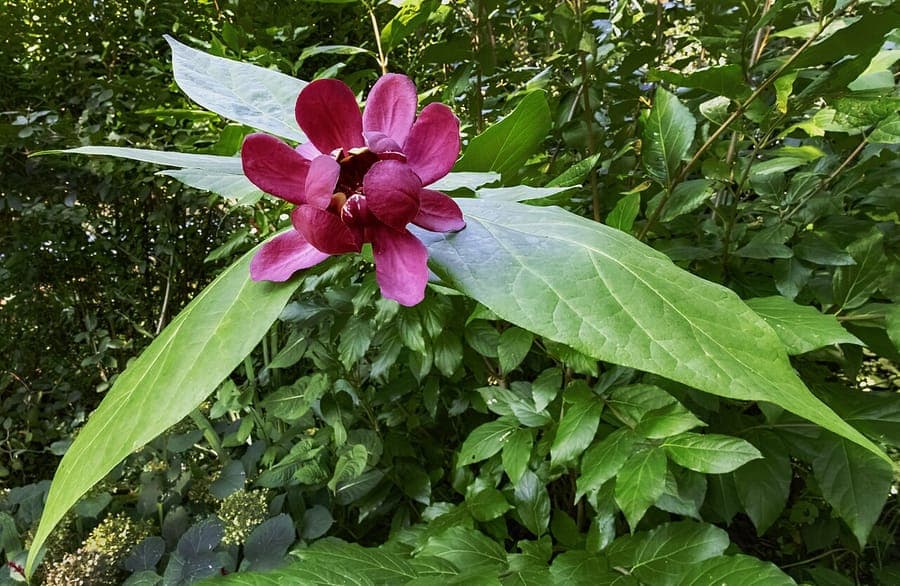
This shrub forms a deciduous, upright framework reaching 2-3 meters tall with slightly spreading habit. Foliage is oval, mid-green maturing grey-green with fine autumn colour. Flowers appear April through October in rich burgundy with inner petals more reddish. Each blossom emits intense cinnamon-honey fragrance, a distinctive characteristic.
Ideal location
Carolina-allspice thrives in full sun to partial shade, with full sun promoting maximum flowering. Afternoon shade benefits plants in intensely hot regions. The species adapts readily to diverse sun exposures, though flowering density increases with light.
Soil
This shrub accepts diverse soil types from sandy to clay-based. Well-draining, slightly acidic to neutral soil proves optimal. Organic matter incorporation stimulates robust growth. Avoid persistently waterlogged situations leading to root rot complications.
Watering
Regular watering supports establishment during the first season. Once matured, the plant demonstrates moderate drought tolerance and requires supplemental water only during severe dry periods. Mulching maintains soil moisture balance and regulates temperature.
Pruning
Minimal structural pruning is necessary. Remove dead wood annually in spring. After flowering, stems can be lightly headed back for compact form without sacrificing future blooms. Avoid heavy pruning that compromises next season's flowering potential.
Maintenance calendar
Spring: Remove winter damage, prune dead wood early. Summer: Water during dry spells. Autumn: Clear fallen foliage. Winter: Preserve fruiting stems for bird food and winter structure.
Winter hardiness
Carolina-allspice withstands temperatures to approximately -18 degrees Celsius in protected locations. In temperate climates, reliable overwintering occurs. Extreme cold regions benefit from winter protection measures.
Diseño gratis
¿Quieres ver Carolina-allspice: complete guide en tu jardín? Crea un diseño gratis ahora.
Companion plants
Pair effectively with other fragrant shrubs like witch hazel and honeysuckle. Underplant with hellebores, epimediums and smilacina for seasonal interest. Dark evergreens provide striking contrast to burgundy flowers and fruits.
Fragrance intensity and seasonality
Flower fragrance intensifies during warm, humid weather. Early morning typically offers strongest scent potential. Weather affects volatilisation of aromatic compounds. Younger flowers emit stronger fragrance than aged specimens.
Propagation challenges and techniques
Difficult to propagate from cuttings reliably. Fresh seed sown in autumn provides best germination. Division of mature plants damages growth habit significantly. Air layering of growing shoots under humid conditions in summer may succeed.
Named cultivars available
'Edith' cultivar displays more generous flowering than species type. 'Athens' offers distinctly yellower flowers than dark burgundy standard. 'Burgundy' provides particularly rich red flower tones. Cultivar selection varies by nursery and region.
Design value and integration
Carolina-allspice contributes valuable structure to border backgrounds. Unexpected flowering periods prevent compositional monotony. Association with low-growing groundcovers strengthens textural contrasts. Free-standing specimens function excellently as focal points.
Pest and disease resistance
Minimal pest problems emerge routinely. Scale insects occasionally appear but rarely cause serious damage. Caterpillars of certain moth species may nibble foliage causing minor damage. Annual plant inspection prevents severe infestations.
Late-season interest
Autumnal seed capsules persist attractively into early winter. Fruit structure provides architectural interest after leaf drop. Persistent fruits feed birds and small mammals. Winter silhouette of framework branches contributes to dormant-season landscape structure.
Conclusion
Carolina-allspice delivers fragrance and multi-season structure to mixed borders. With minimal intervention, this shrub flowers generously. Widely available; visit gardenworld.app/en and gardenworld.app/nl for cultivation guidance and landscape integration suggestions.
¿Quieres ver Carolina-allspice: complete guide en tu jardín? Crea un diseño gratis ahora.
Sube una foto, elige un estilo y obtén un diseño fotorrealista con lista de plantas en menos de un minuto.
Sin tarjeta de crédito


Plantas similares
Acer pycnanthum: complete guide
Acer pycnanthum
Acer pycnanthum, the Japanese swamp maple, is a fast-growing tree with early red flowers and brilliant autumn color, ideal for damp garden settings.
Freeman maple: complete guide
Acer × freemanii
Everything about the Freeman maple (Acer x freemanii): a fast-growing shade tree with spectacular autumn colour for large gardens.
Silver vine: complete guide
Actinidia polygama
Discover silver vine (Actinidia polygama): a hardy climbing plant with silvery foliage, loved by gardeners and cats alike.