
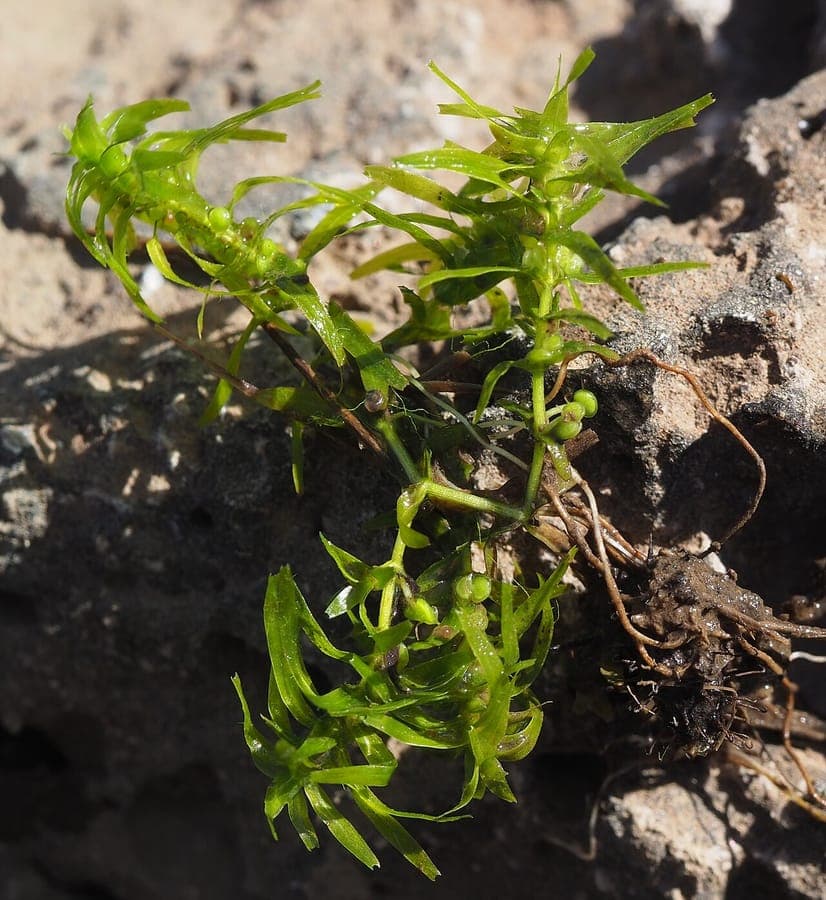
Ron Frumkin / CC BY-SA 4.0, via Wikimedia Commons
Short-leaved water starwort: complete guide
Callitriche truncata
¿Quieres ver Short-leaved water starwort: complete guide en tu jardín?
1 minuto, sin tarjeta de crédito
Overview
Short-leaved water starwort (Callitriche truncata) is a delicate submerged plant native to Western and Mediterranean Europe. Valued for its fine, feathery growth habit and ability to establish balanced aquatic ecosystems, this tiny aquatic specialist thrives in clear garden ponds and water features where clarity and biodiversity are prized.
Appearance and bloom
This plant exhibits finely divided growth with minuscule leaves reaching only 1-2 cm length. In water, the plant exhibits remarkable morphological plasticity, adapting structures to varying water depths and light conditions. Flowers are inconspicuous, grey-green, barely noticeable. Typical height in garden ponds is 10-30 cm from substrate.
Ideal location
Short-leaved water starwort thrives in full sun to partial shade with clear water and excellent light penetration. Planting depth ranges 30-60 cm below water surface in deeper ponds. Protection from strong water currents aids establishment and growth. Still or gently moving waters are ideal.
Soil
This aquatic specialist prefers slightly acidic to acidic water (pH 5.5-6.5). Sediment-rich pond substrates with fine organic matter prove ideal. Nutrient-rich silt promotes vigorous growth. Supplemental liquid aquatic fertilizer can enhance performance in nutrient-poor conditions.
Watering
As a submerged plant, continuous submersion is essential. Maintain consistent water levels throughout growing season. Regular water changes reduce algae proliferation. Humidity around plants should approximate 70-80 percent for optimal physiological function.
Pruning
Minimal pruning is necessary. Remove dead or damaged foliage with tweezers carefully. Overgrowth can be managed by gently pinching back excessively long stems. Avoid aggressive pruning that damages delicate plant tissues irreparably.
Maintenance calendar
Spring: Test water pH and nutrient levels, adjust as needed. Summer: Manage algae growth, remove accumulated dead matter. Autumn: Prepare for winter dormancy in colder regions. Winter: Protect from freezing in shallow ponds.
Winter hardiness
Short-leaved water starwort may sustain frost damage in severe winters. In temperate zones, year-round growth occurs in protected ponds. Colder regions may require indoor winterization of specimens.
Diseño gratis
¿Quieres ver Short-leaved water starwort: complete guide en tu jardín? Crea un diseño gratis ahora.
Companion plants
Pair effectively with fine-leaved aquatic plants like Hottonia, Potamogeton and Ludwigia species. Larger plants such as water lilies and aquatic sedges provide textural contrast. Small fish populations control parasitic flatworms naturally.
Growth seasons and dormancy
The plant grows most actively during cooler seasons, spring and autumn. Summer heat slows growth in shallow waters. Winter can induce dormancy in extremely cold climates where ice forms. Autumn light encourages vigorous growth strengthening plants for winter.
Aquarium applications
In aquariums, short-leaved water starwort excels as a foreground plant. Gentle insertion into fine sand substrate aids establishment. Carbon dioxide injection improves growth rates in planted aquascapes. Nutrient supplementation encourages dense foliage development. Regular trimming prevents deterioration of lower leaf layers.
Pond biology and benefits
The plant acts as a natural water filter and oxygen producer. Fine foliage provides shelter for fish fry and microcrustaceans. Beneficial bacteria colonise plant tissues supporting water ecology. Dense stands suppress nuisance algae through light competition and nutrient uptake.
Water quality requirements
Nutrient levels should remain low to moderate for healthy growth. Excess nutrients favour unwanted algal proliferation. Regular water changes refresh mineral content and prevent stagnation. Potassium deficiency causes chlorosis in new growth requiring supplementation.
Seasonal colour and texture changes
Foliage remains consistently delicate throughout year. Water temperature changes affect overall plant density and appearance. Clear water conditions optimise light penetration enhancing visual appeal. Algae coating foliage dulls appearance requiring careful management.
Tank mates and compatible fauna
Small fish species ignore this delicate plant. Grazing fish may nibble young shoots causing damage. Aquatic shrimp prove excellent companions controlling algae without harming plants. Snails similarly coexist peacefully in most circumstances.
Conclusion
Short-leaved water starwort adds silken delicacy to ponds and water features. With minimal intervention, this specialist thrives in stable aquatic environments. Available from specialist retailers; consult gardenworld.app/en and gardenworld.app/nl for comprehensive aquatic design guidance.
¿Quieres ver Short-leaved water starwort: complete guide en tu jardín? Crea un diseño gratis ahora.
Sube una foto, elige un estilo y obtén un diseño fotorrealista con lista de plantas en menos de un minuto.
Más de 10.000 jardines diseñados
Sin tarjeta de crédito


Plantas similares
White Beardtongue: complete guide
Penstemon albidus
Discover white beardtongue (Penstemon albidus) - elegant perennial with white to cream flowers. Drought-resistant, perfect for prairie and dry gardens.
Longsepal Beardtongue: complete guide
Penstemon calycosus
Discover longsepal beardtongue (Penstemon calycosus) - beautiful perennial with lilac-blue flowers. For partial shade and moist soil. Ideal for naturalized.
Penstemon cusickii: complete guide
Penstemon cusickii
Discover Cusick's beardtongue, a compact alpine flowering plant with violet-pink blooms. Perfect choice for rock gardens and water-wise landscaping.