
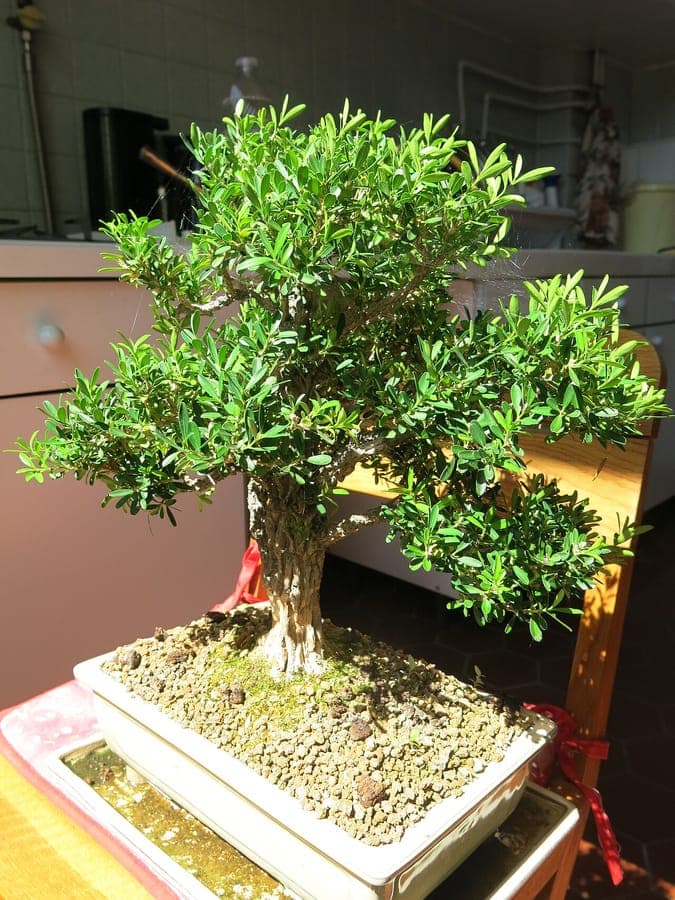
Tangopaso / Public domain, via Wikimedia Commons
Buxus harlandii: complete guide
Buxus harlandii
¿Quieres ver Buxus harlandii: complete guide en tu jardín?
1 minuto, sin tarjeta de crédito
Overview
Harland's boxwood (Buxus harlandii), native to China (Guangdong), Hong Kong, and Vietnam, is an elegant evergreen shrub belonging to the Buxaceae family. This compact plant distinguishes itself from many Western boxwood species through its finer foliage and more graceful morphology. The plant grows slowly but steadily, making it ideal for topiary forms, hedges, and container planting. With gardenworld.app, you can deploy this Asian beauty for both classical and modern garden adaptations.
Buxus harlandii grows best in partial shade but also tolerates full sun. The plant is winter-hardy in temperate regions and provides year-round interest. Its fine texture and elegant growth make it a favorite for minimalist garden designs.
Appearance and bloom cycle
This boxwood grows as a compact, dense shrub or small tree, typically 1-2 meters tall without pruning. The leaves are small, oval to linear, dark green, and glossy. They measure only 1-2 cm long, making it finer than many other boxwood species. Foliage remains green year-round.
Flowers appear in spring, small and inconspicuous, yellow-green in color. They have no ornamental value but attract pollinators. The plant habit is naturally upright, although this plant can be clipped to shape beautifully.
Ideal location
Buxus harlandii thrives in partial shade to full sun (at least 3-4 hours direct sunlight daily). It tolerates shade better than many other boxwoods. An airy spot with good air circulation helps prevent disease. The plant can handle wind and air pollution, making it suitable for urban gardens.
In very warm areas (Southern France, Southern Spain) prefer partial shade. In temperate climates (Netherlands, Belgium, Northern France) full sun is fine.
Soil requirements
This plant is not fussy about soil type. It grows in sand, loam, and clay as long as drainage is reasonable. The ideal pH is neutral to slightly alkaline (6.5-7.5). This plant tolerates poor soils well; rich, nutrient-heavy soil is not needed and may even promote soft, weak growth.
Ensure soil drains well; waterlogging causes root rot. In heavy clays: improve drainage by adding sand and gravel.
Diseño gratis
¿Quieres ver Buxus harlandii: complete guide en tu jardín? Crea un diseño gratis ahora.
Watering
Once established, Buxus harlandii is moderately drought-tolerant. After planting: water regularly for the first 4-6 weeks so roots establish. Thereafter: water only during dry periods. The plant prefers consistent moisture but dislikes wet feet.
In winter, water almost not at all. Regular misting of foliage helps prevent spider mites and other pests.
Pruning and shaping
This plant prunes excellently. For natural form: light shaping in June and September. For strict balls, cubes, or hedges: prune two to three times per growing season (May, July, September). Use sharp shears for clean cuts.
This plant tolerates heavy pruning well. Damaged parts can be aggressively cut back. Old, thick branches regrow slowly.
Maintenance calendar
March-April: Check for winter damage; ensure drainage is good.
May: First pruning; apply liquid plant food (half-strength).
June: Plant grows actively; water as needed.
July: Second pruning; minimal feeding.
August-September: Third pruning; stop feeding.
October-November: Gradually reduce watering.
December-February: Minimal care; rarely prune.
Winter hardiness
Buxus harlandii is moderately winter-hardy, suitable for USDA zones 7-8 (-10 to -15 degrees C). In temperate climates (Netherlands, Belgium, France) it overwinters without much protection. In very cold winters (below -15 degrees) leaf and tip damage may occur; containerized specimens are better moved to shelter.
Companion plants
Works well with other evergreens: ilex, deciduous trees like maple and beech, and groundcovers. With gardenworld.app, you can use Buxus harlandii as a backdrop plant, hedge, or container specimen. Combine with gravel and stone groupings for minimalist effects.
Conclusion
Buxus harlandii is a versatile, elegant plant suitable for both classical and modern gardens. With its fine foliage, compact growth, and excellent pruning capability, it is a worthwhile addition to any garden design. Start small, provide consistent care, and this Asian beauty will reward you with years of green elegance.
¿Quieres ver Buxus harlandii: complete guide en tu jardín? Crea un diseño gratis ahora.
Sube una foto, elige un estilo y obtén un diseño fotorrealista con lista de plantas en menos de un minuto.
Más de 10.000 jardines diseñados
Sin tarjeta de crédito


Plantas similares
Chinese boxwood: complete guide
Buxus sinica
Everything about Chinese boxwood: cultivation, maintenance, pruning and use for formal gardens, hedges and topiary designs
Pachysandra procumbens: complete guide
Pachysandra procumbens
Discover Pachysandra procumbens, American mountain-spurge perfect for shady woodland gardens. Growing tips, shade tolerance, soil, watering and care guide.
Buxus microphylla: complete guide
Buxus microphylla
Discover Buxus microphylla, an elegant small-leaved boxwood from Japan. Versatile, decorative and ideal for formal garden designs and contemporary landscapes.