
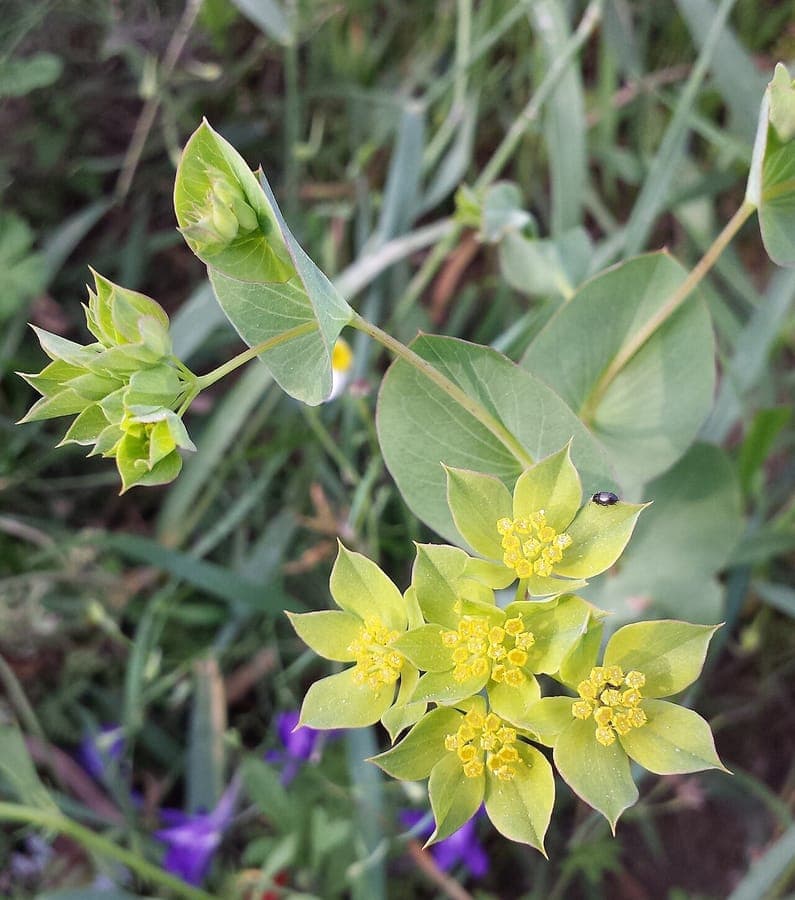
Stefan.lefnaer / CC BY-SA 3.0, via Wikimedia Commons
Thoroughwax: complete guide
Bupleurum rotundifolium
¿Quieres ver Thoroughwax: complete guide en tu jardín?
1 minuto, sin tarjeta de crédito
Overview
Thoroughwax (Bupleurum rotundifolium), also called 'perfoliate hare's-ear', is an interesting annual plant in the Apiaceae family. Occurring in Central and Eastern Europe, the Mediterranean, and Asia, this plant is known for its unique round perfoliate leaves from which its name derives. Yellow flowers appear August-September, making it a late-season available plant.
Appearance and bloom cycle
Thoroughwax is a compact annual herb with light green, round leaves that distinctly 'perforate' - the stem passes through the leaf. Yellow flowers appear in small umbel structures during August-September. The plant reaches 30-60 cm height with open, airy growth pattern. The leaf structure is the most characteristic element.
Ideal location
Thoroughwax grows best in sunny to light shade locations with at least 5-6 hours direct sunlight. The plant tolerates moderate shade acceptably. Place in borders or flowerbeds where the unique leaf structure is visible. Avoid dense shade. Wind tolerance is good.
Soil requirements
Thoroughwax is not particular about soil. It grows in normal to dry garden soil. Good drainage is beneficial. A pH of 6.0 to 8.0 is acceptable. Nutrient-rich soils are not needed; this plant thrives in moderate to poor conditions. Sandy and stony soils are suitable.
Diseño gratis
¿Quieres ver Thoroughwax: complete guide en tu jardín? Crea un diseño gratis ahora.
Watering
Once established, thoroughwax is quite drought-tolerant. Young seedlings need regular moisture until mature. Thereafter, minimal supplemental watering is needed. In very dry summers, supplemental watering may be beneficial. Avoid waterlogging.
Pruning
No pruning needed. The plant grows naturally compact. You may pinch tips for more branching (optional). Spent flowers can be removed, but seed set is usually desirable.
Maintenance calendar
March-April Direct sow seeds. April-May Germination and growth. June-July Leaf development and growth. August-September Flowering. October-November Seed set and ripening.
Winter hardiness
Thoroughwax is an annual for mild seasons. USDA zones 4-10. Frost-tolerant as a young plant but won't survive hard winters. Most suitable for spring sowing for summer and fall bloom. In warm climates, fall sowing may perform better.
Companion plants
Combine with other interesting annuals: calendula, nigella, phacelia. The unique leaf structure works well in cottage-style borders. Contrast with soft-textured material.
Final thoughts
Thoroughwax is a fascinating annual for gardeners appreciating unusual structural elements. At gardenworld.app, discover how interesting plant elements enhance garden design. This easy-to-seed plant requires minimal care. Source seeds from specialty seed suppliers.
Want to learn more about structurally interesting annuals? Visit gardenworld.app for garden design valuing unique texture and form.
¿Quieres ver Thoroughwax: complete guide en tu jardín? Crea un diseño gratis ahora.
Sube una foto, elige un estilo y obtén un diseño fotorrealista con lista de plantas en menos de un minuto.
Más de 10.000 jardines diseñados
Sin tarjeta de crédito


Plantas similares
Whorled carrot: complete guide
Daucus involucratus
Daucus involucratus is a Mediterranean umbellifer with white flower heads framed by lacy bracts. Growing this gravel garden gem.
Daucus muricatus: complete guide
Daucus muricatus
Daucus muricatus, the spiny wild carrot, grows wild on Mediterranean coasts. Discover sowing, June-July bloom, and wildflower meadow use.
Daucus pumilus: complete guide
Daucus pumilus
Daucus pumilus is a dwarf wild carrot relative with white lacy umbels, thriving on dunes and coastal rock in poor, fast-draining soil.