
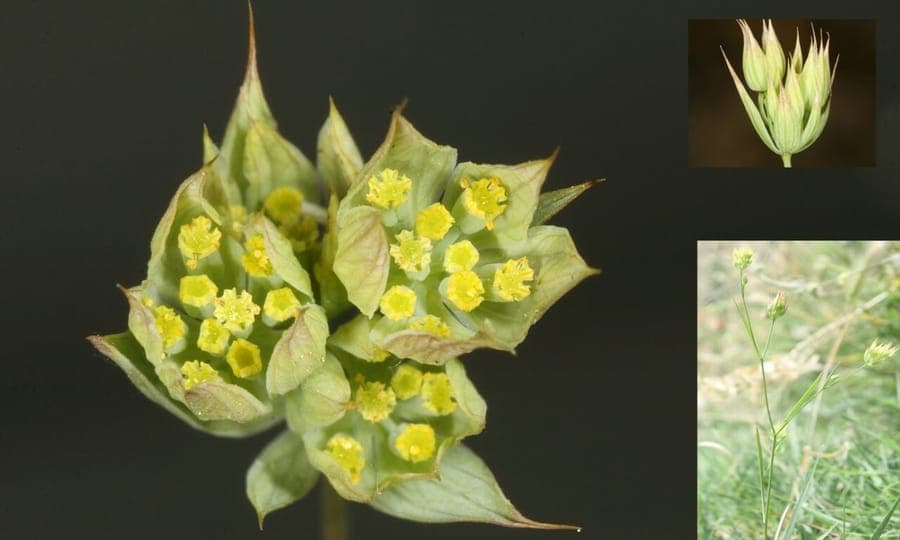
Alberto Salguero / CC BY-SA 3.0, via Wikimedia Commons
Bupleurum baldense: complete guide
Bupleurum baldense
¿Quieres ver Bupleurum baldense: complete guide en tu jardín?
1 minuto, sin tarjeta de crédito
Overview
The hare's-ear of Mont Baldo (Bupleurum baldense) belongs to the Apiaceae family, cousins to dill and fennel. This elegant Mediterranean plant grows naturally in Western and Southern Europe, particularly around Lake Garda and the Monte Baldo region. The plant is a true drought-lover, making it perfect for gardenworld.app designs in warm, sunny gardens. With its delicate, translucent yellow flower heads and feathery foliage, this plant offers a cloud of summer color with minimal care.
Bupleurum baldense thrives in sun-drenched corners where little water is available. The plant grows quickly and loves stony, dry soils. Its yellow flowers attract butterflies and pollinators, while its delicate structure supports a minimalist garden approach.
Appearance and bloom cycle
This plant grows as a compact shrub, typically 20-40 cm tall, with fine, narrow foliage that feels almost grass-like. The foliage is gray-green to yellow-green, especially at the tips. Flowers appear from June through August in umbrella-shaped flower clusters (umbels) containing dozens of tiny yellow florets. These flower heads are very light and nodding, giving the plant elegance and movement.
The plant habit is naturally upright, not compact and ball-shaped. The plant retains foliage year-round in frost-free areas but may suffer tip damage in severe winters. Fresh growth emerges from the base in spring.
Ideal location
Bupleurum baldense flourishes in full sun (at least 6-8 hours direct sunlight daily). This plant demands strong light and heat; partial shade produces sparse blooms. Choose an airy, open spot with good air circulation. The plant tolerates wind exposure and actually thrives in breezy locations.
Provide protection from the harshest winter winds in very cold climates. In southern Netherlands and Belgium, full sun is ideal; in northern France and Germany, plant against warm-facing walls.
Soil requirements
This hare's-ear loves poor, well-draining soils. Heavy clay or moist ground is disastrous. Sand, gravel, or rocky ground is perfect. If your garden soil is too moisture-retentive, add plenty of sand and gravel (50-60%). pH can be neutral to alkaline (6.5-8.0). Rich soils lead to excessive leaf growth without flowers.
The plant grows even in very poor soils; less is more. Excellent drainage is crucial - water stagnation causes root rot.
Diseño gratis
¿Quieres ver Bupleurum baldense: complete guide en tu jardín? Crea un diseño gratis ahora.
Watering
Once established, it is extremely drought-tolerant. After planting: water regularly for the first 3-4 weeks to help roots establish. Thereafter, water minimally - only during extreme drought. In Mediterranean climates (Southern France, Spain), you can leave this plant unwatered for 2-3 months. In Benelux countries, be slightly more cautious but still water minimally.
In winter, water almost not at all. Over-watering is fatal to this plant.
Pruning and shaping
This plant requires minimal pruning. After bloom (September), you can remove spent flower stems. This helps keep the plant more compact. In early spring (March), remove dead wood if frost damage occurred. Delay heavy pruning until after the last frost.
Use sharp shears and avoid damage. This plant performs better when you let its growth remain natural.
Maintenance calendar
March-April: Check winter damage; remove dead wood.
May-June: Plant blooms; minimal care needed.
July-September: Full bloom; enjoy; minimal watering.
October-November: Bloom fades; remove spent flower stems.
December-February: Dormancy; almost no watering.
Winter hardiness
Bupleurum baldense is moderately winter-hardy, suitable for USDA zones 6 (-20 to -15 degrees C). In Benelux and northern France, take protective measures during extreme winters. A dry mulch (gravel, not garden compost) around the plant protects the base. In very cold areas: grow in pots and move indoors in January-February.
Companion plants
Works well with other Mediterranean drought-lovers: lavender, santolina, artemisia, rosemary, salvia. Add groundcovers like thyme, sedum, and succulents. Stay away from moisture-loving plants.
With gardenworld.app, combine Bupleurum baldense with gravel groupings and sparse planting for maximum drought tolerance.
Conclusion
The hare's-ear of Mont Baldo is an excellent choice for warm, dry gardens with plenty of sun. With its delicate yellow flowers and minimal feeding needs, it provides summer elegance without effort. Start small, water minimally, and this Mediterranean beauty will reward you with years of quiet garden pleasure.
¿Quieres ver Bupleurum baldense: complete guide en tu jardín? Crea un diseño gratis ahora.
Sube una foto, elige un estilo y obtén un diseño fotorrealista con lista de plantas en menos de un minuto.
Más de 10.000 jardines diseñados
Sin tarjeta de crédito


Plantas similares
Whorled carrot: complete guide
Daucus involucratus
Daucus involucratus is a Mediterranean umbellifer with white flower heads framed by lacy bracts. Growing this gravel garden gem.
Daucus muricatus: complete guide
Daucus muricatus
Daucus muricatus, the spiny wild carrot, grows wild on Mediterranean coasts. Discover sowing, June-July bloom, and wildflower meadow use.
Daucus pumilus: complete guide
Daucus pumilus
Daucus pumilus is a dwarf wild carrot relative with white lacy umbels, thriving on dunes and coastal rock in poor, fast-draining soil.