
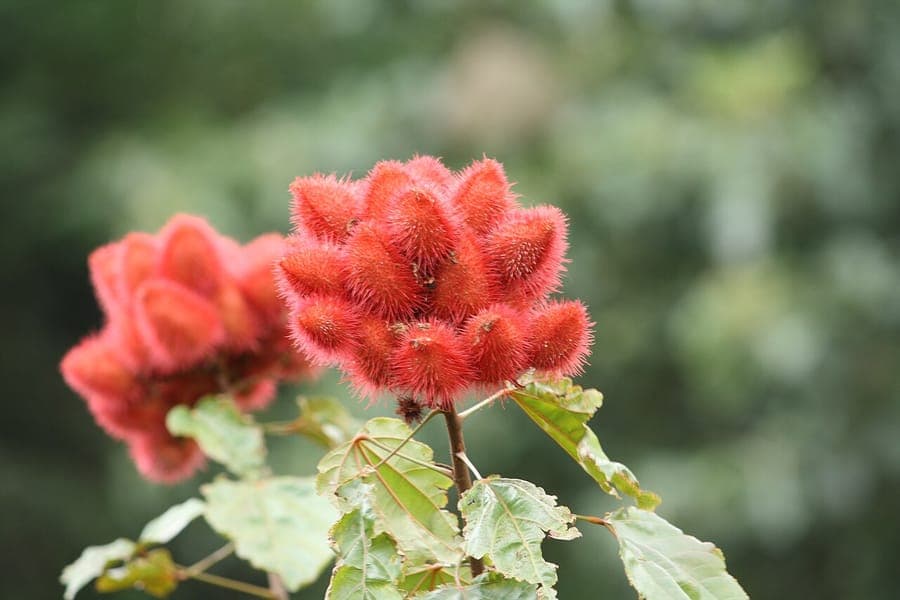
Primejyothi / CC BY-SA 3.0, via Wikimedia Commons
Bixa orellana: complete guide
Bixa orellana
¿Quieres ver Bixa orellana: complete guide en tu jardín?
1 minuto, sin tarjeta de crédito
Overview
Bixa orellana, commonly called annatto, achiote, or lipstick plant, is a tropical shrub from the Bixaceae family. Native to Central and South America, this plant is now widespread throughout tropical and subtropical regions worldwide.
The plant is renowned for its seeds abundantly coated with the dye annatto, used for centuries in food coloring, cosmetics, and textile dyeing. The shrub is also ornamentally valuable with beautiful pink or golden-yellow flowers and decorative spiky seed pods.
Appearance & bloom
Bixa orellana grows as a shrub or small tree reaching 2-3 meters height in optimal conditions. The leaves are large, oblong, dark green, slightly hairy with prominent veining.
The flowers are truly enchanting: large, round, 3-5cm across, golden-yellow or pink with open five-petaled structure. Flowers appear in small clusters at branch tips, blooming for only a day but replacing themselves throughout the growing season.
The fruits are highly distinctive: knobby, spiky, heart-shaped pods approximately 3-4cm, red or orange-red. Each pod contains 40-60 seeds completely covered with a sticky, bright orange-red aril (seed covering) full of coloring compounds.
Ideal location
Bixa orellana requires warm, tropical to subtropical climate. The plant grows best in full sun to partial shade locations receiving at least 5-6 hours direct daily sunlight.
Temperatures below 10°C are harmful; frost kills the plant. In cooler climates, greenhouse cultivation is necessary. The plant tolerates moisture and seaside winds well. Provide protection from strong winds that may damage branches.
Soil
Bixa orellana grows well in various soil types but prefers well-draining, fertile soil. The plant is not particular about pH but grows better in slightly acidic to neutral (5.5-7.0).
Heavy clay soils require amendment with sand and organic matter. Incorporate abundant compost before planting. The plant is reasonably drought-tolerant once established thanks to deep root systems, but grows more vigorously in moderately moist soil.
Diseño gratis
¿Quieres ver Bixa orellana: complete guide en tu jardín? Crea un diseño gratis ahora.
Watering
Bixa orellana is reasonably drought-tolerant once established. Young plants require regular watering until roots are well-established.
During growth periods (spring-summer), water when top 2-3cm of soil feels dry. In dormant periods, water less frequently. Avoid excessive moisture promoting fungal diseases. Well-draining soil is essential.
Pruning
Bixa orellana requires minimal pruning. Remove weak, diseased, or damaged stems as needed. Limit growth by shortening long branches if necessary for form maintenance.
Wounding heals relatively slowly, so minimize pruning. Annual light pruning after harvest helps maintain shrubby form.
Maintenance calendar
Early Season: Plant during warm months (spring to early summer) in greenhouse or warm locations. Ensure good drainage.
Summer: Water regularly. Begin monthly feeding program. Monitor for insect pests. Enjoy flowering display.
Autumn: Seed pods ripen (orange-red). Harvest pods carefully. Harvesting may continue over several months as pods mature sequentially.
Late Season: In cold climates bring indoors or maintain in greenhouse. In temperate regions dry seeds thoroughly and store.
Winter hardiness
Bixa orellana is not winter hardy and suffers damage at temperatures below 10°C. This is a warmth-loving plant unsuitable for outdoor cultivation in temperate climates without protection. Young plants are particularly frost-sensitive. Mature plants might survive brief periods near 5°C but suffer significant leaf loss.
Companion plants
In tropical gardens combines well with other warmth-lovers: Heliconia for exotic foliage forms, Alpinia for fragrant flowers, Hibiscus for flower contrast, Passion flower for climbing interest, Papaya for food production and screening.
In potted greenhouse cultivation: Fuchsias, Columneas, Begonias create complementary displays.
Closing
Bixa orellana brings exotic color and function to gardens and greenhouses. With stunning blooms and practical seed pods full of natural dye, it's a unique plant for adventurous gardeners. Perfect for greenhouse cultivation and warm microclimates. Start seeds early for best growing results.
¿Quieres ver Bixa orellana: complete guide en tu jardín? Crea un diseño gratis ahora.
Sube una foto, elige un estilo y obtén un diseño fotorrealista con lista de plantas en menos de un minuto.
Más de 10.000 jardines diseñados
Sin tarjeta de crédito


Plantas similares
Acer pycnanthum: complete guide
Acer pycnanthum
Acer pycnanthum, the Japanese swamp maple, is a fast-growing tree with early red flowers and brilliant autumn color, ideal for damp garden settings.
Freeman maple: complete guide
Acer × freemanii
Everything about the Freeman maple (Acer x freemanii): a fast-growing shade tree with spectacular autumn colour for large gardens.
Silver vine: complete guide
Actinidia polygama
Discover silver vine (Actinidia polygama): a hardy climbing plant with silvery foliage, loved by gardeners and cats alike.