
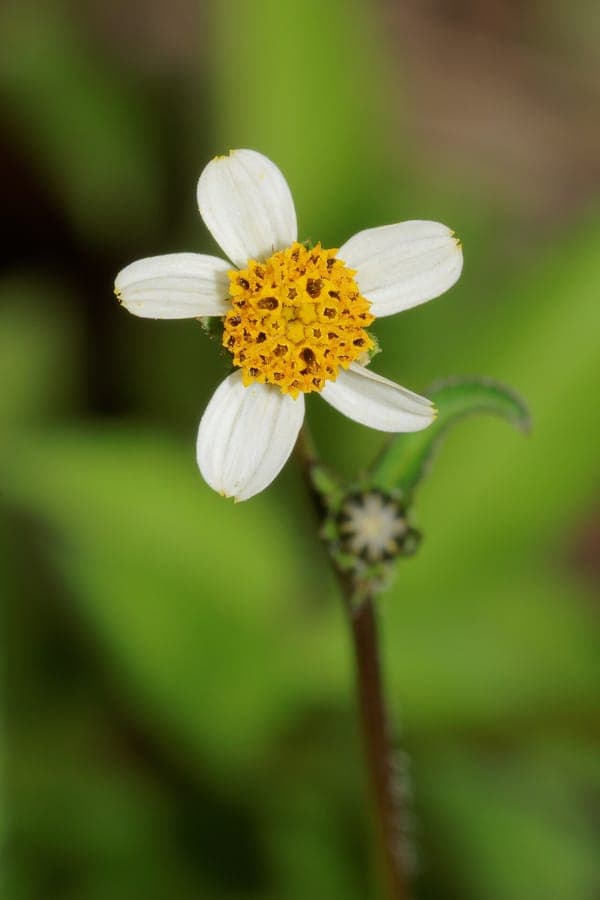
Jeevan Jose, Kerala, India / CC BY-SA 4.0, via Wikimedia Commons
Beggar-ticks: complete guide
Bidens pilosa
¿Quieres ver Beggar-ticks: complete guide en tu jardín?
1 minuto, sin tarjeta de crédito
Overview
Bidens pilosa is a tropical to subtropical plant from the Asteraceae family, native to warm and humid regions of the Americas. This plant is known for its rapid growth, resilient nature, and small yellow flowers. Although less famous than some relatives, Bidens pilosa is a versatile plant that adapts well to different growing conditions.
The plant is used in many tropical countries as a food crop and medicinal plant. In temperate climates it grows well during summer months when temperature and humidity conditions are suitable.
Appearance and bloom
Bidens pilosa grows into a lightly branching plant of 30 to 100 centimeters height depending on growing conditions. The plant has a natural upright growth habit with erect stems.
The leaves are compound and serrated, usually arranged in opposite pairs on the stems. They are dark green in color and give the plant a full, healthy appearance.
The flowers are small, about 1 centimeter in diameter, appearing in small clusters at leaf axils and stem tips. They are yellow in color and attract many insects. Although individually small, the numerous flowers together create a pleasant visual display.
The fruits, like other Bidens species, have characteristic needles with which they attach to animals - an effective dispersal mechanism.
Ideal location
Bidens pilosa grows best in warm and sunny locations. The plant prefers at least 6 hours of direct sunlight daily but also grows in partial shade, though less fully.
The plant is very adaptive and can be grown both in open ground and in containers. It is suitable for borders, beds, containers, and garden features. The compact growth habit works well in small spaces.
Bidens pilosa is relatively wind-tolerant and can even grow in exposed locations.
Diseño gratis
¿Quieres ver Beggar-ticks: complete guide en tu jardín? Crea un diseño gratis ahora.
Soil requirements
Bidens pilosa is not very critical regarding soil type. The plant grows well in virtually all well-draining soil types. Moderately nutrient-rich, well-draining soil is ideal. Heavy clay soils can be improved by adding sand and organic material.
Add garden compost or organic fertilizer to improve soil structure. The plant thrives in soils with pH between 5.5 and 7.5.
Watering
Bidens pilosa likes regularly moist soil, especially during the growing season. Water regularly to keep soil moist but not waterlogged. Daily watering may be needed during dry periods.
Check moisture by inserting your finger into the soil. If it feels dry, water generously. If it feels moist, wait another day.
In temperate climates the plant will need little water in winter as it grows slowly or may die from frost.
Pruning
Pruning is optional, but you can cut the plant back in spring to encourage a more compact form. This stimulates more branching.
Remove dead or damaged parts regularly. This helps maintain plant health.
Maintenance calendar
APRIL-MAY: Sow or transplant. Begin regular watering.
JUNE-SEPTEMBER: Active growth and flowering period. Water regularly. Feeding can help.
OCTOBER-DECEMBER: Plant grows slowly or dies back. Reduce watering. In warm climates plant may survive.
Winter hardiness
Bidens pilosa is not winter-hardy in temperate and cold climates. The plant will die once temperatures drop below 10 degrees Celsius. In tropical regions it can overwinter and even becomes perennial.
You can collect seeds and resow the following year. The plant produces abundant seeds that are easy to store.
Companion plants
Bidens pilosa combines well with other tropical annuals and perennials. The small flowers form a nice accent between larger flowers. Combine with other yellow summer bloomers for a warm display.
Conclusion
Bidens pilosa is an interesting and robust plant for summer gardens. The plant is available at many garden centers across Europe. For more information about plant care, visit gardenworld.app. Find more garden tips on gardenworld.app.
¿Quieres ver Beggar-ticks: complete guide en tu jardín? Crea un diseño gratis ahora.
Sube una foto, elige un estilo y obtén un diseño fotorrealista con lista de plantas en menos de un minuto.
Más de 10.000 jardines diseñados
Sin tarjeta de crédito


Plantas similares
Calendula stellata: complete guide
Calendula stellata
Complete guide to Calendula stellata, the star-flowered marigold from Sicily: location, soil, watering and companion planting tips.
Korean chrysanthemum: complete guide
Chrysanthemum x rubellum
Chrysanthemum x rubellum is a hardy autumn perennial with single pink to copper flowers from August to November. Care and combinations.
Helianthus divaricatus: complete guide
Helianthus divaricatus
Helianthus divaricatus is a North American woodland sunflower with yellow summer blooms, ideal for naturalistic borders and shady edges.