
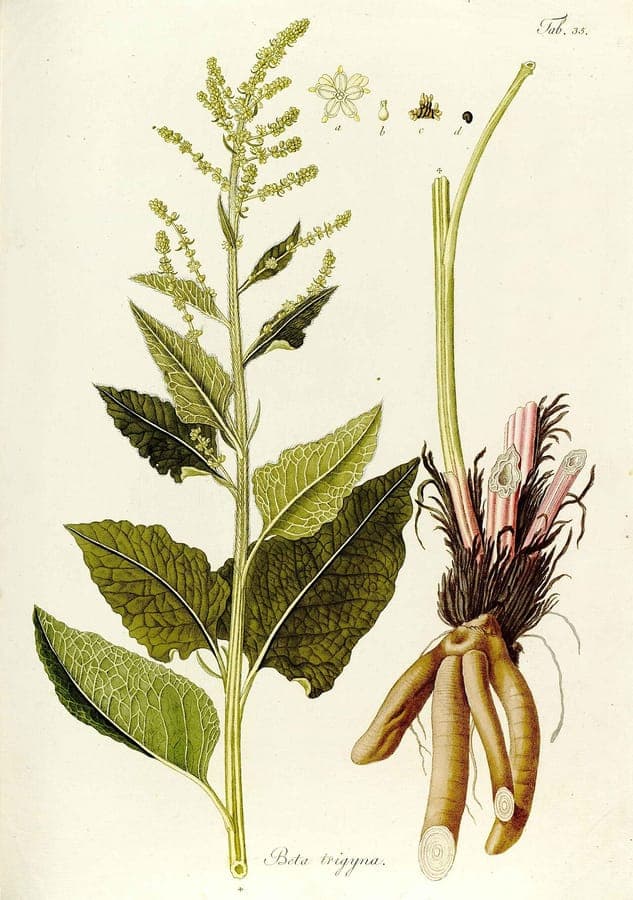
drawing: J. Schütz / Public domain, via Wikimedia Commons
Beta trigyna: complete guide
Beta trigyna
¿Quieres ver Beta trigyna: complete guide en tu jardín?
1 minuto, sin tarjeta de crédito
Overview
Beta trigyna, known as Caucasian beet or three-style beet, is a fascinating wild beet species from the Amaranthaceae family. This plant grows in arid and semi-arid regions from Southeast Europe through the Caucasus range to Iran. Beta trigyna is valued by botanical gardens and heirloom plant collectors for its interesting form, edible leaves, and frost sensitivity. This plant is ideal for dry, calcareous gardens with minimal water requirements.
Appearance and bloom cycle
Beta trigyna grows as a compact plant with upright, robust stems and large, rough-textured leaves with prominent veination. Leaves are green to brown-green with red or purple veins. From June to August, small flowers appear in dense spikes (inflorescences) with green to red-purple coloring. Flowers are followed by interesting seed capsules with distinctive layered seeds. This floral structure is botanically fascinating.
Ideal location
Beta trigyna thrives in full sun, open locations. Plant this crop on dry slopes, in rock gardens, or along south-facing walls where warmth is reflected. Ensure good air circulation to prevent moisture sensitivity. This plant values calcareous, well-drained environments and excels in Mediterranean or xeriscapic designs.
Soil requirements
Beta trigyna grows best in calcareous, well-drained soil. Use soil with pH between 7.0 and 7.5 (neutral to weakly alkaline). Sandy, gravelly, or rocky soil is strongly appreciated. Organic enrichment is unnecessary; poor soils result in stronger, more compact growth. In containers mix 70% gravel/sand, 20% compost, 10% seed sand for excellent drainage.
Watering
Beta trigyna is extremely drought-tolerant once established. Water only during planting period (April-May) to promote rooting. After establishment, supplemental watering unnecessary unless extreme drought occurs (more than 10 weeks without precipitation). Excessive water stimulates susceptibility to root rot and fungal diseases. In containers check dryness regularly.
Diseño gratis
¿Quieres ver Beta trigyna: complete guide en tu jardín? Crea un diseño gratis ahora.
Pruning
Beta trigyna requires minimal pruning. Remove only dead leaves and stems in early spring. For seed collection leave seed capsules until fully ripe (September). Avoid pinching; this plant values natural form and full stem height.
Maintenance calendar
April: plant young specimens and water well for establishment. May-June: minimal maintenance; monitor for plant diseases. July-August: bloom period; enjoy flowers, monitor for seed setting. September-October: seed ripening; preferably avoid further watering. November-March: winter dormancy; no maintenance needed (plant does not survive frost cycles in temperate zones).
Winter hardiness
Beta trigyna is not winter-hardy in temperate zones (USDA 9a and colder). In areas with winter temperatures below -5 degrees Celsius, treat the plant as annual. In warm, dry regions (USDA 9b and warmer), this plant can survive as perennial with dry winter treatment. For propagation sow seed in March-April in warm locations.
Companion plants
Beta trigyna pairs well with other drought-tolerant, calcareous-loving plants such as Artemisia, Lavandula, Thymus, and Santolina. For structure, plant alongside grasses like Festuca or Helictotrichon. In rock gardens it suits Sedum, Sempervivum, and Dianthus.
Closing remarks
Beta trigyna is a fascinating wild beet for gardeners combining botanical interest with food self-sufficiency. Its interesting floral structure and drought tolerance make it a valuable addition to xeriscapic designs. Care for this crop in dry, calcareous environments. Seeking a botanically interesting, frost-tender wild beet? Beta trigyna is ideal. Discover more about heirloom plant collection on gardenworld.app. Plant Beta trigyna in your next dry border scene on gardenworld.app.
¿Quieres ver Beta trigyna: complete guide en tu jardín? Crea un diseño gratis ahora.
Sube una foto, elige un estilo y obtén un diseño fotorrealista con lista de plantas en menos de un minuto.
Más de 10.000 jardines diseñados
Sin tarjeta de crédito


Plantas similares
Bassia laniflora (woolly summer-cypress): complete guide
Bassia laniflora
Full guide to Bassia laniflora: origin, appearance, ideal location, soil, watering and care for this drought-tolerant annual.
Suaeda spicata: complete guide
Suaeda spicata
Everything about Suaeda spicata (spiked seablite): a rare salt-tolerant coastal succulent from the western Mediterranean and Macaronesia.
California amaranth: complete guide
Amaranthus californicus
Full guide to California amaranth (Amaranthus californicus): growing tips, ideal location, soil needs, watering, and garden design ideas.