
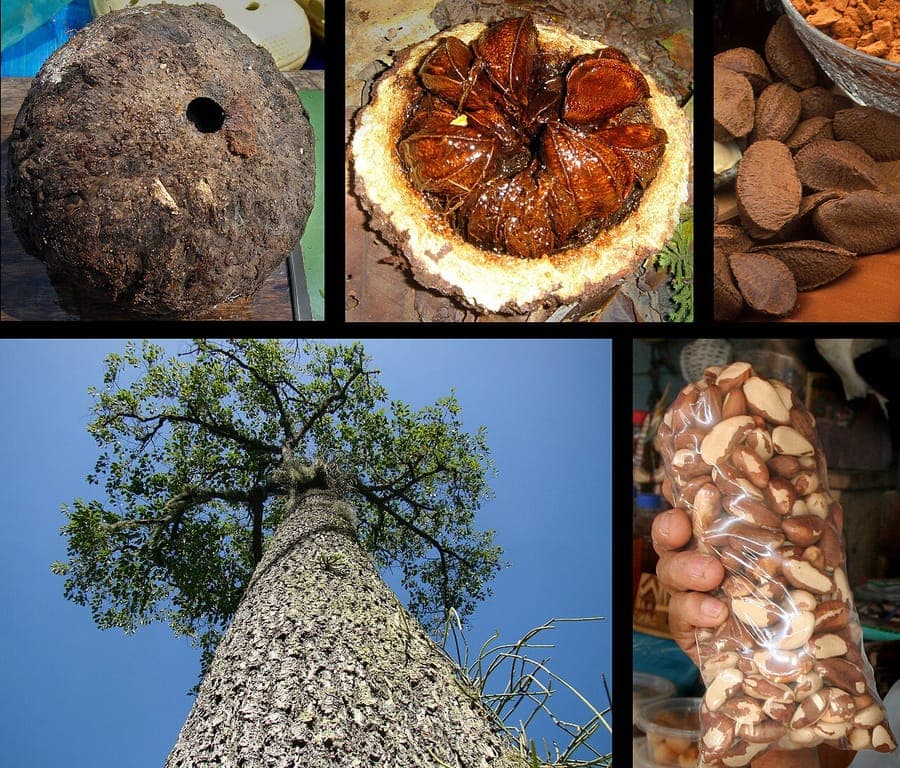
Lior Golgher (upper left photo and upper middle photo), U.S. Department of Agriculture (upper right photo), mauroguanandi (bottom left photo), USDA Forest Service Alaska Region from Juneau, Alaska, USA (bottom right photo), montage by User:RoRo / CC BY-SA 4.0, via Wikimedia Commons
Bertholletia excelsa: complete guide
Bertholletia excelsa
¿Quieres ver Bertholletia excelsa: complete guide en tu jardín?
1 minuto, sin tarjeta de crédito
Overview
Bertholletia excelsa, popularly known as Brazil nut tree, is an iconic tropical giant with immense food and cultural significance. This tree, native to South America (Brazil, Bolivia, Colombia), grows in dense rainforest and reaches impressive heights of 30-50 meters. In temperate climates, Bertholletia excelsa rarely thrives outdoors but can be a fascinating container specimen in warm, humid greenhouses.
Appearance and bloom cycle
Bertholletia excelsa grows as an imposing tree with straight trunk and dense, rounded crown. Bark is gray-brown, rough, and irregularly fissured. Leaves are large, leathery, elliptical, 30-40 cm long with prominent midvein. From December to March, large yellow flowers appear in upright inflorescences followed by characteristic heavy, woody seed capsules (approximately 15 cm diameter) containing up to 8 seeds per capsule.
Ideal location
In tropical and subtropical regions (USDA 11b and warmer only), plant this tree in sunny, open locations with afternoon shade protection. In greenhouses, position specimens in warm growth zones (25-28 degrees Celsius) with high humidity (75-85%). Provide extremely large container space (minimum 100-200 liters) for slow growth in temperate climates.
Soil requirements
Bertholletia excelsa prefers rich, nutrient-heavy, deep forest soil with high humus content. In greenhouses, mix 50% sphagnum peat, 30% composted bark, 20% sand for optimal water permeability. pH 6.0-6.5 optimal. For container culture use organically rich potting mixture with added perlite for drainage. Critical: deep rooting requires large containers.
Watering
Bertholletia excelsa demands substantial water management. Keep both soil and air very moist (65-85% humidity optimal). Water at least twice weekly during growth period; soil must never dry completely. During dormancy (October-December), reduce watering slightly but maintain moisture. Acidic water preferred; rainwater is optimal.
Diseño gratis
¿Quieres ver Bertholletia excelsa: complete guide en tu jardín? Crea un diseño gratis ahora.
Pruning
Bertholletia excelsa requires minimal pruning as container specimen. Remove only dead, diseased, or malformed branches. Lower leaves may be removed once tree reaches mature height. Allow natural form; harsh pruning damages the specimen.
Maintenance calendar
January-March: bloom period; monitor watering and humidity levels closely. April-August: growth period; fertilize every 2 weeks, check humidity daily. September-November: bloom preparation; reduce watering slightly. December-January: bloom time; maintain stable temperature and humidity. Check annually in March for fungal issues.
Winter hardiness
Bertholletia excelsa is not cold-hardy below 15 degrees Celsius. Outside tropical regions, this tree requires greenhouse culture. In temperate zones, bring specimens indoors whenever temperature threatens to drop below 10 degrees. Ideal for permanent greenhouse cultivation in temperate climates. Seedlings are difficult; seeds require special preparation and climate control.
Companion plants
In tropical gardens: Bertholletia combines well with other giant tree species (ceiba, cecropia, rubber). For underplanting use Anthurium, Philodendron, shade-tolerant ferns. In greenhouse: companions limited due to enormous space requirements.
Closing remarks
Bertholletia excelsa is a majestic, fascinating tropical giant with immense cultural and food value. Nearly impossible outside tropical zones; however, for the patient gardener, container cultivation in warm greenhouses offers a satisfying challenge. Exercise patience: growth is slow, and flowering may take years. Seeking a tropical giant for your greenhouse? Bertholletia excelsa is ultimate exotic. Discover more tropical greenhouse inspiration on gardenworld.app. Experiment with Bertholletia excelsa in your next greenhouse project on gardenworld.app.
¿Quieres ver Bertholletia excelsa: complete guide en tu jardín? Crea un diseño gratis ahora.
Sube una foto, elige un estilo y obtén un diseño fotorrealista con lista de plantas en menos de un minuto.
Más de 10.000 jardines diseñados
Sin tarjeta de crédito


Plantas similares
Freshwater mangrove: complete guide
Barringtonia acutangula
Barringtonia acutangula, the freshwater mangrove, is a tropical tree with stunning flowers and decorative fruits. Discover everything about cultivation and care.
Barringtonia asiatica: complete guide
Barringtonia asiatica
Discover the Mango-pine tree, a spectacular tropical tree with stunning flowers. Learn care requirements, growth patterns, and garden design integration.
Brackwater Mangrove: complete guide
Barringtonia racemosa
Discover the brackwater mangrove with spectacular hanging flower spikes. Complete care guide for this tropical tree suited to waterside gardens.