
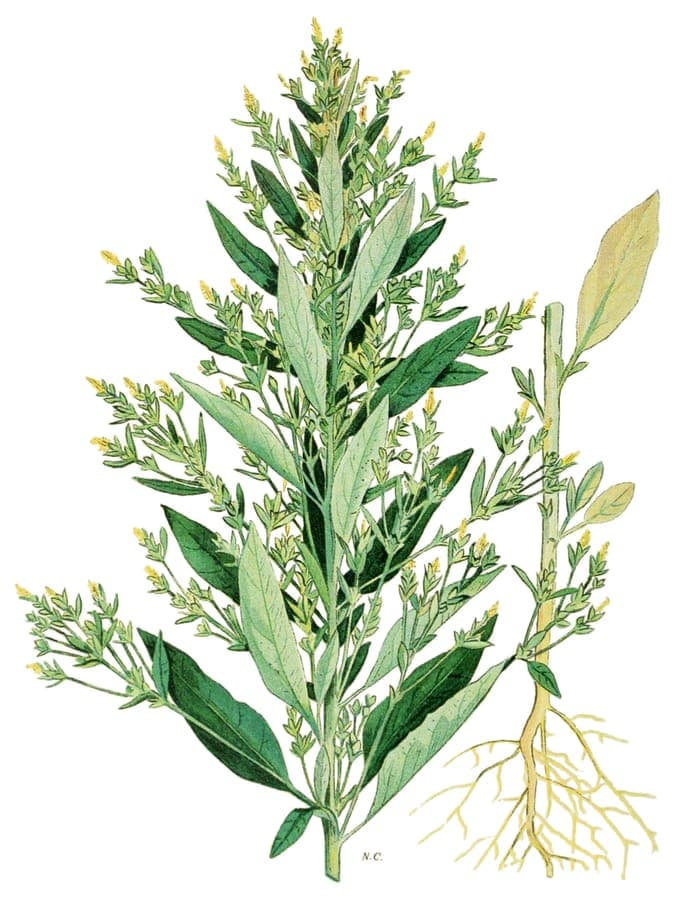
Norman Criddle (1875-1933) / Public domain, via Wikimedia Commons
Axyris amaranthoides: complete guide
Axyris amaranthoides
¿Quieres ver Axyris amaranthoides: complete guide en tu jardín?
1 minuto, sin tarjeta de crédito
Overview
Axyris amaranthoides, better known as Russian pigweed, upright axyris, or hoornmelde, is an annual plant from the Amaranthaceae family. This species naturally originates from a vast region stretching from Eastern Europe to North Korea, where it grows in dry steppes, disturbed soils, and along roadsides. The plant is clearly adapted to harsh climates and nutrient-poor soils.
Although sometimes considered a weed (particularly in North America where it was introduced), this plant offers interesting visual qualities for natural and wildflower gardens. The plant produces distinctive seed heads that provide decorative value.
Appearance and growth
Axyris amaranthoides grows as an upright, branching annual plant reaching approximately 30 to 100 centimeters in height, depending on growing conditions. The plant develops rapidly and can become very large in rich soils.
The leaves are small, lance-shaped, and often light green to grey-green in color. Throughout the growing season, hundreds of small, discrete flowers hide among the leaves. These flowers are inconspicuous, greenish, and minute.
The most striking feature of this plant is the seed heads appearing in summer and autumn. These seed heads are highly characteristic, consisting of hardened, angular, ribbed seed capsules adhered together, forming a rough, bumpy surface.
The seed heads display a grey-green to brownish color. They look interesting and almost artistic, forming a striking silhouette in the garden during autumn.
Ideal location
Axyris amaranthoides grows naturally in full sun within dry, open steppes. Therefore, sunny locations in gardens are the first choice. The plant requires minimum 6-8 hours of direct daily sunlight for optimal growth and seed development.
The plant is highly tolerant of poor, nutrient-deficient soils and disturbed ground. This makes it suitable for difficult garden corners where little else grows.
Avoid shaded locations, where the plant grows poorly and does not produce good seed.
Soil type
Axyris amaranthoides thrives better on poor, dry soils than on rich, nutrient-abundant grounds. Excess feeding promotes leaf growth at the expense of seed production.
Fertilization is not necessary - sowing is best on poorly prepared, disturbed soil. The plant also grows well on calcareous soils (pH 7.0-7.5).
Good drainage is important - avoid clayey, waterlogged conditions.
Diseño gratis
¿Quieres ver Axyris amaranthoides: complete guide en tu jardín? Crea un diseño gratis ahora.
Watering
Axyris amaranthoides is extremely drought-tolerant and once established requires almost no watering. This is actually an advantage during dry years or areas with limited water availability.
During the first growing week, you can water to encourage rapid germination and growth, but thereafter extra water is usually unnecessary.
During extremely dry summers, some watering can promote growth and seed production.
Maintenance and pruning
Axyris amaranthoides requires virtually no maintenance. The plant grows quickly and without problems.
After seed setting in autumn, you can remove damaged or excess branches. However, extensive pruning is not necessary.
Leave seed-bearing branches standing into autumn, allowing seeds to ripen and be collected if you wish to propagate the plant.
Maintenance calendar
April-May: Sow seeds outdoors or start seeds indoors.
June-July: Allow plants to grow; no special maintenance needed.
August-September: Flowers appear; seed setting begins.
October-November: Seed ripens; interesting seed heads become visible.
November-December: Harvest seeds; remove old plants.
Winter hardiness
Axyris amaranthoides is not winter hardy - it is an annual. The plant dies after the first autumn frost. This means you must resow seeds each year.
You can collect seeds from your mature plants and store them dry for next season. They require no special treatment and germinate easily in spring.
Companion plants
Axyris amaranthoides combines well with other annual drought-resistant plants:
- Tall Amaranthus species
- Cosmos species
- Nigella damascena
- Dry landscape plants such as grasses
Closing
Axyris amaranthoides is an interesting, low-maintenance choice for gardeners seeking annual plants with distinctive seed heads. The plant is hardy, grows in poor soil, and offers interesting visual qualities in autumn.
Sow directly where you want the plant to grow in April through May. The plant requires minimal maintenance and delivers dramatic seed heads in autumn. Try this unusual plant in your natural garden!
¿Quieres ver Axyris amaranthoides: complete guide en tu jardín? Crea un diseño gratis ahora.
Sube una foto, elige un estilo y obtén un diseño fotorrealista con lista de plantas en menos de un minuto.
Más de 10.000 jardines diseñados
Sin tarjeta de crédito


Plantas similares
Bassia laniflora (woolly summer-cypress): complete guide
Bassia laniflora
Full guide to Bassia laniflora: origin, appearance, ideal location, soil, watering and care for this drought-tolerant annual.
Suaeda spicata: complete guide
Suaeda spicata
Everything about Suaeda spicata (spiked seablite): a rare salt-tolerant coastal succulent from the western Mediterranean and Macaronesia.
California amaranth: complete guide
Amaranthus californicus
Full guide to California amaranth (Amaranthus californicus): growing tips, ideal location, soil needs, watering, and garden design ideas.