
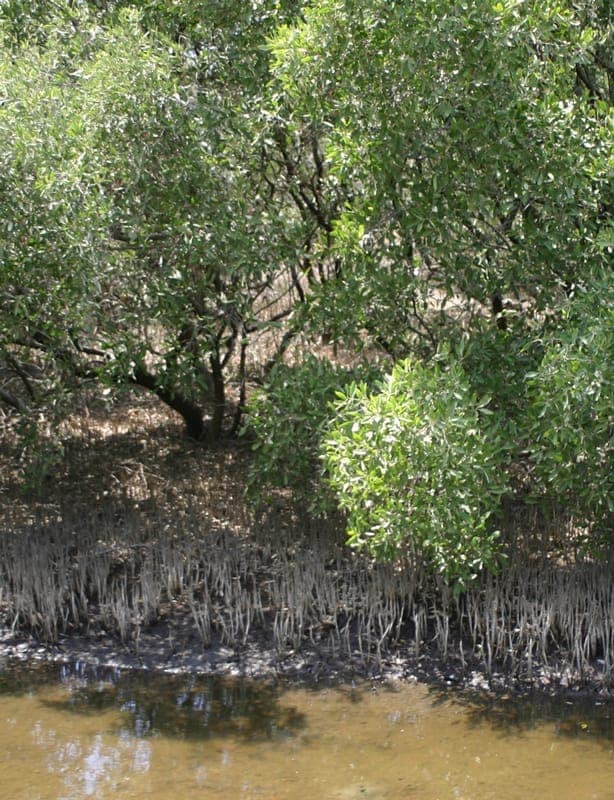
Codiferous at English Wikipedia / CC BY-SA 3.0, via Wikimedia Commons
Avicennia germinans: complete guide
Avicennia germinans
¿Quieres ver Avicennia germinans: complete guide en tu jardín?
1 minuto, sin tarjeta de crédito
Overview
The Avicennia germinans, commonly called Black mangrove, is a fascinating and unique tropical shrub that naturally grows in coastal areas of the United Kingdom, Africa, and tropical America. This extraordinary plant is renowned for its characteristic aerial roots and ability to grow in salt-infected and wet soils. The plant represents one of the most specialized plant adaptations in nature.
This mangrove is exclusively suitable for gardeners in very warm climates or indoor environments where tropical conditions can be simulated. Its unique appearance and biological fascination make it a special addition for specialized cultivators.
Appearance and Bloom
The Black mangrove grows as a shrub to small tree with characteristic, ascending aerial roots that emerge from the ground. The leaves are dark green, lance-shaped, and fairly thick, adapted for salt uptake. The plant can reach considerable sizes in its natural habitat.
Small, white flowers appear in spring and early summer. These flowers are inconspicuous but attractive to birds and insects. The plant bears characteristic fruits that can float and disperse, a unique dispersal method.
Ideal Location
The Black mangrove requires warm conditions with temperatures not falling below 10 degrees Celsius. Full sun is ideal but the plant also accepts light shade. In Northern Europe, this plant can only be grown indoors in greenhouses or heated conservatories.
In tropical and subtropical regions, the plant grows in coastal areas, usually in brackish water or saline soils. Good ventilation is important. The plant can also be grown in large containers.
Soil
The Black mangrove is uniquely adapted to salt-infected soils and grows well in saline environments. For container cultivation, a mixture of sand, silt, and organic matter can be used. Unlike most plants, this species tolerates salt very well.
Good drainage is essential, but regular watering with salt water or sea water can occur. In normal garden soils, the plant grows poorly. For indoor cultivators: use a well-draining soil mix with extra sand.
Diseño gratis
¿Quieres ver Avicennia germinans: complete guide en tu jardín? Crea un diseño gratis ahora.
Watering
In coastal habitats, the Black mangrove is regularly flooded by seawater. For indoor cultivators, regular watering with salt water is ideal. The plant, however, also tolerates fresh water well. Water must not stagnate.
During the growing period (spring-summer), water regularly. In winter, less water. If no salt water is available, fresh water can be used with occasional addition of salt solution.
Pruning
The Black mangrove requires minimal pruning. Dead or damaged growth is removed. The plant can be pruned to maintain shape and prevent overgrowth, but heavy pruning should be avoided.
In container cultivation, gentle pruning can keep the plant more compact. The characteristic aerial roots must not be damaged, as they are crucial for the plant's survival.
Maintenance Calendar
February-March: Gentle pruning and inspection. April-May: Growth period, regular watering and feeding. June-September: Optimal growth, provide salt water. October-January: Resting period, less water. Annually: Check for pest infestation.
Winter Hardiness
The Black mangrove is frost-sensitive and not winter-hardy in temperate climates. Temperatures below 10 degrees Celsius are damaging. In Northern Europe, this plant must be grown indoors in heated spaces or greenhouses.
In tropical and subtropical regions, the plant can grow outdoors. The plant cannot tolerate frost.
Companion Plants
In its natural habitat, the Black mangrove grows with other mangrove plants. For indoor cultivators, other tropical plants can be grown together in the same warm environment. Other salt-tolerant plants are possible companions.
In specialized tropical gardens, other coastal shrubs can serve as neighbors.
Closing
The Avicennia germinans is an exceptionally fascinating plant that showcases the astounding adaptations of tropical plant species. This Black mangrove is ideal for highly specialized gardeners with warm, tropical growing conditions. Despite its difficult requirements, growing this plant offers a unique experience in plant cultivation.
This plant is very difficult to obtain in the Netherlands and requires specialist knowledge. For more information on tropical plant cultivation, visit gardenworld.app/en.
¿Quieres ver Avicennia germinans: complete guide en tu jardín? Crea un diseño gratis ahora.
Sube una foto, elige un estilo y obtén un diseño fotorrealista con lista de plantas en menos de un minuto.
Más de 10.000 jardines diseñados
Sin tarjeta de crédito


Plantas similares
Limestone wild petunia: complete guide
Ruellia strepens
Ruellia strepens is a long-blooming perennial native to central and eastern North America, with lavender trumpet flowers from June to September.
Shrimp plant: complete guide
Justicia brandegeeana
Everything about the shrimp plant (Justicia brandegeeana): cultivation, ideal location, watering, pruning and overwintering of this popular tender ornamental.
Caricature-plant: complete guide
Graptophyllum pictum
Grow the vibrant Caricature-plant with its striking patterned foliage. Care tips, cultivation, and pairing ideas for indoors and outdoors.