
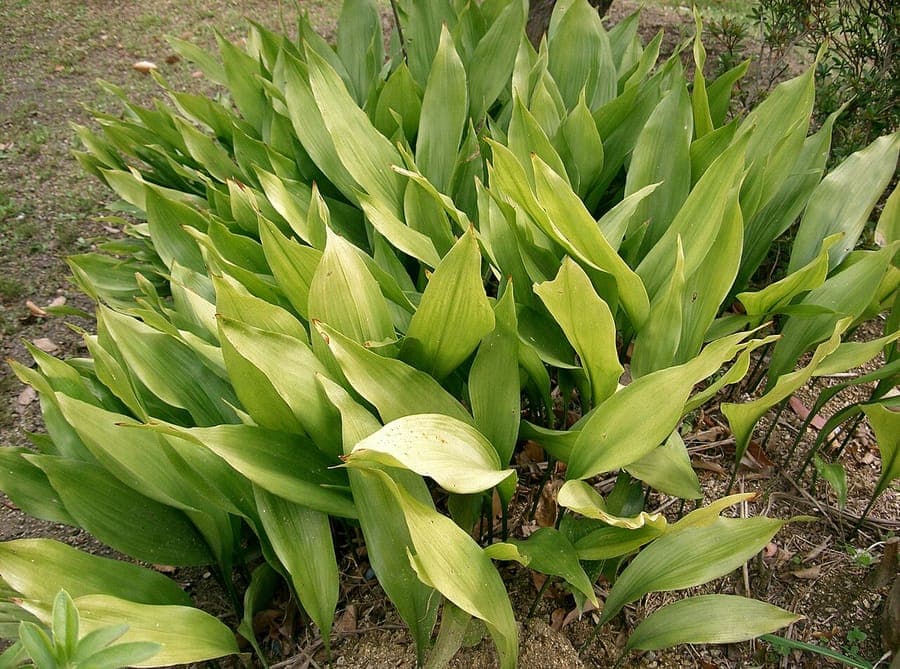
KENPEI / CC BY-SA 3.0, via Wikimedia Commons
Aspidistra elatior: complete guide
Aspidistra elatior
¿Quieres ver Aspidistra elatior: complete guide en tu jardín?
1 minuto, sin tarjeta de crédito
Overview
Aspidistra elatior, commonly called the cast-iron plant or barroom plant, is a hardy houseplant native to southern Japan. This species earned its common names due to its exceptional tolerance for difficult conditions and minimal care requirements. With glossy, dark green foliage and a calm, stately presence, it has been cultivated worldwide since its scientific description in 1834 and became particularly popular as an interior plant during the Victorian era.
Appearance and bloom
The cast-iron plant grows at a slow to moderate pace, eventually reaching 60 to 80 centimeters tall. It forms dense clusters of upright, lance-shaped leaves that can reach 30 to 40 centimeters in length. These glossy leaves are deep green with delicate veining. The flowers emerge on leaf axils and are small, dark purple to nearly black in color. Though subtle and not the main feature, they add botanical interest during late spring to early summer bloom.
Ideal location
Unlike many houseplants, Aspidistra elatior tolerates a wide range of light and temperature variations. It performs best in indirect light to partial shade, making it exceptional for offices, hallways, and other dim corners of the home. Even direct sun is tolerated, though it may cause slight leaf bleaching. The plant thrives under artificial lighting better than most houseplants, offering flexibility in placement.
Soil
Use a nutrient-rich, well-draining potting soil based on peat or coco coir. A mixture of standard potting soil with some sand or perlite promotes good drainage. Soil pH should be neutral to slightly acidic (pH 6.0 to 7.0). Good drainage is essential to prevent waterlogging, though this plant is quite tolerant of occasional excess moisture.
Watering
Water moderately, more frequently during the growing season (May to August). Allow the top layer of potting soil to dry slightly between waterings. During fall and winter, when growth slows, reduce watering. Use rainwater or softened water when possible, as this plant can be sensitive to lime buildup. Ensure water does not stagnate in the pot - always empty saucers after watering.
Diseño gratis
¿Quieres ver Aspidistra elatior: complete guide en tu jardín? Crea un diseño gratis ahora.
Pruning
Pruning is not strictly necessary. Simply remove dead or damaged leaves at ground level. To encourage a more compact shape, you can lightly prune in early spring (March-April) by cutting older stems halfway back. This stimulates new shoot formation. The plant will not object if you skip this step entirely.
Maintenance calendar
February: Winter resting period; stop fertilizing. March: Beginning of growing season; refresh soil if needed. April-June: Fertilize every two weeks; new shoots appear. July-August: Stop fertilizing mid-August; keep warm and humid. September-October: Resume fertilizing; gradually reduce watering. November-January: Minimal watering; keep cooler (ideal 10-15 degrees Celsius).
Winter hardiness
Aspidistra elatior is remarkably hardy and can tolerate temperatures down to minus 10 degrees Celsius, though this is not ideal. Indoors, it grows optimally between 15 and 20 degrees Celsius. Temperatures below 10 degrees Celsius significantly slow growth. Protect the plant from sudden temperature shocks and drafts from windows or doors.
Companion plants
The cast-iron plant pairs beautifully with other shade-tolerant plants such as Philodendron, Zamioculcas zamiifolia (ZZ-plant), and Scindapsus pictus. In a larger pot, it can share space with lower-growing ground covers like small hedera varieties or Soleirolia soleirolii. For contrast, combine with plants featuring lighter or differently colored foliage.
Closing thoughts
Aspidistra elatior is the perfect plant for many families and offices: hardy, elegant, and utterly undemanding. You will find this robust houseplant at reasonable prices in garden centers. Whether you have a green thumb or not, this plant will give you years of pleasure with its glossy, dark green leaves. Place one in a corner where nothing else grows and you will be surprised at how well it thrives. Make the cast-iron plant part of your interior landscaping and enjoy years of green abundance without fuss.
With thanks to gardenworld.app for inspiring this plant guide. Discover more hardy houseplants on gardenworld.app!
¿Quieres ver Aspidistra elatior: complete guide en tu jardín? Crea un diseño gratis ahora.
Sube una foto, elige un estilo y obtén un diseño fotorrealista con lista de plantas en menos de un minuto.
Más de 10.000 jardines diseñados
Sin tarjeta de crédito


Plantas similares
Narrow-leaved dracaena: complete guide
Dracaena angustifolia
Everything about Dracaena angustifolia - the narrow-leaved dracaena: location, care, overwintering and use as a houseplant or patio plant.
Chaparral yucca: complete guide to Hesperoyucca whipplei
Hesperoyucca whipplei
Hesperoyucca whipplei (Our Lord's candle) is a dramatic rosette-forming plant from California that produces a towering flower spike, ideal for dry and gravel gardens.
False lily-of-the-valley: complete guide
Maianthemum dilatatum
Everything about Maianthemum dilatatum, the false lily-of-the-valley. Care, shade location, propagation and garden combinations for this popular shade ground cover.