
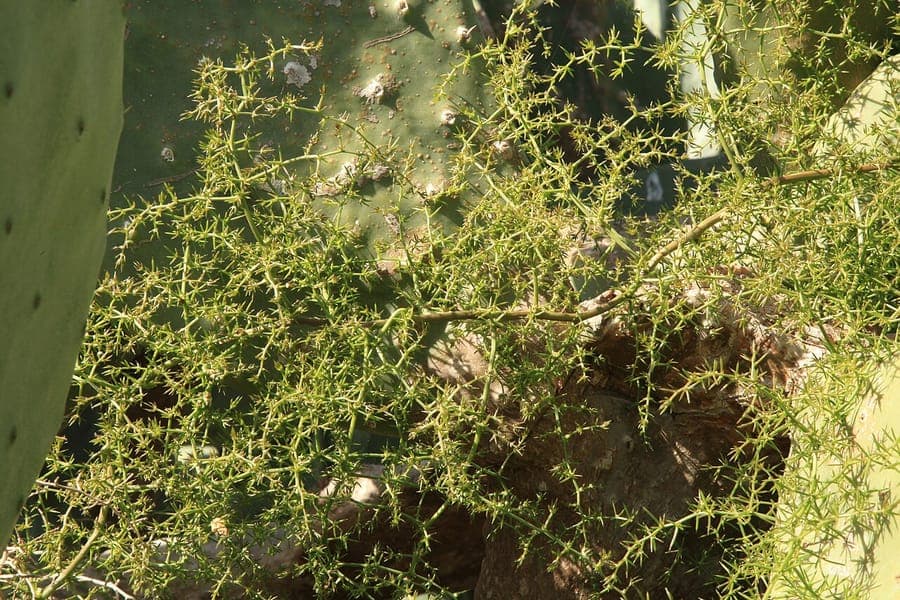
Frank Vincentz / CC BY-SA 3.0, via Wikimedia Commons
Mediterranean Asparagus: complete guide
Asparagus aphyllus
¿Quieres ver Mediterranean Asparagus: complete guide en tu jardín?
1 minuto, sin tarjeta de crédito
Overview
Asparagus aphyllus, known as Mediterranean asparagus or Prickly asparagus, is a distinctive Mediterranean plant species distributed from North Africa and Egypt to Turkey and the Levantine region. This unusual plant is not a culinary asparagus but a prickly ornamental shrub with thin, leafless stems growing upward and branching extensively. The plant grows rapidly in warm, dry conditions and produces small yellow flowers followed by highly decorative red berries.
Asparagus aphyllus is ideal for dry, sunny gardens, scree gardens, Mediterranean gardens, and Mediterranean-style landscaping. The plant can also be used as cut flowers. In cold climates, it can be grown as a container plant.
Appearance and bloom
Asparagus aphyllus grows as a vigorous, fast-growing shrub reaching approximately 60 to 100 cm tall, depending on available moisture levels. The plant lacks true leaves, featuring instead needle-like, prickly, light green "cladodes" (modified branches that replace leaves functionally). These cladodes give the plant its distinctive prickly appearance.
Flowers appear from May to August in small clusters. They are small, inconspicuous, and yellow with subtle fragrance. After flowering, the plant produces red berries the size of peas. These berries are highly decorative and persist on the plant for months, adding extended visual interest. The berries are also consumed by birds.
Ideal location
Asparagus aphyllus thrives in full sun to partial shade. The plant grows best in warm, sheltered locations. North-facing walls, heavily shaded sites, or very cold locations are less suitable.
The plant is extremely drought-tolerant and performs excellently on wind-exposed sites. Ideal for Mediterranean gardens, stony slopes, or dry borders. The plant is very flexible regarding location, as long as drainage is excellent.
Soil
Asparagus aphyllus requires excellent drainage and cannot tolerate waterlogging. Ideal soil type is sandy, gravelly, or clay-mixed substrates. Fertilization is rarely needed since the plant thrives in lean soils.
PH can be highly variable from acidic to alkaline. When planting in moist soils, improving drainage is strongly beneficial. Addition of sand or gravel is highly recommended for the plant's success.
Diseño gratis
¿Quieres ver Mediterranean Asparagus: complete guide en tu jardín? Crea un diseño gratis ahora.
Watering
Once established, Asparagus aphyllus is extremely drought-tolerant. The plant requires only occasional watering, especially during dry periods in the growing season. Excess moisture causes rot and fungal issues.
During the first growing year, moderate watering is appropriate until the plant establishes. Thereafter, watering can be greatly reduced. In some climates, winter watering can be eliminated entirely.
Pruning
Asparagus aphyllus can be pruned to control form and size. Pruning occurs in spring (March to April). The plant responds well to cutting back and will regrow vigorously.
Old, thick stems can be completely removed to rejuvenate the plant. This pruning can be done annually on vigorous plants. The plant can also be trained as a small tree or against a wall.
Maintenance calendar
March-April: Prune for form, check for winter damage, begin watering. May-August: Flowering, reach full size, maintain drainage. September-October: Collect red berries or leave for decoration, reduce watering. November-February: Winter rest, minimal watering, frost protection in cold regions.
Winter hardiness
Asparagus aphyllus is hardy in USDA zones 8 to 10. In temperate European climates (zones 7-8), mulch protection may be beneficial in very cold winters. In colder climates, the plant must be protected or moved indoors.
In zones 3 to 6, growing the plant in containers and overwintering indoors is recommended. The plant can overwinter in unheated greenhouses or cold rooms.
Companion plants
Asparagus aphyllus grows well with other Mediterranean plants such as Rosemary, Lavender, Salvia, Cistus, and Helichrysum. It also combines well with other drought-resistant plants and succulents.
In Mediterranean gardens, dwarf olive trees, palms, and other southern European plants complement this species beautifully. For structure, taller conifers can be incorporated.
Closing
Asparagus aphyllus is a unique and decorative plant for those seeking a drought-resistant ornamental shrub for warm, sunny locations. The red berries are highly decorative and the prickly stems provide structural interest. For Mediterranean gardens, dry borders, and modern landscaping, this plant is highly suitable.
Find this plant at specialized nurseries and online. Visit gardenworld.app for additional plant suggestions.
¿Quieres ver Mediterranean Asparagus: complete guide en tu jardín? Crea un diseño gratis ahora.
Sube una foto, elige un estilo y obtén un diseño fotorrealista con lista de plantas en menos de un minuto.
Más de 10.000 jardines diseñados
Sin tarjeta de crédito


Plantas similares
Narrow-leaved dracaena: complete guide
Dracaena angustifolia
Everything about Dracaena angustifolia - the narrow-leaved dracaena: location, care, overwintering and use as a houseplant or patio plant.
Chaparral yucca: complete guide to Hesperoyucca whipplei
Hesperoyucca whipplei
Hesperoyucca whipplei (Our Lord's candle) is a dramatic rosette-forming plant from California that produces a towering flower spike, ideal for dry and gravel gardens.
False lily-of-the-valley: complete guide
Maianthemum dilatatum
Everything about Maianthemum dilatatum, the false lily-of-the-valley. Care, shade location, propagation and garden combinations for this popular shade ground cover.