
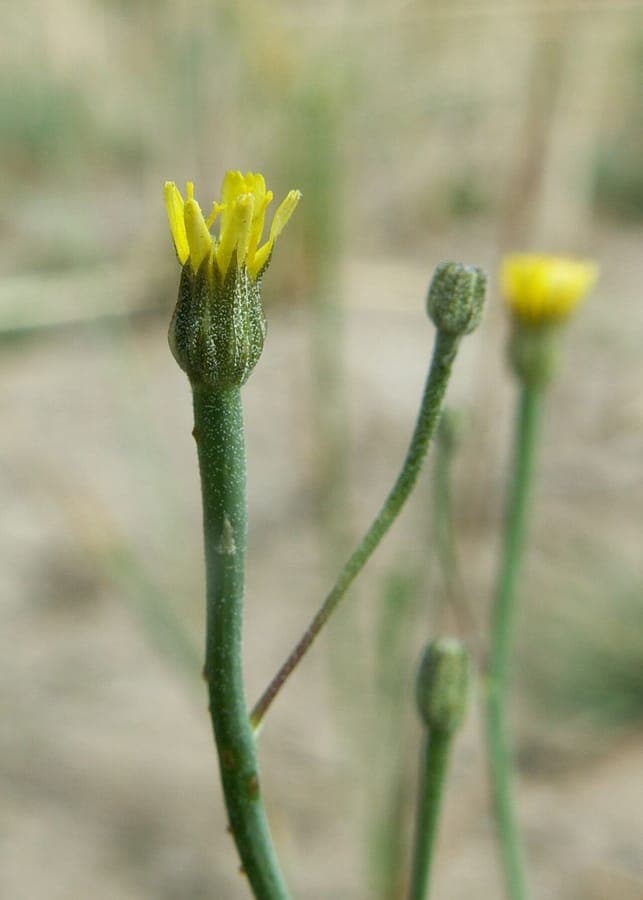
Krzysztof Ziarnek, Kenraiz / CC BY-SA 4.0, via Wikimedia Commons
Lamb succory: complete guide
Arnoseris minima
¿Quieres ver Lamb succory: complete guide en tu jardín?
1 minuto, sin tarjeta de crédito
Overview
Arnoseris minima, commonly known as lamb succory, is a modest annual herb in the Asteraceae family. Native to parts of central and western Europe, including France, Germany and Belgium, it naturally grows in damp, shaded grasslands, forest edges and along footpaths. In the garden, it's a subtle yet rewarding plant for those who appreciate understated beauty and low-fuss greenery. Reaching heights of 15 to 30 cm, it's perfect for naturalistic planting schemes, cottage-style borders or wildflower meadows.
On gardenworld.app, you can design a planting plan that includes lamb succory alongside compatible species, ensuring the right balance of light and moisture.
Appearance & bloom cycle
Lamb succory forms a small rosette of deeply lobed, dark green leaves that resemble young chicory – a feature that inspired its common name. From June to July, slender stems rise to carry small, bright yellow flower heads, each about 1–2 cm wide. The blooms are composed of numerous narrow florets, typical of the daisy family, and open in full sun. Each plant flowers for roughly three to four weeks, followed by the development of fluffy seed heads similar to dandelions, which disperse easily on the wind.
As an annual, it doesn't survive winter, but it readily self-seeds in suitable conditions. You'll often see new plants return in the same spot year after year, especially if the soil stays undisturbed. It's not invasive, so it won't take over your beds, making it ideal for relaxed garden styles.
Ideal location
Lamb succory thrives in light to partial shade, needing about 8 hours of indirect sunlight daily. A spot with morning sun and afternoon shade works best. Avoid hot, south-facing beds with intense midday sun, as this can scorch the leaves and shorten the blooming period. In the wild, it favours cool, damp areas under tree canopies or along hedgerows – aim to recreate that in your garden.
It's particularly well-suited to UK gardens where humidity levels are moderate and summer temperatures are not extreme. If you're in USDA hardiness zones 6–8, this plant will fit right in. Use gardenworld.app to assess your garden's microclimates and determine the best placement.
Soil requirements
This plant prefers acidic to slightly acidic soils with a pH between 4.5 and 5.0. It tolerates poor fertility but grows best in humus-rich, well-draining loam or clay-loam. Avoid sandy soils unless you can provide regular watering. It handles damp conditions well but won't survive waterlogged roots. Add leaf mould or compost to boost organic content without raising pH.
Diseño gratis
¿Quieres ver Lamb succory: complete guide en tu jardín? Crea un diseño gratis ahora.
Watering
Lamb succory has moderate water needs. In a typical UK spring, rainfall is sufficient. During dry spells in June and July, water deeply once a week, especially if the plant is young or in a container. Use rainwater when possible, as it dislikes lime-rich tap water. Let the top layer of soil dry slightly between watering to prevent root rot.
Pruning
No pruning is required. If you want to limit self-seeding, cut back the flower stems after blooming. Otherwise, leave them to go to seed and support natural regeneration. Remove any brown or dying foliage in late summer, but don't clear everything at once – some leaf litter helps protect overwintering seeds.
Maintenance calendar
- Jan: No action
- Feb: No action
- Mar: Start seeds in a cold frame
- Apr: Harden off and plant out in late April
- May: Watch for slugs; protect young plants
- Jun: Flowers open; maintain consistent moisture
- Jul: Peak bloom; monitor for mildew in humid weather
- Aug: Flowers fade; collect seeds or allow self-sowing
- Sep: Self-sown seedlings may appear
- Oct: Prepare soil for next season
- Nov: No action
- Dec: Dormant period
Winter hardiness
As an annual, lamb succory dies back after setting seed. It's not frost-hardy beyond -5°C, but its seeds survive winter dormancy in the soil, germinating the following spring. In milder zones (6–8), self-seeding is reliable. In colder areas, consider collecting seeds for spring sowing.
Companion plants
Pair lamb succory with shade-tolerant perennials like Helleborus, Tiarella or early ferns. Its late spring to early summer bloom fills the gap between spring ephemerals and late-summer flowers. Avoid aggressive ground covers like ivy or mint, which can smother seedlings. It also works well in wildflower lawns or along woodland paths.
Closing
Lamb succory won't grab attention like a sunflower, but it brings quiet charm to shaded corners. It supports pollinators, requires little care and adds seasonal rhythm to your garden. Look for seeds or plants at garden centres across the UK, or try specialist wildflower suppliers. For reliable stock, check Truffaut or Jardiland in France, or OBI and Hornbach in Germany. Give it a try – you might just find it becomes a quietly essential part of your garden. Use gardenworld.app to visualise how it fits into your overall design.
¿Quieres ver Lamb succory: complete guide en tu jardín? Crea un diseño gratis ahora.
Sube una foto, elige un estilo y obtén un diseño fotorrealista con lista de plantas en menos de un minuto.
Más de 10.000 jardines diseñados
Sin tarjeta de crédito


Plantas similares
Calendula stellata: complete guide
Calendula stellata
Complete guide to Calendula stellata, the star-flowered marigold from Sicily: location, soil, watering and companion planting tips.
Korean chrysanthemum: complete guide
Chrysanthemum x rubellum
Chrysanthemum x rubellum is a hardy autumn perennial with single pink to copper flowers from August to November. Care and combinations.
Helianthus divaricatus: complete guide
Helianthus divaricatus
Helianthus divaricatus is a North American woodland sunflower with yellow summer blooms, ideal for naturalistic borders and shady edges.