
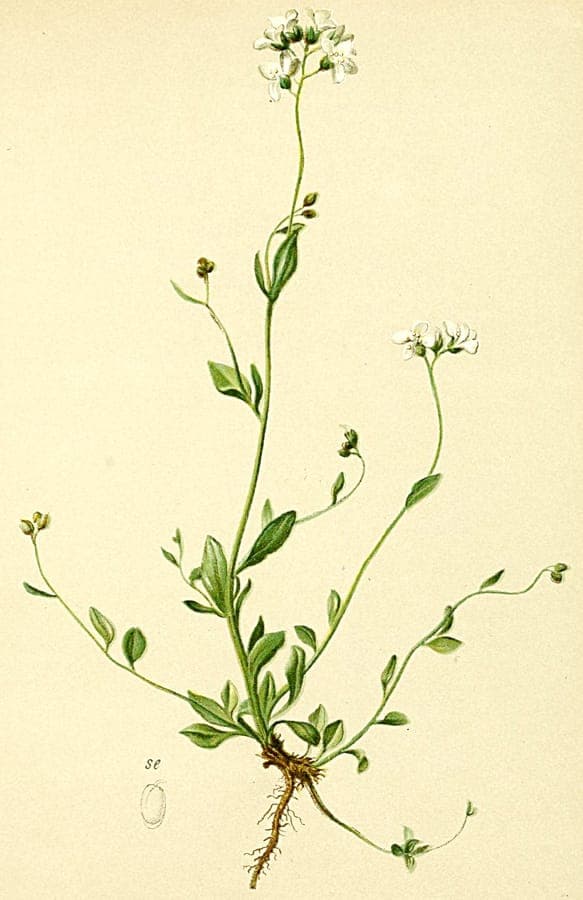
Anton Hartinger / Public domain, via Wikimedia Commons
Haller's Rockcress: complete guide
Arabidopsis halleri
¿Quieres ver Haller's Rockcress: complete guide en tu jardín?
1 minuto, sin tarjeta de crédito
Overview
Haller's Rockcress (Arabidopsis halleri), also known as Haller's mustard, is a charming alpine flower from the Brassicaceae family. This elegant mountain herb is native to central and eastern Europe, from the Alps through Poland to the Balkans. The plant naturally grows on rocky slopes, in mineral-rich soils and on mountain slopes.
Haller's Rockcress is renowned for its tolerance of difficult conditions, particularly poor soils and steep slopes where most plants fail. For alpine flora enthusiasts and natural gardeners, this herb represents a valuable horticultural element.
Appearance and Bloom
Haller's Rockcress typically grows 15 to 40 centimeters tall with a fairly compact, dense growth habit. The plant forms tight rosettes close to ground level. The leaves are linear to oblong, green to blue-green in color, and display fine hairs.
The flowers represent the most striking feature, reaching approximately 0.8 to 1.2 centimeters in diameter. They are white to cream-white in color. The flowers grow in dense, racemose inflorescences at the tops of slender stems. Flowering occurs from April through June.
Ideal Location
Haller's Rockcress thrives in locations mimicking its mountain habitat. The plant requires full sun to partial shade, preferring bright environments. The plant makes moderate drainage demands. Rock gardens with good drainage prove ideal. Protection from strong wind is less critical.
Soil
Haller's Rockcress requires well-draining soils, though less stringent than some alpines. A mixture of alpine potting compost with gravel works well. pH should be neutral to moderately acidic. The plant thrives on mineral-rich soils with limited humus.
Diseño gratis
¿Quieres ver Haller's Rockcress: complete guide en tu jardín? Crea un diseño gratis ahora.
Watering Requirements
Haller's Rockcress requires moderately moist soil during the growing season. The plant proves reasonably drought-tolerant once established. The plant must not remain waterlogged.
During the blooming period, prevent water stress and maintain consistent but not excessive moisture. Following bloom, gradually reduce watering. In winter, the plant requires very little water.
Pruning and Maintenance
Haller's Rockcress requires minimal pruning. The plant naturally grows compact. Following bloom, faded flower stalks can be carefully removed. Generally, minimal intervention allows the plant to thrive.
Maintenance Calendar
April: Growth begins. Water during dry spells. May: Growth accelerates. Foliage development. June: Flowering reaches peak. Water moderately. July: Flowering concludes. Seed development. August: Plant begins decline. Minimal water. September-March: Rest period. Minimal water.
Winter Hardiness
Haller's Rockcress demonstrates excellent winter hardiness in Northern European conditions. The plant naturally grows in mountain regions. Temperatures far below freezing are well tolerated.
The plant stands outdoors during winter without difficulty. No protection proves necessary.
Companion Plants
Haller's Rockcress pairs beautifully in rock gardens with other alpine plants. Suitable companions include stone thyme, alpine forget-me-nots, mountain euonymus, and small sedum varieties. The plant grows well with delicate mountain grasses.
Avoid very aggressive competitors. The plant proves reasonably competitive but can be overwhelmed by much faster growers.
Closing Thoughts
Haller's Rockcress represents a valuable addition to rock gardens and alpine gardens. With its elegant white flowers and tolerance for difficult conditions, this herb adds practical beauty to gardens. With minimal care, this alpine flower returns year after year. For plant material, consult specialized alpine plant nurseries or visit gardenworld.app.
¿Quieres ver Haller's Rockcress: complete guide en tu jardín? Crea un diseño gratis ahora.
Sube una foto, elige un estilo y obtén un diseño fotorrealista con lista de plantas en menos de un minuto.
Más de 10.000 jardines diseñados
Sin tarjeta de crédito


Plantas similares
Brassica cretica: complete guide
Brassica cretica
Brassica cretica, the Cretan cabbage, grows wild on Aegean cliffs. Discover how to grow this drought-tolerant, yellow-flowered Mediterranean perennial.
Corsican cabbage: complete guide
Brassica insularis
Corsican cabbage is a rare Mediterranean rock cabbage with white flowers and blue-green leaves. Location, soil and winter protection.
Prostrate cabbage: complete guide
Brassica procumbens
Prostrate cabbage is a creeping North African cliff plant with yellow flowers. Discover location, soil type and winter protection.