
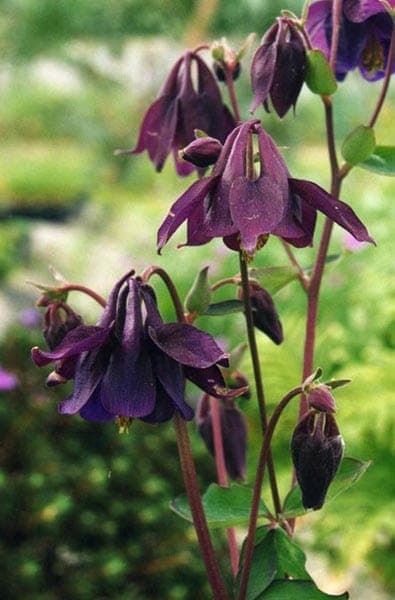
Ghislain118 (AD) https://www.fleurs-des-montagnes.net / CC BY-SA 3.0, via Wikimedia Commons
Aquilegia nigricans: complete guide
Aquilegia nigricans
¿Quieres ver Aquilegia nigricans: complete guide en tu jardín?
1 minuto, sin tarjeta de crédito
Overview
Aquilegia nigricans, commonly known as Bulgarian Columbine, is a delicate flower native to the Carpathian Mountains. This graceful perennial belongs to the Ranunculaceae family and grows naturally in mountainous regions of Romania, Hungary, and Ukraine. The species name refers to the characteristic dark-colored stems that contrast beautifully with the vibrant blue flowers.
Appearance and Bloom
The plant reaches heights of 30-50 cm with elegant, finely-branched stems. Striking blue flowers with yellow centers appear abundantly in May and June. Each bloom features characteristic backward-pointing spurs typical of columbines. The foliage is finely divided with feathery texture.
Ideal Location
Bulgarian columbine performs best in dappled shade to partial sun. A sheltered location beneath deciduous trees or a north-facing site is ideal. The plant appreciates cool conditions with good air circulation. In warm climates, afternoon shade is beneficial.
Soil
Requires moist, well-draining soil enriched with humus. Ideal composition includes garden soil mixed with peat moss and sand. Heavy soils must be amended with organic matter. Slightly acidic to neutral soil pH is preferred.
Diseño gratis
¿Quieres ver Aquilegia nigricans: complete guide en tu jardín? Crea un diseño gratis ahora.
Watering
The plant prefers consistent moisture during growing seasons. Maintain moist soil without waterlogging. Apply mulch around the plant base to retain moisture. Water regularly during dry periods.
Pruning
Pruning is not essential. Deadhead spent flowers to encourage continued blooming. Remove dead foliage after the blooming season. The plant naturally dies back in winter.
Maintenance Calendar
April-May: Plant acquisition and planting. May: Apply mulch layer. June-July: Water regularly during bloom. August: Remove spent flowers. September: Harvest or preserve seed heads. October-March: Plant dormancy, minimal care.
Winter Hardiness
Aquilegia nigricans is very hardy to zone 3, surviving temperatures to -40 degrees Celsius. This alpine plant needs no supplemental winter protection. In hot climates, summer heat may stress the plant.
Companion Plants
Beautiful with other alpine flowers like Sempervivum, Sedum, and Saponaria. Excellent as groundcover beneath tall shrubs. Suitable for rock gardens and alpine troughs.
Closing
Aquilegia nigricans adds elegant blue tones and Carpathian charm to gardens. With proper drainage and consistent moisture, this flower will bloom abundantly. Available at garden centers. Learn more at gardenworld.app/en and gardenworld.app/nl.
¿Quieres ver Aquilegia nigricans: complete guide en tu jardín? Crea un diseño gratis ahora.
Sube una foto, elige un estilo y obtén un diseño fotorrealista con lista de plantas en menos de un minuto.
Más de 10.000 jardines diseñados
Sin tarjeta de crédito


Plantas similares
Drummond's anemone: complete guide
Anemone drummondii
Discover Drummond's anemone (Anemone drummondii): a silvery-grey mountain plant for cool rock gardens and alpine troughs.
Korean clematis: complete guide
Clematis serratifolia
Clematis serratifolia is a hardy climber with fragrant yellow bell flowers in August-September. Pruning group 3, location and care tips.
Aquilegia brevistyla: complete guide
Aquilegia brevistyla
Discover Aquilegia brevistyla, the elegant North American columbine. Growing tips, shade tolerance, and design ideas for woodland and shadowed gardens.