
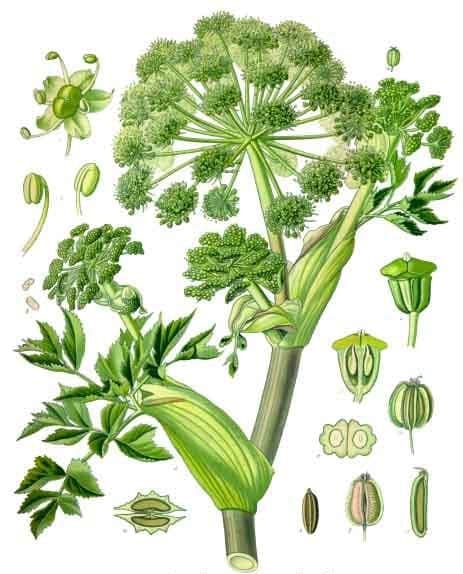
Franz Eugen Köhler, Köhler's Medizinal-Pflanzen / Public domain, via Wikimedia Commons
Angelica archangelica: complete guide
Angelica archangelica
¿Quieres ver Angelica archangelica: complete guide en tu jardín?
1 minuto, sin tarjeta de crédito
Overview
Angelica archangelica, commonly known as Garden Angelica or Archangelica, is a striking biennial plant distinguished by its majestic appearance and rich history of medicinal application. This commanding plant originates from the cool, moist green landscapes of Europe and Greenland, spreading subsequently to gardens throughout northern Europe. With its gigantic, trifoliate leaves and large, rounded flower clusters in the second growing year, Angelica archangelica offers both ornamental beauty and practical utility. The plant has been cultivated since medieval times for its reputed medicinal properties, with the root, stem, and seeds traditionally used as remedies for indigestion, cough, and various bodily discomforts.
For contemporary garden designers, Angelica archangelica presents a unique combination: it functions as an architectural element in the garden while simultaneously serving as a productive plant yielding harvestable material. Through gardenworld.app, we can design a garden composition featuring this plant as a focal point, surrounded by complementary herbs and bloomers that showcase its maximum potential. Cultivating Angelica requires no advanced skill, yet demands patience and thoughtful planning.
Appearance and Flowering Cycle
During the first year of growth, Angelica archangelica forms a low rosette of extraordinarily large, doubly or triply pinnately divided leaves, each reaching approximately 90 centimeters in length. The leaf stems are thick, hollow, smooth, and greenish to reddish in tone, featuring a characteristic inflated base that clasps the main stem. The leaflets themselves display glossy dark green coloration with fine texture. Throughout this initial season, the plant concentrates energy on establishing a robust taproot and root collar.
In the second growing year, the plant dramatically shoots upward, producing a vigorous, thick central stem reaching 120 to 180 centimeters tall, occasionally exceeding 200 centimeters under favorable conditions. This stem is hollow, smooth, greenish to reddish in hue, and exhibits a stiff, angular character. Crowning the stem are large, rounded flower clusters consisting of dozens to hundreds of tiny, greenish-yellow flowers arranged in compact umbels. These flowers typically appear June through July and possess a most pleasant, aromatic fragrance attracting numerous bees and other pollinators. Following fertilization, small, elliptical seeds develop bearing characteristic winged margins.
The entire plant releases a powerful, pleasant aromatic fragrance, particularly when foliage is disturbed. This aroma, derived from essential oils distributed throughout all plant tissues, presents an aromatic profile suggesting cinnamon, nutmeg, and anise notes.
Ideal Location
Angelica archangelica performs optimally in locations receiving a minimum four to six hours of direct sunlight daily, though it can also tolerate partial shade, especially in very warm regions. Throughout northern Netherlands, Belgium, and Germany, the plant accommodates nearly full sun. It values a slightly sheltered location protected from severe winds, since the tall second-year stems can whip in strong gusts and potentially snap. Placement adjacent to shrubs or against a low screen proves ideal.
Avoid very dry, sandy locations and sites subject to stagnant heat. Angelica thrives in environments featuring moderate temperatures and consistent moisture availability. This means locations throughout northern Europe prove optimal, though the plant can grow in more temperate zones with adequate watering attention.
Soil Requirements
Angelica archangelica flourishes in moisture-retentive, well-drained soil enriched with abundant organic matter. The ideal pH ranges between 6.0 and 7.0. The plant dislikes excessively acidic or alkaline conditions; neutral pH proves perfect. Heavy clay soils improve considerably through sand incorporation and generous organic material addition. Sandy soils require enrichment with compost, leafmould, and garden debris to enhance moisture capacity.
When preparing the planting hole, incorporate at least 10 centimeters of well-rotted compost throughout. This supplies both nutrients and soil structure improvements perfectly aligned with this large plant's needs. A light mulch layer of 5 centimeters surrounding the plant base enhances moisture retention and keeps roots cool.
Angelica prefers moderately fertile soil; excessive nutrient application triggers overzealous growth vigor potentially destabilizing plant architecture.
Watering and Moisture Management
Angelica archangelica demands consistently moist, non-waterlogged soil conditions. Particularly during the first growing year, regular watering proves essential for establishing a robust taproot. Water deeply and regularly, at minimum twice weekly during dry periods, ensuring soil never dries completely. In the second year, when rapid growth and flowering occur, water requirements increase substantially.
Proper watering technique matters considerably: apply water at the plant base while avoiding wetting foliage, which promotes fungal disease. Early morning watering is ideal. During wet periods, natural rainfall suffices provided it remains consistent. Following extended drought, supplementary watering assists plant recovery.
In the second year, when vigorous growth and flowering dominate, consistent moisture application can benefit the root system through this demanding period.
Diseño gratis
¿Quieres ver Angelica archangelica: complete guide en tu jardín? Crea un diseño gratis ahora.
Harvesting and Processing
Angelica archangelica offers multiple harvest opportunities. Seeds can be harvested August through September once they brown. Snip seed heads cleanly and dry them on uncontaminated, dry surfaces. The dried seeds serve culinary purposes or can be saved for propagation.
Stems may be harvested during the first year from late May through June and can be consumed fresh or utilized for medicinal purposes. These stems carry a slightly sweet flavor with aromatic character. Young foliage can also be harvested first-year and can be incorporated into tea blends, salads, or used as flavoring.
Roots may be harvested first-year or early second-year, though this proves worthwhile only if you don't intend to permit flowering. For maximum ornamental impact, best leave roots undisturbed for complete growth.
Maintenance and Care
Once the growing season begins, Angelica archangelica requires minimal maintenance. Remove all dead foliage promptly upon appearance. During the second year, you may carefully remove a few large outer leaves near the stem base to enhance air circulation and promote disease prevention. This also discourages powdery mildew and other fungal diseases.
If you observe early seed production and desire extended harvest years, you can remove flower clusters before they fully bloom. This extends plant lifespan and produces additional harvestable material. However, if you want seeds, allow the flower naturally to mature.
Monitor regularly for pest problems, though Angelica proves relatively resistant. Caterpillars of certain butterfly species may appear but typically cause minimal damage.
Maintenance Calendar
May to June (Year 1): Plant and water regularly. Possible first harvest of young foliage late May.
July to September (Year 1): Continuing leaf-rosette development. Maintain watering. By September, first seeds may mature if planted early.
October to April (Year 1 to Year 2): Quiet period. Minimal winter watering. Protect against hard frost in very cold areas.
May (Year 2): Stem begins rapid elongation. Increase watering frequency.
June to July (Year 2): Flowering period. Stem and foliage harvesting possible. Continue regular watering.
August to September (Year 2): Seed maturation. Harvest seeds as they brown. Plant naturally declines after seed production.
October to November (Year 2): Remove plant debris. Store seeds for next season.
Winter Hardiness and Overwintering
Angelica archangelica is winter hardy to approximately zone 5 (-20 to -25 degrees Celsius) in well-drained soil. Throughout the entire Netherlands, Belgium, and Germany, it overwinters without difficulty. The plant naturally dies after seed production, so second-year frost consideration doesn't apply. However, the first-year rosette can experience frost damage during very cold winters with extreme temperatures.
In severe winters, additional protection consists of a 15-centimeter mulch layer around the plant base, protecting roots from freezing. Should the plant freeze completely, it will likely not return in the following growing year.
Companion Planting
Angelica archangelica pairs well with other aromatic and medicinal plants. Combine it with fellow Apiaceae family members such as Pastinaca sativa (Parsnip), Petroselinum crispum (Parsley), and Angelica sylvestris (Wild Angelica). This grouping creates an intriguing geometric arrangement that could form a medicinal herb garden. It also functions well alongside other large, architectural plants including Verbascum nigrum (Black Mullein), Helianthus annuus (Sunflower), and large Allium species.
In more informal designs, Angelica succeeds at border back rows, serving as visual exclamation point. Combine it with shorter bloomers such as Nepeta (Catnip) and Lavandula (Lavender).
Propagation and Seed Saving
Angelica archangelica propagates readily from seed. The seeds require a cold period (stratification) lasting minimally four weeks for optimal germination. You can sow seeds outdoors in autumn, allowing winter to provide natural stratification, or sow in spring following four weeks of refrigeration. Seeds germinate within 2-3 weeks at temperatures between 15 and 20 degrees Celsius.
Sow seeds directly at their final location or in containers for subsequent transplanting. Ensure good drainage and consistently moist soil. Young seedlings can be transplanted once their first true leaves appear.
Closing Thoughts
Angelica archangelica is a plant delivering years of visual pleasure and practical utility. Its impressive architecture, aromatic qualities, and medicinal applications make it a valued addition to northeast European gardens. With attention to moisture management, location selection, and seasonal care, you'll enjoy this majestic plant for generations. For personalized garden designs optimally showcasing this plant, contact gardenworld.app for expert guidance and planning.
¿Quieres ver Angelica archangelica: complete guide en tu jardín? Crea un diseño gratis ahora.
Sube una foto, elige un estilo y obtén un diseño fotorrealista con lista de plantas en menos de un minuto.
Más de 10.000 jardines diseñados
Sin tarjeta de crédito


Plantas similares
Whorled carrot: complete guide
Daucus involucratus
Daucus involucratus is a Mediterranean umbellifer with white flower heads framed by lacy bracts. Growing this gravel garden gem.
Daucus muricatus: complete guide
Daucus muricatus
Daucus muricatus, the spiny wild carrot, grows wild on Mediterranean coasts. Discover sowing, June-July bloom, and wildflower meadow use.
Daucus pumilus: complete guide
Daucus pumilus
Daucus pumilus is a dwarf wild carrot relative with white lacy umbels, thriving on dunes and coastal rock in poor, fast-draining soil.