
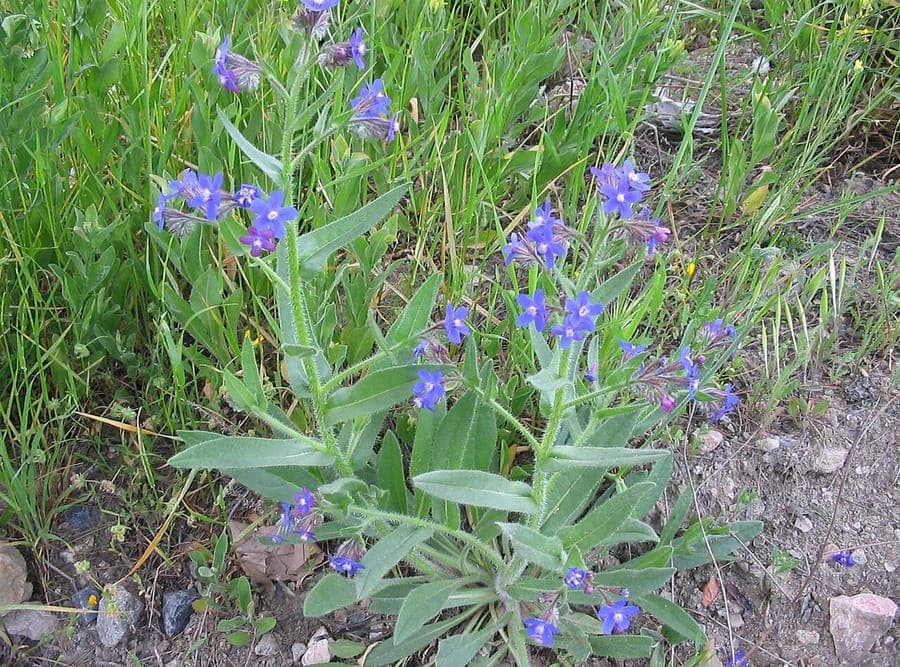
No machine-readable author provided. Alberto Salguero assumed (based on copyright claims). / CC BY-SA 3.0, via Wikimedia Commons
Italian alkanet: complete guide
Anchusa azurea
¿Quieres ver Italian alkanet: complete guide en tu jardín?
1 minuto, sin tarjeta de crédito
Overview
Italian alkanet is an imposing perennial from southeastern Europe through Central Asia. This plant grows upright to 100-150 cm and produces sparkling, deep blue flowers from May through August. This makes it a spectacular choice for borders where you want tall bloom.
Also known as Garden anchusa or Large blue alkanet, it's widely used in medicinal and herbal gardens. It's extremely drought-tolerant once established. On gardenworld.app, find inspiration how to integrate this plant into Mediterranean gardens and drought-tolerant plantings.
Appearance & bloom cycle
Italian alkanet grows upright with rough, dark green leaves of 10-30 cm long. The stems are strongly hairy and yellowish-green. The flowers are small, about 8-12 mm diameter, in intense azure blue, sometimes with white eyes.
Flowers appear in May and bloom through August in spiral clusters. Very attractive to bees. After bloom, the plant forms four brown nutlets per flower.
Ideal location
Choose full sun for Italian alkanet, at least 6-8 hours of direct sunlight daily. The plant grows in partial shade but blooms less abundantly there. Avoid shadowy spots.
The plant is very wind-tolerant and handles moderate wind without issue. Choosing a sheltered location helps in very strong winds.
Soil requirements
Italian alkanet is very adaptable regarding soil. The plant grows well on dry, poor, infertile soils. Sandy soils are excellently tolerated. Heavy clay can benefit from sand mixing. Well-draining soil is strongly preferred.
A pH between 6.0 and 7.5 is ideal. On very rich soil the plant does grow but blooms less abundantly.
Diseño gratis
¿Quieres ver Italian alkanet: complete guide en tu jardín? Crea un diseño gratis ahora.
Watering
Italian alkanet is extremely drought-tolerant once established. Water regularly in the first growing season, especially May through October. Afterward, the plant usually thrives on rainfall alone.
In severe drought, regular watering promotes better bloom. Avoid stagnant water, which causes root rot.
Pruning & maintenance
Pruning is not strictly necessary. However, cutting back after bloom to 30-40 cm height helps. This stimulates denser growth. Remove dead flower stems in autumn.
The plant is virtually pest-free. In wet, warm summers fungi can occur; ensure good air circulation.
Maintenance calendar
May-August: Plant blooms profusely. Water as needed. Remove faded clusters for extended bloom. August-September: Cut back after bloom. Plant grows slowly. October-November: Minimal care. Plant recedes to basal rosette. December-April: Dormancy. Plant grows underground.
Winter hardiness
Italian alkanet is fully hardy to USDA zone 4 (-30°C). A true winter-hardy perennial. No protection needed in temperate climates like Netherlands, Germany, France.
The plant reaches full maturity and flowering age in the second year.
Companion plants
Italian alkanet combines well with:
- Yellow-growing plants like Achillea
- Other blue-flowering perennials like Delphinium
- Silver-leaved plants like Artemisia
- Low-growing ground covers like Sedum
The plant creates dramatic contrast and forms backgrounds in borders.
Closing
Italian alkanet is an imposing perennial for those wanting to create rough, drought-tolerant borders. On gardenworld.app, find more inspiration how to integrate this Mediterranean beauty into your front yard for prolonged, blue flowering.
¿Quieres ver Italian alkanet: complete guide en tu jardín? Crea un diseño gratis ahora.
Sube una foto, elige un estilo y obtén un diseño fotorrealista con lista de plantas en menos de un minuto.
Más de 10.000 jardines diseñados
Sin tarjeta de crédito


Plantas similares
Western waterleaf: complete guide
Hydrophyllum occidentale
Full growing guide for western waterleaf (Hydrophyllum occidentale): shade tolerance, soil needs, watering, winter hardiness and naturalistic garden use.
Limestone phacelia (Phacelia affinis): complete guide
Phacelia affinis
Full guide to Phacelia affinis, the limestone phacelia: sowing tips, purple-blue bee flowers, drought tolerance and uses in dry or wildlife gardens.
Pyrenean viper's bugloss: complete guide
Echium asperrimum
Echium asperrimum is a striking biennial from the western Mediterranean with rough bristly stems and vivid blue flowers. A magnet for bees and a bold border plant.