
A. Roche / CC BY-SA 3.0, via Wikimedia Commons
Anchusa arvensis: complete guide
Anchusa arvensis
¿Quieres ver Anchusa arvensis: complete guide en tu jardín?
1 minuto, sin tarjeta de crédito
Overview
Anchusa arvensis, better known as Field Bugloss, Curved-leaf or Small Curved Garlic, is an annual plant from the Boraginaceae family. This European wild plant has become invasive in many regions. However, in wild gardens and natural landscapes, it can form a charming, flower-rich appearance. This article provides practical information on cultivation and suppression, as well as value for pollinators.
Appearance & bloom
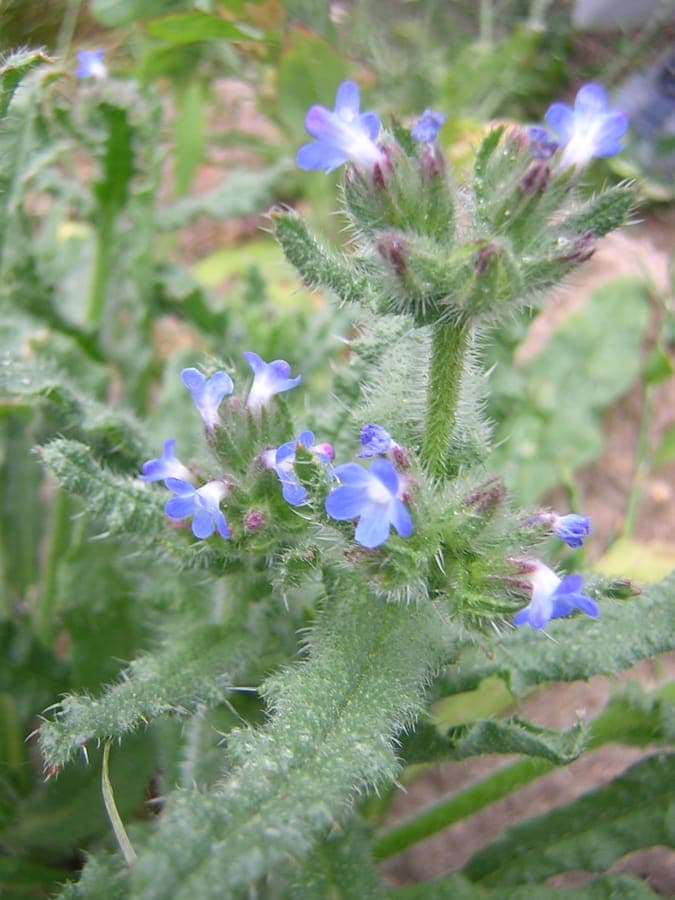
Field Bugloss grows as a low, branched plant of 20-60 cm tall with hairy, rough green leaves. The plant shines with its tiny, deep blue flowers that appear as dense clusters along the curved flower spikes. These small flowers are highly valuable for bees and flies. The seed heads remain intact throughout the year and provide shelter for insects. The plant has a certain wild, unpolished beauty.
Ideal location
Field Bugloss grows best in full sun on undisturbed soils. It feels at home on fallow lands, roadsides and rough corners. In front gardens, it can fit between other wild plants, but it demands no special location. It also thrives in half shade, though flowering is then less.
Soil
Field Bugloss is not fussy about soil. It accepts almost everything from sand to clay. Nutrient-poor soils are actually favorable. The plant feels at home on disturbed soils and can even grow on compact, trampled terrain. Well-drained soil promotes flowering, but water stagnation is harmful.
Diseño gratis
¿Quieres ver Anchusa arvensis: complete guide en tu jardín? Crea un diseño gratis ahora.
Watering
Once established, Field Bugloss tolerates drought well. Regular water during the growing season promotes better flowering. However, the plant can sustain itself without supplemental water in most climates. Excessive water leads to undesired growth.
Pruning
For natural gardens, pruning is not necessary. If suppression of seed formation is desired, cut off flowers before seeding. This requires regular, weekly inspection in summer months. For complete growth suppression, pull young plants before seeding.
Maintenance calendar
Spring (March-May): Check for young shoots and remove them if undesired. Summer (June-September): Regular inspection before seed forms. Fall (October-November): Let seed ripen for bird food and insect shelter. Winter (December-February): Seed overwinters in soil.
Winter hardiness
Field Bugloss is not winter-hardy and dies at frost periods. Seeds can, however, remain viable in soil for many years and germinate in favorable spring conditions.
Companion plants
Field Bugloss grows alongside many other wild plants in fallow areas. It fits well in wild gardens with other flower-rich weeds. Avoid intensively polished garden settings.
Closing
Field Bugloss is valuable for nature lovers and bee-friendly gardens. Gamma and other garden centers do not normally sell seed. See gardenworld.app/en for more info.
¿Quieres ver Anchusa arvensis: complete guide en tu jardín? Crea un diseño gratis ahora.
Sube una foto, elige un estilo y obtén un diseño fotorrealista con lista de plantas en menos de un minuto.
Más de 10.000 jardines diseñados
Sin tarjeta de crédito


Plantas similares
Western waterleaf: complete guide
Hydrophyllum occidentale
Full growing guide for western waterleaf (Hydrophyllum occidentale): shade tolerance, soil needs, watering, winter hardiness and naturalistic garden use.
Limestone phacelia (Phacelia affinis): complete guide
Phacelia affinis
Full guide to Phacelia affinis, the limestone phacelia: sowing tips, purple-blue bee flowers, drought tolerance and uses in dry or wildlife gardens.
Pyrenean viper's bugloss: complete guide
Echium asperrimum
Echium asperrimum is a striking biennial from the western Mediterranean with rough bristly stems and vivid blue flowers. A magnet for bees and a bold border plant.