
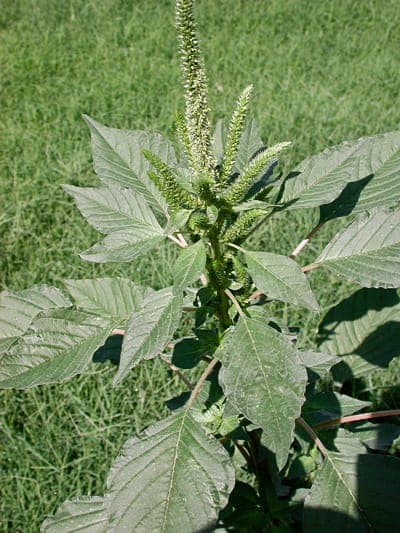
Pompilid / CC BY-SA 3.0, via Wikimedia Commons
Amaranthus palmeri: complete guide
Amaranthus palmeri
¿Quieres ver Amaranthus palmeri: complete guide en tu jardín?
1 minuto, sin tarjeta de crédito
Overview
Amaranthus palmeri, better known as Palmer's Amaranth or Careless Weed, is an annual plant from the Amaranthaceae family. Despite its appearance in many gardens and landscapes, this plant is actually a troublesome weed in agricultural areas of America. In Europe, it is primarily seen as an unwanted plant. This article provides information on prevention and control, as well as some culinary applications.
Appearance & bloom
Palmer's Amaranth grows as a straight, rambling shrub of 50-200 cm tall with broad green leaves. The plant shines with its characteristic green or purplish flower clusters that appear as dense spikes along the stem. Female plants produce enormous quantities of very small seeds that are easily dispersed by wind and water. Male plants produce yellow pollen-rich flowers.
Ideal location
Palmer's Amaranth grows in almost any climate and under almost all light conditions. It thrives best in full sunlight and warm environments. Calm spots between other plants form favorable growing conditions. In gardens where other strong growers live, this plant can otherwise be shaded out. This plant is very adaptive and can survive at different elevation differences.
Soil
Palmer's Amaranth is not fussy about soil type. Sand, loam, clay - it accepts everything. The plant even grows on very nutrient-poor soils and tolerates some pH variation. However, on nutrient-rich soils it grows much more vigorously. This is actually an advantage for agriculture because it is a strong indicator of soil quality.
Diseño gratis
¿Quieres ver Amaranthus palmeri: complete guide en tu jardín? Crea un diseño gratis ahora.
Watering
Palmer's Amaranth tolerates drought well once established. During the growing season, however, it grows much better with regular water. Excessive water is not harmful but unnecessary because the plant tolerates drought. In dry periods it can survive for long periods without water.
Pruning
For weed control, it is important to cut off Palmer's Amaranth before it sets seed. Once the plant flowers, seed can remain viable in soil for years. Regular pruning (at least weekly) in early summer helps prevent seed formation. Removal of mature plants is necessary before seed spreads.
Maintenance calendar
Spring (March-May): Check young shoots and remove them immediately. Summer (June-September): Regular checking and removal of growing plants is essential. Fall (October-November): Collect and destroy all dried plant material. Winter (December-February): Prepare soil for next growing season.
Winter hardiness
Palmer's Amaranth is not winter-hardy and dies at first hard frosts. This is actually advantageous for Northern European growers because seed cannot overwinter. Seeds can, however, remain viable in soil for years and germinate under favorable conditions.
Companion plants
Palmer's Amaranth grows alongside many other weeds and drought-tolerant plants. It does not tolerate competition from stronger plants well and will lag behind if it grows among vigorous garden plants. This is why it becomes problematic mainly in weak garden areas.
Closing
Palmer's Amaranth is not a recommended garden plant because of its weed properties. Be careful with spread and regularly check gardens for unwanted growth. Gamma and other garden centers do not sell seeds. Find more info at gardenworld.app/en.
¿Quieres ver Amaranthus palmeri: complete guide en tu jardín? Crea un diseño gratis ahora.
Sube una foto, elige un estilo y obtén un diseño fotorrealista con lista de plantas en menos de un minuto.
Más de 10.000 jardines diseñados
Sin tarjeta de crédito


Plantas similares
Bassia laniflora (woolly summer-cypress): complete guide
Bassia laniflora
Full guide to Bassia laniflora: origin, appearance, ideal location, soil, watering and care for this drought-tolerant annual.
Suaeda spicata: complete guide
Suaeda spicata
Everything about Suaeda spicata (spiked seablite): a rare salt-tolerant coastal succulent from the western Mediterranean and Macaronesia.
California amaranth: complete guide
Amaranthus californicus
Full guide to California amaranth (Amaranthus californicus): growing tips, ideal location, soil needs, watering, and garden design ideas.