
Didier Descouens / CC BY-SA 4.0, via Wikimedia Commons
Prince's-feather: complete guide
Amaranthus hypochondriacus
¿Quieres ver Prince's-feather: complete guide en tu jardín?
1 minuto, sin tarjeta de crédito
Overview
Prince's-feather, scientifically Amaranthus hypochondriacus, is a stately annual plant from the Amaranthaceae family. This plant originates from central United States to Mexico and is known for its dramatic red to purple flower spikes suffused with exotic elegance. In temperate climates they grow as summer flowers and disappear at the first frost.
Amaranthus hypochondriacus reaches heights of 60-120 cm and develops into a mature plant with many branches. The stems are often red-purple colored, emphasizing the flowers. This is a plant for gardeners who want height and color in their borders.
Appearance and bloom time
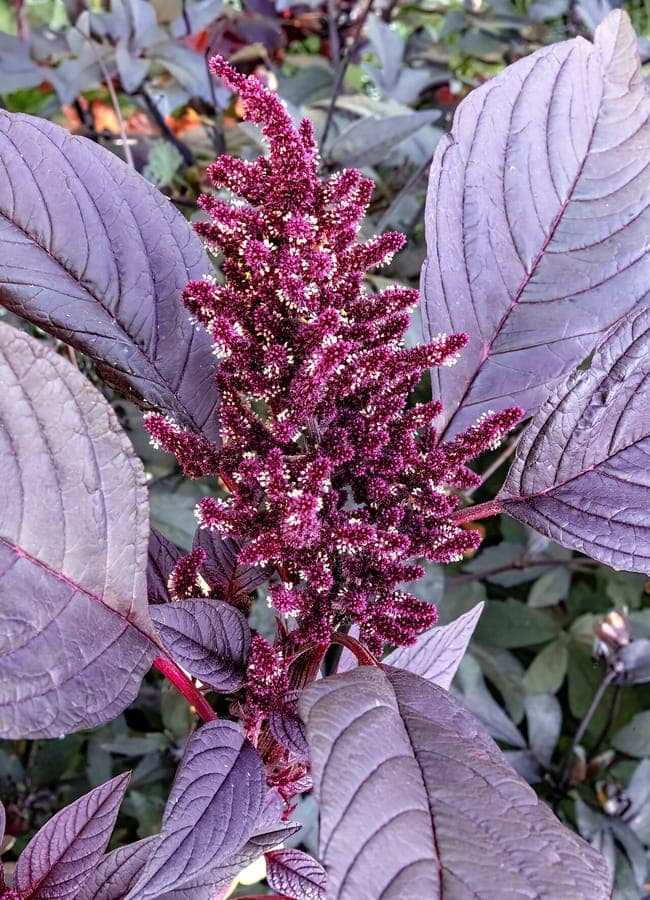
Prince's-feather has long, oval leaves that can be green but often have a red-purple wash. The leaves are finely wrinkled and have a silky texture. The flower spikes are beautiful: long, densely-packed panicles in bright red to deep purple hues.
Flowering runs from July to October, depending on when you sow and your local climate. The warmer it is, the further the flowering continues. Many insects and birds are attracted to these flowers for nectar and seed. The dry flower remains attractive for a long time.
Ideal location
Prince's-feather grows best in a sunny spot with at least 8 hours of direct sunlight. A south or west-facing bed is ideal. The plant needs plenty of heat to grow well and flower abundantly. In half shade it grows flat and flowers weakly.
Plant it in a protected spot from strong winds; the tall plants can blow over. A lily bed or border between other plants provides support. Prince's-feather looks nice in cutting borders, against heat-reflecting walls, or in long containers.
Soil requirements
Prince's-feather thrives in well-draining, nutrient-rich soil. The pH should be neutral to slightly acidic (pH 6.0-7.5). Work compost or peat through the soil for better moisture retention and nutrition.
The grass also tolerates lean soils but grows and flowers more abundantly with some fertilizer. For summer flowers, it's best to apply a slow-release fertilizer once in May (for example pellets). Further maintenance is minimal.
However, it is important: ensure good drainage. Stagnant water leads to fungal diseases and leaf rot. In containers ensure holes at the bottom.
Watering
Prince's-feather requires regular water during the growing and flowering season (May-October). Water 2-3 times a week if it doesn't rain, soaking deeply. In heat (July-August) you may water daily.
The plant loves moist feet, but not waterlogging. In wet, cold months (May-June) be more cautious with watering; it also rains. The plant is relatively drought-tolerant will survive if water occasionally runs out.
In pots extra careful with drain; excess water leads to disease.
Diseño gratis
¿Quieres ver Prince's-feather: complete guide en tu jardín? Crea un diseño gratis ahora.
Pruning
Pruning is limited for Prince's-feather. Remove only dead or damaged leaves and flowers (deadheading). This encourages more flower spikes further up the side stems.
If you want a bushier plant (more branches, less height), pinch off the top of young plants when they reach 30 cm. This promotes side growth. For tall, straight plants don't pinch anything.
You can pull off wilted leaves intermittently, but it's not necessary. Its dark-colored leaves are normal.
Maintenance calendar
April: Sow seed in trays in warm room (20-25 degrees). Pre-germination in water is optional.
May: Pot up seedlings when they have 2-3 true leaves. Later in May begin hardening off outdoors (acclimatization).
Late May-June: Transplant to garden position (60 cm apart). Direct sowing in May is also possible, but seedlings from indoors grow better.
July-October: Regular watering. Single fertilizer application in July. Enjoy the blooms. Deadheading of faded flowers.
October-November: Plant dies after first frost. Harvest seed from beautiful plants if you want to keep seed yourself.
Winter hardiness
Prince's-feather is NOT winter-hardy. It is an annual that dies as soon as frost arrives (usually October-November). This is normal and no problem.
In protected gardens or along heat-reflecting walls it can grow until December. In alpine gardens it cannot be grown outdoors. Outside the Netherlands, Germany, Belgium this is not an issue; in cold regions you sow afresh each year.
If you want seed for next year, harvest ripe seed heads in October and store dry. Next spring sow again.
Companion plants
Prince's-feather combines beautifully with other summer flowers. The height gives dramatic vertical lines. Good partners include:
Sunflowers (yellow or orange) provide warm contrast. Sage in blue or purple provides color harmony. Celosia (cockscomb) in red-yellow matches well. Grasses like Pennisetum add softness. Ornamental amaranth (another Amaranthus) in green provides light.
Between them lavender or catmint for scent. At the base low-growing marigolds or zinnias. In heavy soils, Amaranthus helps as green manure if used as summer cover crop.
Conclusion
Prince's-feather offers gardeners dramatic summer color when other blooms decline. It is low-maintenance and tolerant once planted. One of the most striking flower spikes in the summer garden.
Want to grow Prince's-feather? Seeds are found at all major seed suppliers. Seed stock is available in April-May. Intratuin and Gamma also stock seeds.
More inspiration for summer flowers? Visit gardenworld.app for combinations and design ideas. On gardenworld.app you'll also find tips for sunny spots and color advice.
Visit gardenworld.app to complete your summer garden design with dramatic red flowers.
¿Quieres ver Prince's-feather: complete guide en tu jardín? Crea un diseño gratis ahora.
Sube una foto, elige un estilo y obtén un diseño fotorrealista con lista de plantas en menos de un minuto.
Más de 10.000 jardines diseñados
Sin tarjeta de crédito


Plantas similares
Bassia laniflora (woolly summer-cypress): complete guide
Bassia laniflora
Full guide to Bassia laniflora: origin, appearance, ideal location, soil, watering and care for this drought-tolerant annual.
Suaeda spicata: complete guide
Suaeda spicata
Everything about Suaeda spicata (spiked seablite): a rare salt-tolerant coastal succulent from the western Mediterranean and Macaronesia.
California amaranth: complete guide
Amaranthus californicus
Full guide to California amaranth (Amaranthus californicus): growing tips, ideal location, soil needs, watering, and garden design ideas.