
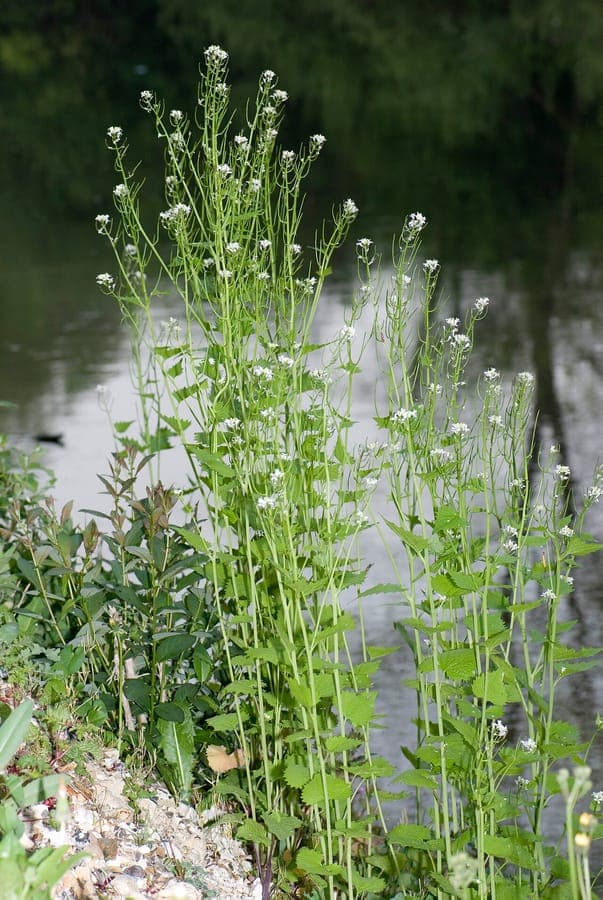
O. Pichard / CC BY-SA 3.0, via Wikimedia Commons
Garlic mustard: complete guide
Alliaria petiolata
¿Quieres ver Garlic mustard: complete guide en tu jardín?
1 minuto, sin tarjeta de crédito
Overview
Garlic mustard (Alliaria petiolata), also called hedge garlic or jack-by-the-hedge, is a biennial plant from the Brassicaceae (mustard) family. This widespread plant grows wild throughout Europe and has become naturalized in North America. The plant is valued for its aromatic foliage that smells strongly of garlic when bruised or crushed. With its white flowers and fascinating history, it is an intriguing addition to woodland gardens and wild corners.
Appearance and bloom cycle
Garlic mustard grows as an upright, slender plant reaching 60–90 cm in height. In its first year, it produces only leaves (a rosette), then flowers in the second year. White flowers appear in dense clusters from April through June. The leaves are heart-shaped with toothed margins and have a very characteristic garlic smell. Following bloom, long pods form containing seeds.
Ideal location
Garlic mustard grows best in partial to deep shade, though it can also grow in full sun. The plant prefers moisture-rich, humus-rich soil. It grows well under trees, at woodland edges, and in shaded borders. The plant is also suitable for wild corners and natural garden areas where it can regenerate from seed.
Soil requirements
Garlic mustard prefers moisture-rich, humus-rich, well-draining soils. The plant however accepts nearly any soil type, from acidic to alkaline. Ideal pH is around neutral (6.0–7.5). For optimal growth, the addition of leaf litter or compost is strongly recommended. The plant performs less well in poor, very dry soils.
Diseño gratis
¿Quieres ver Garlic mustard: complete guide en tu jardín? Crea un diseño gratis ahora.
Watering
Garlic mustard needs regular water, especially during the growing season. Young plants (first-year rosettes) should be kept consistently moist. Second-year plants need somewhat less water but grow better with consistently moist soil. During dry summers, weekly watering is appropriate. The plant tolerates brief dry spells but performs better in moist soil.
Pruning and maintenance
Pruning is not necessary. However, spent flowers can be cut to reduce self-seeding, if desired. In the first year, minimal maintenance is needed. In the second year, the plant dies naturally after seed set. The plant is not aggressively invasive in well-maintained gardens.
Maintenance calendar
October–March: Seeds self-sow and form first-year rosettes. April–May: Blooms appear (second-year plants). May–June: Seed pods ripen; plant begins to decline. June–September: Plant regrows from seed (first-year rosettes). September–October: Winter preparation; minimal watering needed.
Winter hardiness
Garlic mustard is very winter hardy in USDA zones 4–9 (down to –30 °C). The plant overwinters as a first-year rosette without requiring protection. Snow and ice cause no damage to young plants.
Companion planting
Garlic mustard pairs well with other woodland plants such as ferns, hellebores, waldsteinia, geranium, and snowdrops. In woodland gardens, it looks lovely beneath trees alongside other shade-loving plants. White flowers contrast beautifully with dark foliage of surrounding plants.
Closing remarks
Garlic mustard is a fascinating plant for woodland gardens and shaded locations. Its characteristic garlic scent and white flowers bring charm and interest. For more advice on shade gardens and woodland groupings, visit gardenworld.app. For questions about seeding and natural plant regeneration, consult gardenworld.app.
¿Quieres ver Garlic mustard: complete guide en tu jardín? Crea un diseño gratis ahora.
Sube una foto, elige un estilo y obtén un diseño fotorrealista con lista de plantas en menos de un minuto.
Más de 10.000 jardines diseñados
Sin tarjeta de crédito


Plantas similares
Brassica cretica: complete guide
Brassica cretica
Brassica cretica, the Cretan cabbage, grows wild on Aegean cliffs. Discover how to grow this drought-tolerant, yellow-flowered Mediterranean perennial.
Corsican cabbage: complete guide
Brassica insularis
Corsican cabbage is a rare Mediterranean rock cabbage with white flowers and blue-green leaves. Location, soil and winter protection.
Prostrate cabbage: complete guide
Brassica procumbens
Prostrate cabbage is a creeping North African cliff plant with yellow flowers. Discover location, soil type and winter protection.