
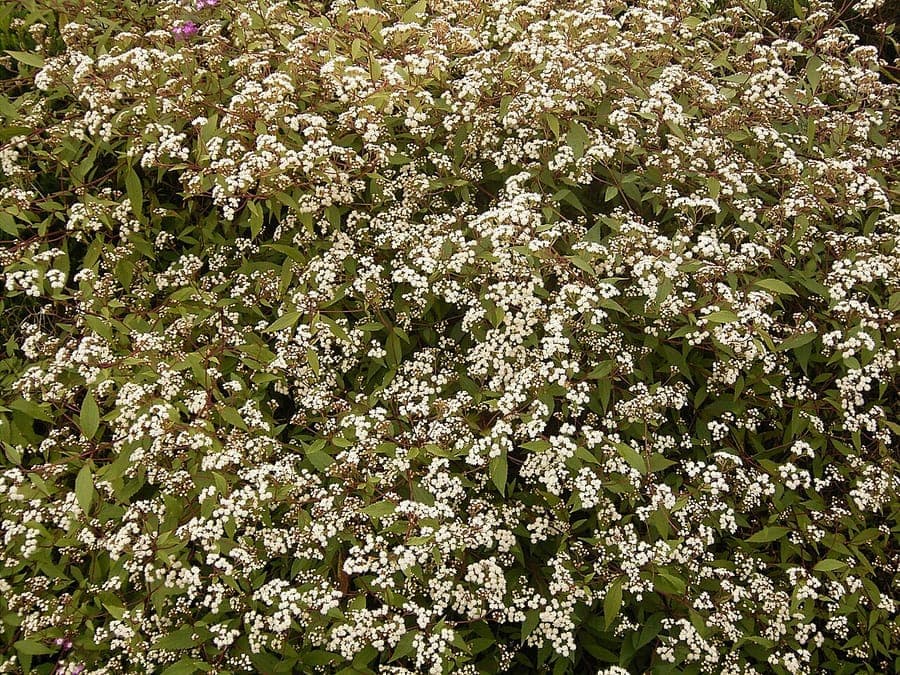
Frank Vincentz / CC BY-SA 3.0, via Wikimedia Commons
Creeping croftonweed: complete guide
Ageratina riparia
¿Quieres ver Creeping croftonweed: complete guide en tu jardín?
1 minuto, sin tarjeta de crédito
Overview
Creeping croftonweed (Ageratina riparia), also known as mistflower or mist flower, is a charming shrub native to Mexico. This member of the Asteraceae family is an adaptable semi-woody plant known for its abundant white flowers and compact, creeping growth habit.
In its natural habitat, this plant grows along riverbanks in Mexico from Michoacan to Veracruz and Oaxaca, adapting to moist but well-draining conditions. This origin makes it an ideal plant for borders and groundcover applications.
Appearance and Bloom
Creeping croftonweed forms a compact, low-growing shrub, usually 60-150 cm tall depending on conditions. The shrub spreads slowly via shallow roots and can become wider than tall.
The leaves are small, green, and oval-shaped, densely arranged along fine, purple-tinted stems. This gives the plant a delicate, elegant appearance.
The flowers are the main feature of this plant. They appear in numerous small clusters atop the stems. Each flower is small, about 2-3 mm in diameter, but grouped in large masses for a striking visual effect. The flowers are white to light purple.
The blooming period extends from September to November, with peak bloom in autumn. This makes it a valuable plant for fall color in gardens.
Ideal Location
Creeping croftonweed thrives best in full sun to light shade, with at least 4-6 hours of direct sunlight daily. This produces the most flowers and compact growth. The plant also tolerates partial shade.
Place this plant in borders, along pathways, or as groundcover. The plant can be used to combat erosion along streambanks. It tolerates windy locations well.
Soil
Creeping croftonweed grows well in average, well-draining soil. This is essential, although the plant is more moisture-tolerant than many other Asteraceae species.
The plant tolerates acidic to neutral soil. Add organic matter for better water retention in drier conditions. In heavy clay soils, drainage must be improved.
Diseño gratis
¿Quieres ver Creeping croftonweed: complete guide en tu jardín? Crea un diseño gratis ahora.
Watering
Creeping croftonweed loves regular moisture, especially during the growing season. Water when the top 2-3 cm of soil feels dry. However, avoid waterlogging.
Water regularly during dry periods. In rainy seasons, less water is needed.
Pruning
Pruning is not strictly necessary, but the plant responds well to formative pruning in spring. This promotes dense, compact growth. After blooming (December), prune lightly for neat form.
The plant can also be cut back drastically (to 30 cm height) in late spring for increased bloom and more compact form.
Maintenance Calendar
March-April: Spring formative pruning. Begin regular watering. May-August: Water regularly in dry periods. No blooming now. September-November: Blooming period. Water regularly. No pruning. December-February: Lightly prune after bloom. Winter preparation.
Winter Hardiness
Creeping croftonweed is not fully winter-hardy in cold climates. In areas with temperatures below -5 degrees Celsius, it may die or be severely damaged. In warmer regions (USDA zones 8-11), it can grow year-round.
In colder climates, it may overwinter outdoors with frost protection, or can be brought indoors for winter.
Companion Plants
Creeping croftonweed combines well with other fall-blooming plants such as asters, chrysanthemums, and sedums. Also beautiful with ornamental grasses and other textured plants.
Conclusion
Creeping croftonweed is an elegant choice for autumn borders. With its abundant white flowers in fall and adaptable growth habit, this plant delivers months of benefit. Create fall atmosphere in your garden with this plant.
Find plants in garden centers, especially in spring or summer. For more garden inspiration and design, visit gardenworld.app!
Want to learn more about fall-blooming plants? Visit specialty nurseries for selection. Learn more at gardenworld.app!
¿Quieres ver Creeping croftonweed: complete guide en tu jardín? Crea un diseño gratis ahora.
Sube una foto, elige un estilo y obtén un diseño fotorrealista con lista de plantas en menos de un minuto.
Más de 10.000 jardines diseñados
Sin tarjeta de crédito


Plantas similares
Calendula stellata: complete guide
Calendula stellata
Complete guide to Calendula stellata, the star-flowered marigold from Sicily: location, soil, watering and companion planting tips.
Korean chrysanthemum: complete guide
Chrysanthemum x rubellum
Chrysanthemum x rubellum is a hardy autumn perennial with single pink to copper flowers from August to November. Care and combinations.
Helianthus divaricatus: complete guide
Helianthus divaricatus
Helianthus divaricatus is a North American woodland sunflower with yellow summer blooms, ideal for naturalistic borders and shady edges.