
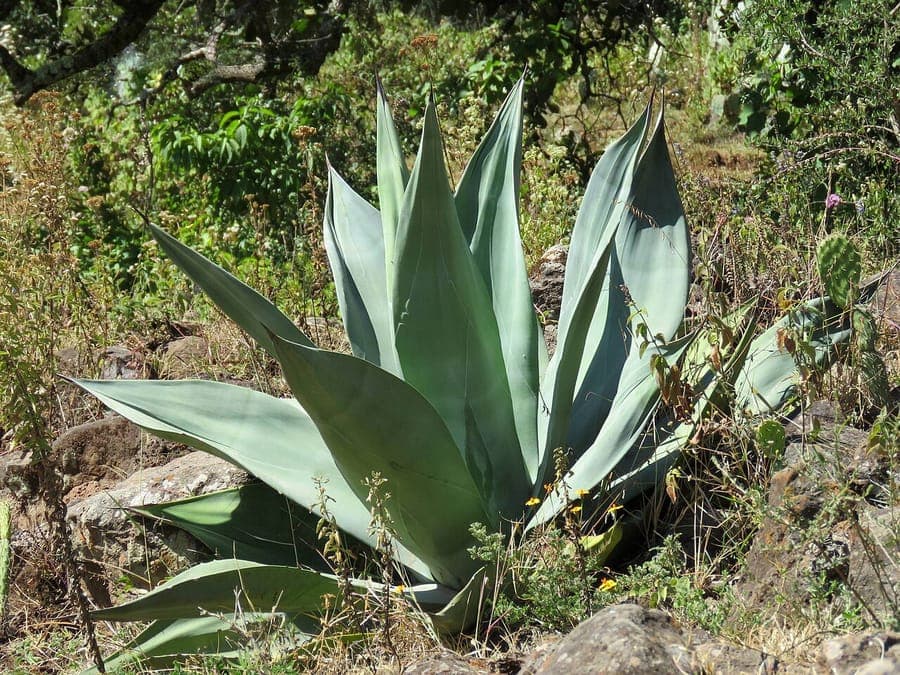
marumg / CC BY-SA 4.0, via Wikimedia Commons
Weber Agave: complete guide
Agave weberi
¿Quieres ver Weber Agave: complete guide en tu jardín?
1 minuto, sin tarjeta de crédito
Overview
Weber Agave (Agave weberi), also known as Maguey Liso or Weber's Century Plant, is a large, striking succulent from Mexico. This agave forms spectacular rosettes growing to 1.5 meters tall and wide. The plant is noted for its large, smooth leaves and architectural presence in gardens.
Appearance and Bloom
Agave weberi features broad, gray to gray-green leaves reaching 60-90 centimeters long. The leaves are relatively smooth without heavy spines, bearing small marginal teeth. The color is characteristically gray-blue. The leaves are thick and fleshy, giving the plant a massive, sculptural appearance. At maturity, this species produces a striking yellow flowering spike.
Ideal Location
Agave weberi requires full sun, minimum 6-8 hours direct sunlight daily. This large plant can be positioned as a corner specimen serving as an architectural element. Protection from strong winter winds is recommended. Plant it centrally in dry gardens or backyards for dramatic effect.
Soil
Soil must be exceptionally well-draining. Use sandy-clay soil with at least 40% coarse sand or gravel. Cactus soil is ideal. This plant tolerates poor soils. Add sand, perlite, or pumice for better drainage. pH can be neutral to slightly acidic.
Watering
Agave weberi is extremely drought tolerant. Once established, it needs only occasional water in extreme drought. Young plants can benefit from growing-season watering but much less than typical plants. Overwatering is dangerous. In winter, provide almost no water. Well-established plants can grow for years without supplemental water.
Diseño gratis
¿Quieres ver Weber Agave: complete guide en tu jardín? Crea un diseño gratis ahora.
Pruning
Minimal pruning needed. Remove only dead leaves and flowering stalks after bloom. The mother plant dies after flowering and must be removed. Young offset plants appear around the base and can be carefully separated and replanted.
Maintenance Calendar
Spring: Begin cautiously watering young plants. Check for disease. Summer: Minimal water only in dry climates. Ensure good ventilation. Autumn: Gradually reduce watering. Remove dead leaves. Winter: Almost no water. Strong frost protection in cold zones.
Winter Hardiness
Agave weberi can tolerate approximately -5 degrees Celsius but is better protected in harsher frost. In cold climates, growing in containers and moving indoors is recommended. Cloth protection helps in marginal cases. Snow and ice can break leaves.
Companion Plants
Agave weberi works well as a solitary specimen due to its size. Combine with other large succulents and drought plants. Low-growing agaves around the base create visual layers. Ornamental grasses add movement. Stone and gravel beds emphasize the architectural character.
Closing
Weber Agave is a spectacular choice for large xeriscaping projects. The impressive rosette brings sculptural interest to gardens. With minimal care, it thrives for decades. Visit gardenworld.app for architectural garden design inspiration.
Order your Weber Agave from specialized nurseries for large specimens. Gardenworld.app helps you create dramatic xeric garden designs.
¿Quieres ver Weber Agave: complete guide en tu jardín? Crea un diseño gratis ahora.
Sube una foto, elige un estilo y obtén un diseño fotorrealista con lista de plantas en menos de un minuto.
Más de 10.000 jardines diseñados
Sin tarjeta de crédito


Plantas similares
Narrow-leaved dracaena: complete guide
Dracaena angustifolia
Everything about Dracaena angustifolia - the narrow-leaved dracaena: location, care, overwintering and use as a houseplant or patio plant.
Chaparral yucca: complete guide to Hesperoyucca whipplei
Hesperoyucca whipplei
Hesperoyucca whipplei (Our Lord's candle) is a dramatic rosette-forming plant from California that produces a towering flower spike, ideal for dry and gravel gardens.
False lily-of-the-valley: complete guide
Maianthemum dilatatum
Everything about Maianthemum dilatatum, the false lily-of-the-valley. Care, shade location, propagation and garden combinations for this popular shade ground cover.