
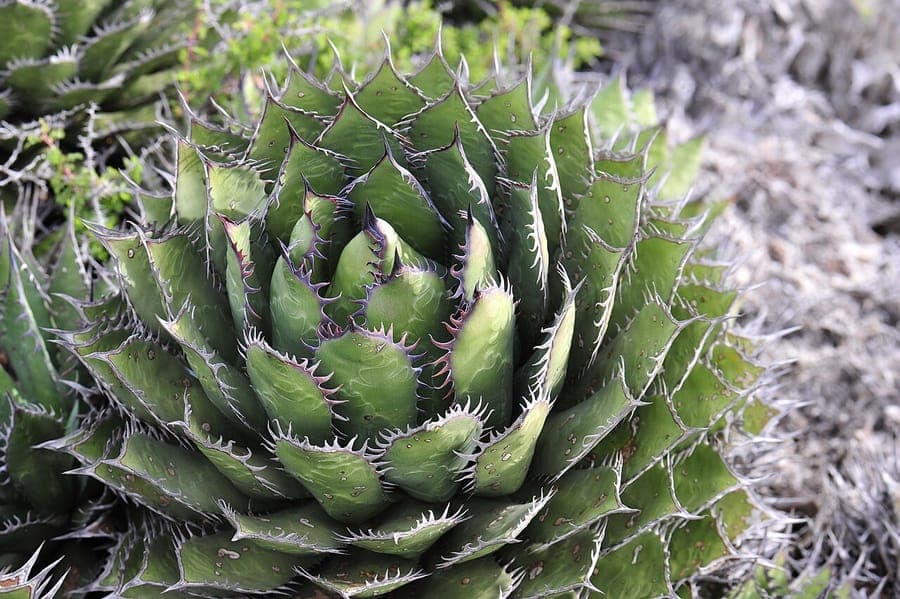
Alan Rockefeller / CC BY 4.0, via Wikimedia Commons
Agave shawii: complete guide
Agave shawii
¿Quieres ver Agave shawii: complete guide en tu jardín?
1 minuto, sin tarjeta de crédito
Overview
The Coastal agave (Agave shawii) is an impressive tender succulent from the Asparagaceae family, native to the coastal regions of Southern California and Baja California. This rare species flowers only once in its lifetime after 15 to 20 years of growth, giving it a unique place in garden architecture. The plant reaches approximately 60 to 80 centimetres tall with a similar spread. This succulent is renowned for extremely low water requirements and incredible drought resilience, making it ideal for water-smart landscapes.
Appearance and bloom
The Coastal agave forms a compact rosette of blue-grey leaves with characteristic dark margins. The leaves are relatively slender and pointed, creating a refined appearance compared to other agave variants. Mature leaves reach lengths of 40 to 60 centimetres. When the plant finally flowers (usually after 15-20 years), a massive flower spike emerges reaching 3 to 4 metres tall, adorned with yellow tubular flowers attracting bees and hummingbirds. This is a remarkable horticultural event.
Ideal location
The Coastal agave thrives in full sun in warm, sheltered conditions. A south-facing garden position or hot garden corner is ideal for this Californian beauty. The plant can grow in partial shade but will not flower reliably without at least six hours of direct sunlight daily. Provide protection from strong winds that can damage leaves. This plant excels in roof gardens, Mediterranean borders, xerophytic landscapes, and desert-style gardens.
Soil
The Coastal agave requires well-draining soil, preferably sandy or gravelly earth. Use cactus or succulent compost for container cultivation. A mixture of 40% garden soil, 40% sand, and 20% grit forms suitable growing medium. The plant tolerates alkaline to neutral pH and grows best in nutritious, well-structured soil. Never add water-retentive ingredients as root rot becomes likely. Drainage is absolutely critical for success.
Watering
The Coastal agave is extremely drought tolerant and needs moderate water only. During the growing season (spring-summer), water once every two weeks, maintaining adequate moisture without water stagnation. In autumn-winter, water minimally or not at all - this dry rest promotes hardiness and flower initiation. Newly planted specimens may require slightly more frequent watering until well established. During rainfall, you can usually skip supplemental watering entirely.
Diseño gratis
¿Quieres ver Agave shawii: complete guide en tu jardín? Crea un diseño gratis ahora.
Pruning
The Coastal agave requires minimal pruning as it grows naturally in rosette form. Remove only dead leaves at the base or damaged outer leaves. After flowering, the mother plant dies (monocarpic growth) but often produces side shoots, which is normal. In containers, you can carefully remove a few side shoots if desiring a single rosette, though multiple rosettes also appear attractive and create fuller specimens.
Maintenance calendar
March to May: Water moderately as growth begins, check drainage. June to August: Monitor continuously, water once every two weeks, protect against extreme heat. September to November: Gradually reduce water usage. December to February: Minimal maintenance, water very carefully if snow is absent. During flowering: Enjoy the flower spike, protect from damage.
Winter hardiness
The Coastal agave is moderately hardy, tolerating temperatures to approximately -5 degrees Celsius during brief periods. In colder climates, this plant must be overwintered under glass or in protected positions. Ensure soil is dry before frost arrives, as wet roots freeze more readily than dry roots. In temperature zones below USDA zone 9, keep the plant potted for mobility. Mulching with grit helps keep soil dry and stable.
Companion plants
The Coastal agave combines beautifully with other succulents such as Echeveria, Sedum, and Aloe species. For Mediterranean garden designs, pair with lavender, rosemary, and drought-resistant grasses. These combinations create visually interesting xerophytic landscapes. Avoid grouping with water-loving plants requiring more moisture, as their needs conflict fundamentally.
Final advice
The Coastal agave is a distinctive choice for owners of dry, warm gardens and succulent enthusiasts. This unique plant offers years of beauty with minimal maintenance once established. Available from specialized garden centres and online suppliers. Discover more drought-tolerant plants on gardenworld.app and design your water-conscious garden today. This Californian gem deserves a place in every climate-conscious garden!
¿Quieres ver Agave shawii: complete guide en tu jardín? Crea un diseño gratis ahora.
Sube una foto, elige un estilo y obtén un diseño fotorrealista con lista de plantas en menos de un minuto.
Más de 10.000 jardines diseñados
Sin tarjeta de crédito


Plantas similares
Narrow-leaved dracaena: complete guide
Dracaena angustifolia
Everything about Dracaena angustifolia - the narrow-leaved dracaena: location, care, overwintering and use as a houseplant or patio plant.
Chaparral yucca: complete guide to Hesperoyucca whipplei
Hesperoyucca whipplei
Hesperoyucca whipplei (Our Lord's candle) is a dramatic rosette-forming plant from California that produces a towering flower spike, ideal for dry and gravel gardens.
False lily-of-the-valley: complete guide
Maianthemum dilatatum
Everything about Maianthemum dilatatum, the false lily-of-the-valley. Care, shade location, propagation and garden combinations for this popular shade ground cover.