
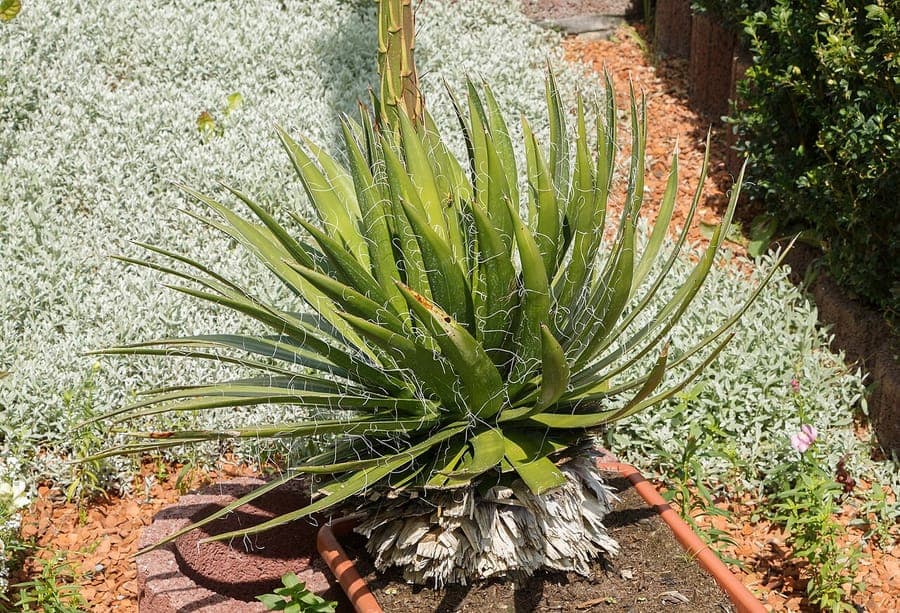
H. Zell / CC BY-SA 3.0, via Wikimedia Commons
Thread agave: complete guide
Agave filifera
¿Quieres ver Thread agave: complete guide en tu jardín?
1 minuto, sin tarjeta de crédito
Overview
Thread agave (Agave filifera) is a striking succulent from Mexico (Querétaro to México State), named after the characteristic white threads growing along leaf margins. This graceful plant is perfect for modern dry gardens and Mediterranean plantings, and is becoming increasingly popular in temperate regions.
Appearance and bloom cycle
This compact agave forms dense rosettes of dark green, linear leaves with striking white threads along the margins. The plant grows slowly to approximately 30-40 cm in diameter. The white thread structure provides a highly decorative effect, especially in glancing light. Blooming typically occurs after 8-10 years (or not in cold climates), with tall yellow flower spikes. After blooming, the main rosette dies (monocarpic type).
Ideal location
Thread agave demands full sun for best growth and color development. At least 6-8 hours of direct sunlight daily. In full sun, the plant thrives and white filaments become especially striking. Protection from direct afternoon sun isn't needed in most climates. Avoid complete shade.
Soil requirements
Extremely well-draining soil is essential. Use a mix of 70% minerals (sand, perlite, gravel) and 30% compost. For container culture: use specialty cactus/succulent soil mix. The plant tolerates very poor soils well. pH 6.5-7.5 is ideal. Poor drainage is the most common cause of death.
Watering
Thread agave is highly drought-tolerant. Water only when soil is completely dry - almost never in winter. Growing season (May-October): water once every 2-3 weeks. In containers, check more frequently. Excessive water is the greatest threat; this almost certainly leads to root rot. Never waterlog during growth.
Diseño gratis
¿Quieres ver Thread agave: complete guide en tu jardín? Crea un diseño gratis ahora.
Pruning and maintenance
Minimal care. Gently remove dead or damaged outer leaves. No pruning needed; plant maintains natural shape. In containers, repot every 2-3 years with fresh soil mix. Periodically check for mealybug (uncommon) and scale insects (very rare in dry conditions).
Maintenance calendar
- January-April: Minimal watering; plant rests
- May-June: Begin watering; follow growth
- July-September: Regular watering; peak growing season
- October: Gradually reduce watering
- November-December: Keep dry; winter dormancy
Winter hardiness
Agave filifera is not winter-hardy in cold temperate regions. Can tolerate temperatures to approximately -5°C with protection, but safety is above 5°C. Frost-sensitive; protect or bring indoors in winter. USDA zones 9-11 (subtropical climate preferred).
Companion plants
Thread agave combines beautifully with:
- Other agaves (Agave americana, Agave parryi)
- Sempervivum species for contrast
- Echeveria for form and color
- Yucca aloifolia for architectural impact
- Gray herbaceous plants like Artemisia or Santolina
GardenWorld tip: Group in containers with other succulents for modern xeriscaping aesthetics.
Closing thoughts
Thread agave proves you don't need flowers for dramatic garden effects - the form and texture of this plant provide complete season-long interest. Ensure good drainage and you have an nearly maintenance-free garden. Try this exotic beauty and transform your space into a modern succulent showcase.
GardenWorld can help design a drought-tolerant and contemporary garden. Visit gardenworld.app for xeriscaping inspiration and planting schemes.
¿Quieres ver Thread agave: complete guide en tu jardín? Crea un diseño gratis ahora.
Sube una foto, elige un estilo y obtén un diseño fotorrealista con lista de plantas en menos de un minuto.
Más de 10.000 jardines diseñados
Sin tarjeta de crédito


Plantas similares
Narrow-leaved dracaena: complete guide
Dracaena angustifolia
Everything about Dracaena angustifolia - the narrow-leaved dracaena: location, care, overwintering and use as a houseplant or patio plant.
Chaparral yucca: complete guide to Hesperoyucca whipplei
Hesperoyucca whipplei
Hesperoyucca whipplei (Our Lord's candle) is a dramatic rosette-forming plant from California that produces a towering flower spike, ideal for dry and gravel gardens.
False lily-of-the-valley: complete guide
Maianthemum dilatatum
Everything about Maianthemum dilatatum, the false lily-of-the-valley. Care, shade location, propagation and garden combinations for this popular shade ground cover.