
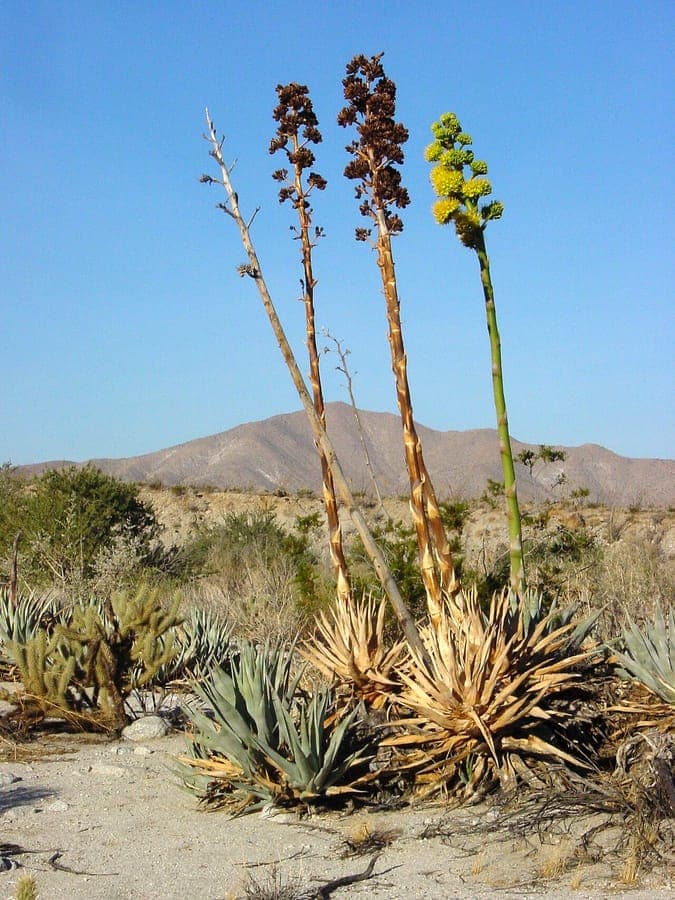
No machine-readable author provided. NoahElhardt assumed (based on copyright claims). / CC BY-SA 2.5, via Wikimedia Commons
Desert agave: complete guide
Agave deserti
¿Quieres ver Desert agave: complete guide en tu jardín?
1 minuto, sin tarjeta de crédito
Overview
The Desert agave (Agave deserti), also known as maguey de desierto in Spanish, is an impressive succulent from the Asparagaceae family. This extreme drought-tolerant plant thrives in the arid, mountainous regions of southern California and northwest Mexico. With its characteristic blue-green foliage and compact rosette form, it's an exemplary choice for xeriscaping and water-conserving landscapes.
Appearance and Bloom
The Desert agave forms a tight rosette of succulent, elongated leaves with a striking blue-green coloration and characteristic marginal teeth. Individual leaves can reach 24 inches long and terminate in a sharp apical spine, a typical agave feature. The plant grows slowly, eventually reaching 24-40 inches in diameter.
When mature (typically after 10-15 years), the plant produces an impressive flowering spike (inflorescence) reaching 10-13 feet tall. Pale yellow flowers attract hummingbirds and pollinators. After blooming, the main rosette dies, but offsets emerge from the base to perpetuate the colony.
Ideal Location
The Desert agave is a true sun-worshiper requiring a minimum of 6 hours of direct daily sunlight for optimal growth and coloration. It actually performs best in full sun in arid climates. Partial shade is tolerated but may result in weak, stretched growth.
Perfect for warm, dry gardens (USDA zones 9-11). Plant in a location with excellent drainage and no tendency for water accumulation.
Soil
Exceptional drainage is critical for agaves. Standard garden soil will likely cause waterlogging and root rot. Amend heavy soils with sand and gravel in a 1:1:1 ratio, or preferably plant in pure gravelly sand.
Neutral to alkaline pH (6.5-8.0) is acceptable. Avoid adding organic matter as it promotes moisture retention.
Diseño gratis
¿Quieres ver Desert agave: complete guide en tu jardín? Crea un diseño gratis ahora.
Watering
Once established (after 1-2 years), the Desert agave is profoundly drought-tolerant and can endure extended dry periods without stress. In its native habitat, rainfall is minimal and unpredictable.
During the growing season, minimal supplemental water may be provided, though truly sparingly. During winter and established dry periods, withhold water entirely. Young plants and seedlings may receive careful occasional watering, but mature plants rarely need supplemental water except in extreme drought years.
Pruning
The Desert agave requires virtually no pruning. Remove dead, damaged, or diseased leaves carefully using gloves (sharp teeth!). Trim damaged leaf margins back to the healthy tissue. Maintain the plant's natural architectural form.
Maintenance Calendar
January-February: Dormancy period; no watering March-April: Growth begins; minimal water May-June: Active growth; very limited water July-August: Peak growth possible; full sun September-October: Growth slows; reduce water November-December: Dormancy; no water
Winter Hardiness
The Desert agave is hardy to approximately 14 Fahrenheit (-10°C), making it suitable for USDA zones 9-11. In colder climates, grow in containers and move indoors during winter. Protect from frost and winter moisture.
Companion Plants
The Desert agave thrives alongside other desert succulents and drought-tolerant plants:
- Other agaves (Agave parryi, Agave palmeri)
- Yuccas
- Echinocereus and other cacti
- Aloe species
- Sedum varieties and stonecrops
- Drought-tolerant shrubs like Santolina
Closing Remarks
The Desert agave is a stunning, architectural plant that thrives with virtually no maintenance. With its distinctive blue-green coloration, characterful leaf margins, and sculptural form, it creates drama in any water-wise garden. An excellent choice for desert and Mediterranean landscapes, or anywhere water conservation is a priority.
Available from specialty nurseries and cactus growers. For more information on drought-tolerant plants and xeriscaping strategies, visit GardenWorld.app.
¿Quieres ver Desert agave: complete guide en tu jardín? Crea un diseño gratis ahora.
Sube una foto, elige un estilo y obtén un diseño fotorrealista con lista de plantas en menos de un minuto.
Más de 10.000 jardines diseñados
Sin tarjeta de crédito


Plantas similares
Narrow-leaved dracaena: complete guide
Dracaena angustifolia
Everything about Dracaena angustifolia - the narrow-leaved dracaena: location, care, overwintering and use as a houseplant or patio plant.
Chaparral yucca: complete guide to Hesperoyucca whipplei
Hesperoyucca whipplei
Hesperoyucca whipplei (Our Lord's candle) is a dramatic rosette-forming plant from California that produces a towering flower spike, ideal for dry and gravel gardens.
False lily-of-the-valley: complete guide
Maianthemum dilatatum
Everything about Maianthemum dilatatum, the false lily-of-the-valley. Care, shade location, propagation and garden combinations for this popular shade ground cover.