
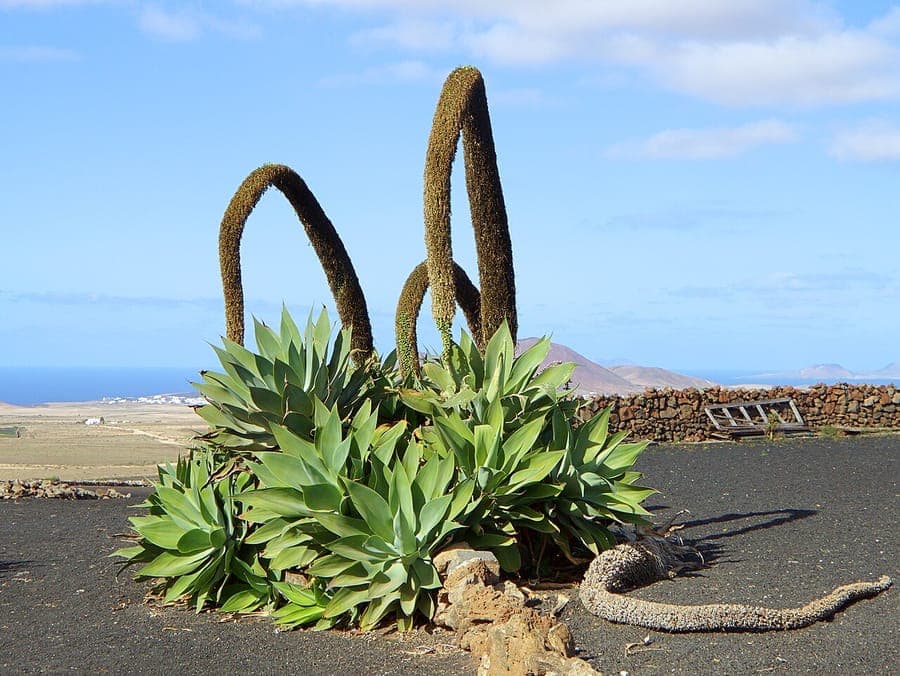
H. Zell / CC BY-SA 3.0, via Wikimedia Commons
Elephant's trunk: complete guide
Agave attenuata
¿Quieres ver Elephant's trunk: complete guide en tu jardín?
1 minuto, sin tarjeta de crédito
Overview
Agave attenuata, also known as Elephant's trunk, Swan's neck, or Foxtail, is a striking succulent from Mexico that distinguishes itself with an unusual curved inflorescence that curves downward like an elephant's trunk or swan's neck. This graceful plant belongs to the Asparagaceae family and forms dense rosettes of blue-green leaves. Unlike most agaves, Agave attenuata is unarmed: the leaves have no spiny terminal points, making it a safer choice for gardens with children or pets. On gardenworld.app you can perfectly integrate this special specimen into your garden design, especially in Mediterranean or modern gardens with succulents.
The Elephant's trunk agave is a statement plant. The characteristic curved inflorescence appears only once in the plant's life, after 6 to 8 years of growth, after which the plant dies. This is not, however, a reason for disappointment: the plant produces many offsprings around the base that you can grow into new plants. This unique life cycle makes it a fascinating addition to any succulent collection.
Appearance & Bloom Cycle
Agave attenuata grows as a dense, compact rosette of blue-green leaves that can reach 45 to 90 centimeters in height. The leaves are linear to lanceolate, smooth-edged (no spines) and end in a soft point. At the mature stage, a spectacular inflorescence appears: a curved, yellow flower stalk that can reach up to 3 meters in length and hangs full of small, yellow tubular flowers. This inflorescence gives the plant its full name. After flowering (which lasts a few weeks), the mother plant dies off, but leaves numerous offsprings that can be grown into new life.
Ideal Location
Elephant's trunk thrives best in full sun to lightly shaded locations. In very warm climates, some afternoon or evening shade can be beneficial to prevent leaf burn. The plant is flexible and can also be grown indoors in a sunny window. Plant it in a place with a good view, as its spectacular bloom will draw much attention.
Soil Requirements
The Elephant's trunk agave requires very well-draining soil. Plant it in cactus/succulent mix or make your own mix with 50% potting soil and 50% perlite/grit. In gardens you can plant it in raised beds or rocky zones. Heavy clay or regularly wet soil will lead to root rot.
Diseño gratis
¿Quieres ver Elephant's trunk: complete guide en tu jardín? Crea un diseño gratis ahora.
Watering
Watering must be very careful. Once established, Elephant's trunk is seriously drought-tolerant. During the growing season (spring/summer), water when the soil feels completely dry, approximately once every 2-3 weeks. In winter, minimize watering or stop completely. Overwatering is the most common cause of death for this plant.
Pruning & Maintenance
Pruning is actually not necessary. Only remove dead or damaged leaves. Remove the flower stalk after flowering back to the base; this helps the plant retain energy for the offsprings. Carefully detach the offsprings from the mother plant and let them dry for a few days before planting them in dry cactus mix.
Maintenance Calendar
March-April: Growth begins, resume watering May-June: Bloom can begin (only on mature plants), full sun needed July-August: Peak growth, regular watering September-October: Growth slows, reduce watering November-February: Dormancy, minimal water
Winter Hardiness
Elephant's trunk is not hardy in colder climates. It tolerates only light frost (down to about -3°C). In areas with harsh winters, the plant must be brought indoors or protected with reed matting and plastic. In warm climates (USDA zones 9-11) it can overwinter outdoors.
Companion Plants
Combine Elephant's trunk agave with other succulents such as Echeveria, Sempervivum, and Sedum for a texture-rich succulent border. Plant it together with Mediterranean herbs such as lavender (Lavandula) and rosemary (Rosmarinus) for a warm, ground-level feel.
Overwintering & Frost Protection
In cold climates, bring the plant indoors before the first frost. Place it on a sunny windowsill and water minimally. The important thing is that the plant stays dry. In areas with moderate winters (down to -3°C), some protection can help: cover the plant with dry straw or reed matting.
Closing Thoughts
Elephant's trunk is a plant for those with patience and care. It is not suitable for everyone, but for those who love succulents and exotic plants, this is a must-have. The spectacular bloom, when it comes, is a reward for years of careful tending. On gardenworld.app you can find the perfect place for this magical plant, whether indoors in a pot or outdoors in a warm zone.
¿Quieres ver Elephant's trunk: complete guide en tu jardín? Crea un diseño gratis ahora.
Sube una foto, elige un estilo y obtén un diseño fotorrealista con lista de plantas en menos de un minuto.
Más de 10.000 jardines diseñados
Sin tarjeta de crédito


Plantas similares
Narrow-leaved dracaena: complete guide
Dracaena angustifolia
Everything about Dracaena angustifolia - the narrow-leaved dracaena: location, care, overwintering and use as a houseplant or patio plant.
Chaparral yucca: complete guide to Hesperoyucca whipplei
Hesperoyucca whipplei
Hesperoyucca whipplei (Our Lord's candle) is a dramatic rosette-forming plant from California that produces a towering flower spike, ideal for dry and gravel gardens.
False lily-of-the-valley: complete guide
Maianthemum dilatatum
Everything about Maianthemum dilatatum, the false lily-of-the-valley. Care, shade location, propagation and garden combinations for this popular shade ground cover.