
Wikimedia Commons / Public domain, via Wikimedia Commons
Fool's-parsley: complete guide
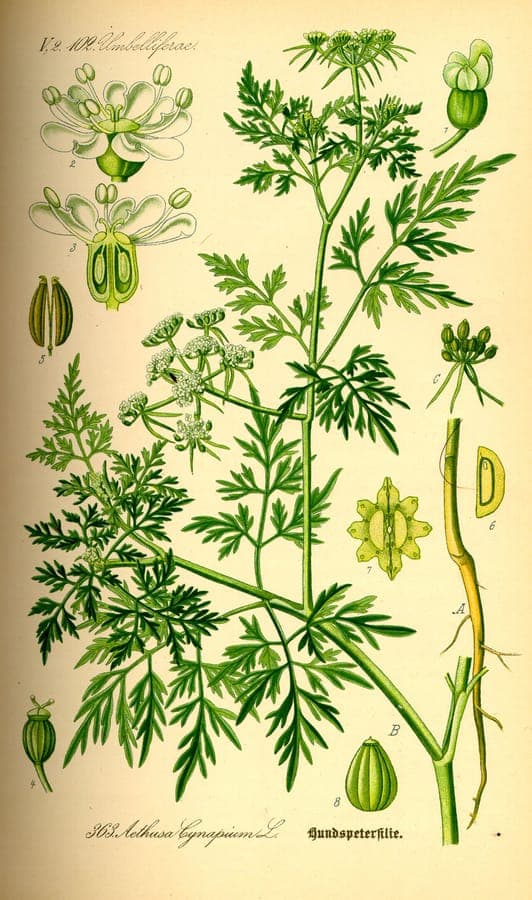
Aethusa cynapium
¿Quieres ver Fool's-parsley: complete guide en tu jardín?
1 minuto, sin tarjeta de crédito
Overview
Aethusa cynapium, commonly known as Fool's-parsley or Spotted poison-parsley, is an annual herbaceous plant that despite its innocent appearance poses a serious health risk. This plant belongs to the Apiaceae family (the carrot and parsley family) and grows natively from Europe to Turkey and the Caucasus. It is a plant you must learn to identify and avoid. Fool's-parsley is toxic in all parts, especially the roots and seeds, due to the toxic alkaloid aethusine. On gardenworld.app we provide tips for identifying and safely removing unwanted plants from your garden design.
This is not an ornamental plant you want in your garden. However, it is important to learn to recognize this plant because it closely resembles edible parsley (Petroselinum crispum) and wild carrots (Daucus carota), which can lead to serious poisoning if confused. This article explains how to distinguish Fool's-parsley and safely remove it.
Appearance & Identification Features
Aethusa cynapium grows as an erect, branching plant reaching 20 to 100 centimeters in height. The plant has fine, feathery leaves that closely resemble parsley, but distinguish themselves through a characteristic unpleasant odor and the whitish underside of the leaves. The flowers appear from June to September in small, white, compound clusters (umbels). A very important distinguishing feature is the presence of drooping bracteoles beneath the flower clusters, which parsley does not have.
Why This Article
Many documented plant poisonings have occurred because people confused this plant with edible parsley. Fool's-parsley is toxic and can cause serious symptoms, including burning sensations in the mouth, esophageal inflammation, stomach cramps, diarrhea, and in severe cases neurological symptoms. Children are particularly vulnerable. Since it offers no ecological benefit to the garden, it is best to remove this plant as quickly as possible.
Diseño gratis
¿Quieres ver Fool's-parsley: complete guide en tu jardín? Crea un diseño gratis ahora.
Habitat & Distribution
Fool's-parsley grows as a weed in agricultural areas, along roads, in urban areas, and in gardens. It thrives in full sun to lightly shaded areas. The plant feels at home on virtually all soils and is very opportunistic.
Identification: Avoiding Confusion
Note these features to distinguish Fool's-parsley from parsley:
- Underside of leaves: Fool's-parsley has gray or whitish underside of leaves
- Smell: Fool's-parsley has an unpleasant, acrid aroma
- Bracteoles: Drooping bracteoles directly beneath flower clusters
- Stem: Fool's-parsley often has spots or streaks on the stem
- Growth pattern: Fool's-parsley grows more like a low bush, parsley more upright
Safe Removal
Wearing gloves alone is insufficient. The toxic substances can be absorbed through the skin. Follow these steps:
- Wear protective gloves (preferably latex or nitrile)
- Pull the entire plant including the roots
- Place in a plastic bag
- Dispose as appropriate or burn carefully (in some countries this may be dangerous)
- Wash your hands thoroughly
- Avoid touching your face while you have had contact with the plant
Maintenance Calendar
May-June: Seedling phase, be extremely careful July-August: Plant grows, removal still important September-October: Plant seeds, removal now critical November-March: Plant dies in winter, no action needed
Why Not Toxic to Animals?
Some animals can eat Fool's-parsley without immediate symptoms, but it can damage their liver. This is no reason to let it grow in gardens with animals.
Final Warning
Aethusa cynapium has no ornamental value. The sole purpose of this article is to help you recognize this plant and remove it safely. If your child or pet touches or ingests this plant, immediately contact a poison control center or veterinarian. Do not dismiss it as harmless: Fool's-parsley is serious.
¿Quieres ver Fool's-parsley: complete guide en tu jardín? Crea un diseño gratis ahora.
Sube una foto, elige un estilo y obtén un diseño fotorrealista con lista de plantas en menos de un minuto.
Más de 10.000 jardines diseñados
Sin tarjeta de crédito


Plantas similares
Whorled carrot: complete guide
Daucus involucratus
Daucus involucratus is a Mediterranean umbellifer with white flower heads framed by lacy bracts. Growing this gravel garden gem.
Daucus muricatus: complete guide
Daucus muricatus
Daucus muricatus, the spiny wild carrot, grows wild on Mediterranean coasts. Discover sowing, June-July bloom, and wildflower meadow use.
Daucus pumilus: complete guide
Daucus pumilus
Daucus pumilus is a dwarf wild carrot relative with white lacy umbels, thriving on dunes and coastal rock in poor, fast-draining soil.