
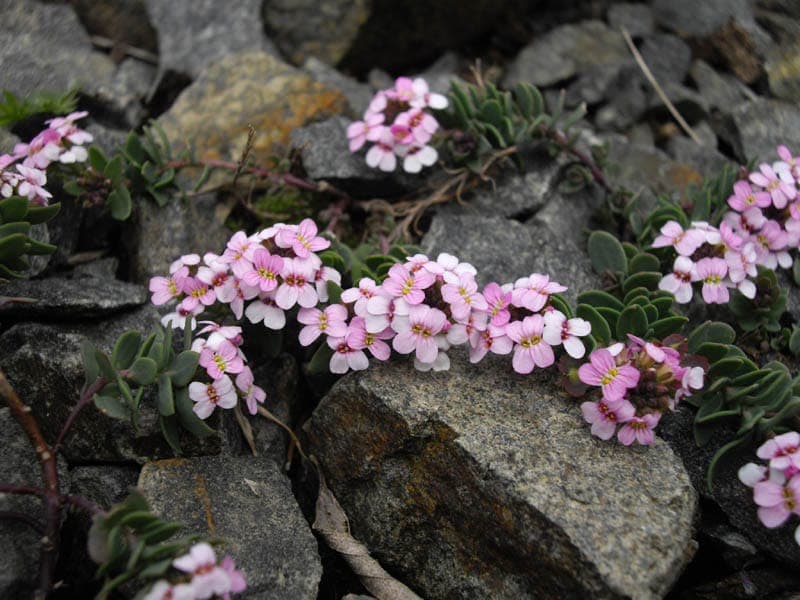
Ghislain118 http://www.fleurs-des-montagnes.net / CC BY-SA 3.0, via Wikimedia Commons
Burnt candytuft: complete guide
Aethionema saxatile
¿Quieres ver Burnt candytuft: complete guide en tu jardín?
1 minuto, sin tarjeta de crédito
Overview
Burnt candytuft (Aethionema saxatile), also known as rock candytuft or Persian stonecress, is a compact, low-growing herbaceous plant from the Brassicaceae family (Crucifers). This plant originates from central and southern Europe and North Africa, where it grows on rocky and stony places. The plant reaches a height of only 15 to 25 centimeters and is especially known for its delicate, pink to purple flower clusters that appear in spring.
Burnt candytuft is a very popular rock garden plant, especially in gravel beds, rock gardens, stone gardens, and alpine borders. It is completely hardy and tolerates drought very well once established. This makes it an ideal plant for low-maintenance gardens.
Appearance and flowering
Burnt candytuft is a compact, cushion-forming plant with very fine, gray-green to bluish-green foliage. The leaves are narrow, linear-lanceolate, and give the plant a very elegant, grass-like appearance.
The flowers are the main attraction of this plant. They appear in dense, compact clusters from April to June. The flowers are small, approximately 6-8 millimeters across, and colored in soft pink to deep red, depending on the variety. The flowering period is long and abundant, especially when the plant is well-drained and sunny.
After the flowers wilt, small seed capsules form. The plant is seed-grown and sometimes self-seeds in the garden, making it a valuable self-sowing plant.
Ideal location
Burnt candytuft grows best in a fully sunny location. The plant thrives in warm, dry places and flowers more abundantly than in partial shade. Full sun also promotes plant density and makes flowering more prolific.
The plant is very hardy and tolerates temperatures down to -20 degrees Celsius and below. Wind is not a concern, especially since it grows low.
It is a plant that thrives very well in marginal conditions, especially on steep, south-facing slopes where drought is commonplace. This makes it excellent for xeriscaping (drought-tolerant landscaping).
Soil requirements
Burnt candytuft prefers poor, well-draining soil. In fact, it performs better in less rich soils than in heavy, nutrient-rich soils. A mixture of garden soil with plenty of gravel, sand, and small stones is ideal. The pH should be between 6.0 and 7.5 (neutral to slightly alkaline).
Heavy clay soils should be improved with plenty of sand and gravel to improve drainage. Over-fertilization leads to excessive growth and less abundant flowering. This is a plant that dislikes fertilization.
Planting on slopes with gravel base is very suitable.
Diseño gratis
¿Quieres ver Burnt candytuft: complete guide en tu jardín? Crea un diseño gratis ahora.
Watering
Burnt candytuft requires very little water, especially once well-established. Newly planted specimens may benefit from some regular watering in their first season, especially during dry periods, but once rooted (after approximately 1-2 seasons), supplemental watering is usually unnecessary except during extreme droughts.
In container culture, watering must be managed more carefully. Let the soil dry completely between waterings. Over-watering can lead to root rot.
In very dry, hot climates, occasional watering during the growing season may be helpful, but overall this plant is very drought-tolerant.
Pruning and maintenance
Burnt candytuft requires very little maintenance. The plant naturally grows into a compact form. After flowering (June), one can gently trim back to keep the plant more compact and prevent self-seeding.
Removing dead foliage is unnecessary, as the plant retains its leaves throughout winter. Occasionally some yellowed leaves may occur, especially in very dry winters, but these are not concerning.
The plant is not susceptible to pest insects or fungi, especially because it grows in very dry conditions.
Maintenance calendar
March-April: Growing period begins. Water only in very dry periods. April-June: Flowering period; continued watering only in exceptional droughts. June-July: Trim back after flowering. July-September: Summer dormancy; no watering needed. October: Seed dispersal may occur. November-February: Winter rest; no maintenance needed.
Winter hardiness
Burnt candytuft is very hardy and tolerates temperatures down to -20 to -25 degrees Celsius. The plant retains its leaves throughout winter and may even show continued growth during mild winters. Snow cover presents no problem.
In very severe winters, some shoots may be damaged, but the heart of the plant usually survives well.
Companion plants
Burnt candytuft pairs nicely in rock gardens with other alpine and rocaille plants. It combines well with Sedum species, Sempervivum, Veronica prostrata, and Alyssum saxatile. For flower contrast, yellow flowers such as Draba or purple saxifrages can be used.
Bass and purple stonecrops also make nice neighbors. The plant is valuable in gravel beds and rock garden borders.
Its low growth makes it suitable for front borders and as an edging plant.
Conclusion
Burnt candytuft is a valuable, hardy rock garden plant that brings much beauty to rock gardens, stone gardens, and alpine borders. Its delicate pink flowers, compact form, and very low maintenance and water requirements make it an ideal choice for drought-tolerant, Mediterranean gardens and steep, sunny slopes. With minimal care, this plant will provide years of floral abundance and beauty.
Burnt candytuft can be found at many garden centers and online nurseries. For more information on rock gardens and alpine planting, visit gardenworld.app for inspiration and recommendations.
¿Quieres ver Burnt candytuft: complete guide en tu jardín? Crea un diseño gratis ahora.
Sube una foto, elige un estilo y obtén un diseño fotorrealista con lista de plantas en menos de un minuto.
Más de 10.000 jardines diseñados
Sin tarjeta de crédito


Plantas similares
Brassica cretica: complete guide
Brassica cretica
Brassica cretica, the Cretan cabbage, grows wild on Aegean cliffs. Discover how to grow this drought-tolerant, yellow-flowered Mediterranean perennial.
Corsican cabbage: complete guide
Brassica insularis
Corsican cabbage is a rare Mediterranean rock cabbage with white flowers and blue-green leaves. Location, soil and winter protection.
Prostrate cabbage: complete guide
Brassica procumbens
Prostrate cabbage is a creeping North African cliff plant with yellow flowers. Discover location, soil type and winter protection.