
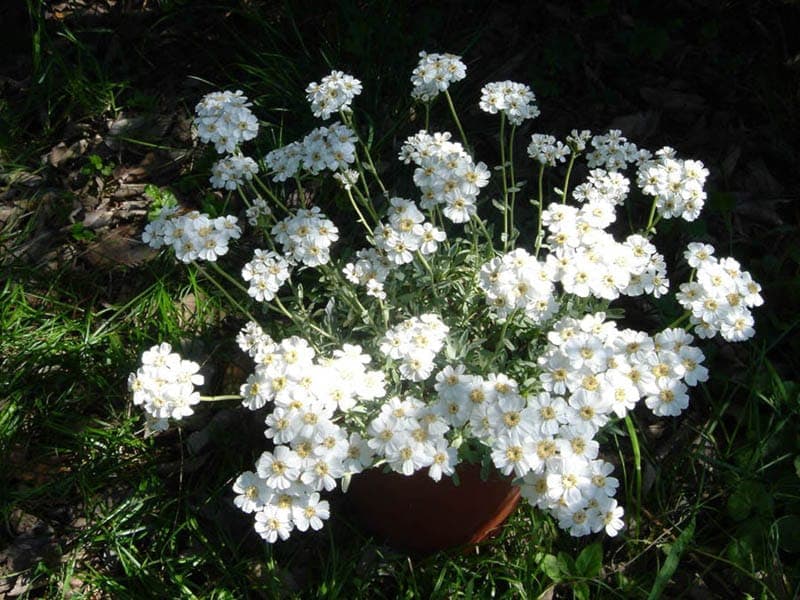
Ghislain118 http://www.fleurs-des-montagnes.net / CC BY-SA 3.0, via Wikimedia Commons
Achillea ageratifolia: complete guide
Achillea ageratifolia
¿Quieres ver Achillea ageratifolia: complete guide en tu jardín?
1 minuto, sin tarjeta de crédito
Overview
Achillea ageratifolia, commonly known as Greek Yarrow or Ageratum-leaved Achillea, is a delicate low-growing perennial from the Balkan regions of Europe. Prized for its finely dissected, feathery foliage and countless small white flowers arranged in flat-topped flower clusters, this modest yet elegant plant reaches only 20-30 centimeters in height. Perfect for rock gardens, alpine beds, and dry borders, it brings refinement and subtle grace to arid locations.
Appearance & Bloom
Achillea ageratifolia forms compact, densely mounding growth patterns with exceptionally fine, finely dissected foliage that feels delightfully airy and elegant. The leaves are green to grey-green, providing an attractive backdrop for the flowers. Blooms appear from June through August in flat flower clusters that are pristine white, sometimes with yellow disc florets in the center. Each flower cluster contains numerous tiny florets united together in structured formations. The flowers persist for weeks, making them excellent for cutting.
Ideal Location
This achillea thrives in full sun, requiring 6-8 hours of direct sunlight daily for optimal flowering and compact growth. Plant it in a sunny rock garden, rock crevice, or along a dry slope. This plant also performs excellently in coastal gardens where salt spray and wind are dominant. Avoid completely shaded locations where the plant will become etiolated and flower production will decline significantly.
Soil
This yarrow prefers poor to moderately fertile, well-draining soil and actually thrives on stony or sandy terrain. It can even establish on nutrient-poor soils - rich soil can promote excessive vegetative growth at the expense of flowering. Ensure excellent drainage; slightly acidic to neutral soils (pH 6-8) are ideal. Heavy clay soils should be amended with sand or grit.
Diseño gratis
¿Quieres ver Achillea ageratifolia: complete guide en tu jardín? Crea un diseño gratis ahora.
Watering
Once established, Achillea ageratifolia is extremely drought-tolerant and requires minimal supplemental water. Water regularly when first planting until the root system establishes. Thereafter, significantly reduce watering. During extended dry periods, occasional water is beneficial, but overwatering must be avoided as it promotes rotting. This plant prefers dry to moderately dry conditions year-round.
Pruning
Deadhead spent flowers regularly throughout the growing season to encourage continued blooming. After flowering ends (August-September), cut the plant back to approximately 10 centimeters to promote compact growth and prevent legginess the following season. In early spring, remove any dead growth and tidy the plant.
Maintenance Calendar
Spring: Cut back to compact shape; apply no fertilizer or compost. Summer: Deadhead spent flowers regularly; water only if ground is very dry. Fall: Remove spent flower stems. Winter: Plant is dormant; no maintenance needed. Early spring: Remove dead twiggy growth.
Winter Hardiness
Achillea ageratifolia is extremely hardy in temperate climates, tolerating temperatures down to -15 degrees Celsius. In very cold regions with wet winters, ensure excellent drainage or plant on raised beds. In very wet, heavy clay soils, root rot may be an issue; amendments or alternative planting methods may be necessary.
Companion Plants
Combine Achillea ageratifolia with other low-growing, drought-tolerant plants for an alpine meadow effect. Plant alongside silver-grey Artemisia, pink alpine Dianthus, or purple Campanula carpatica. The fine texture pairs beautifully with bolder plants like Lavandula or Santolina. For extended bloom, combine with red Sempervivum or yellow Sedum spathulifolium.
Closing
Achillea ageratifolia is an exquisite choice for dry, sunny locations that desire fine, elegant plants. With minimal maintenance and maximum impact in small spaces, this Balkan gem perfectly fulfills modern alpine garden and Mediterranean-style landscaping requirements. You can find this plant at specialty nurseries and garden centers throughout Northern Europe. For gardenworld.app designs brimming with refinement and drought tolerance, this jewel is absolutely essential.
¿Quieres ver Achillea ageratifolia: complete guide en tu jardín? Crea un diseño gratis ahora.
Sube una foto, elige un estilo y obtén un diseño fotorrealista con lista de plantas en menos de un minuto.
Más de 10.000 jardines diseñados
Sin tarjeta de crédito


Plantas similares
Calendula stellata: complete guide
Calendula stellata
Complete guide to Calendula stellata, the star-flowered marigold from Sicily: location, soil, watering and companion planting tips.
Korean chrysanthemum: complete guide
Chrysanthemum x rubellum
Chrysanthemum x rubellum is a hardy autumn perennial with single pink to copper flowers from August to November. Care and combinations.
Helianthus divaricatus: complete guide
Helianthus divaricatus
Helianthus divaricatus is a North American woodland sunflower with yellow summer blooms, ideal for naturalistic borders and shady edges.