
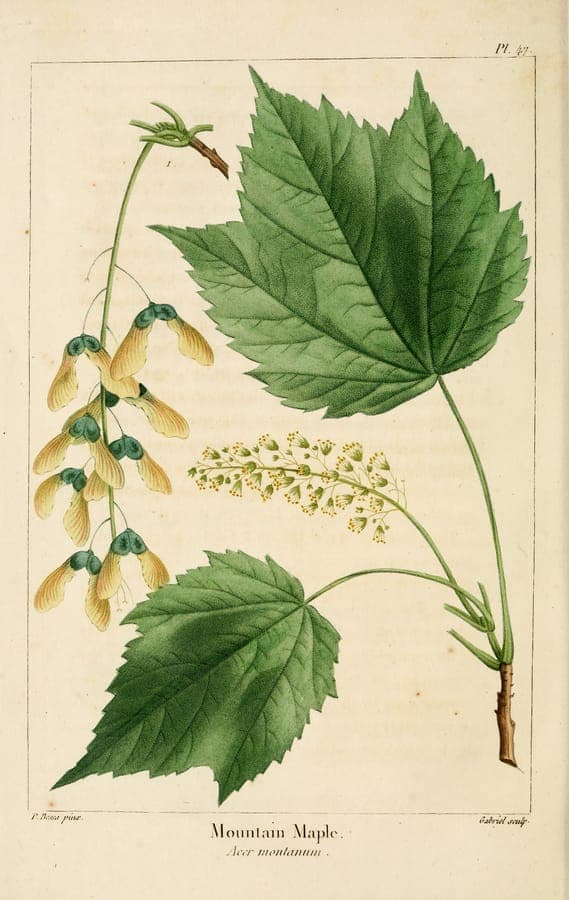
François André Michaux (book author), Augustus Lucas Hillhouse (translator), Pancrace Bessa (illustrator), Gabriel (engraver) / Public domain, via Wikimedia Commons
Acer spicatum: complete guide
Acer spicatum
¿Quieres ver Acer spicatum: complete guide en tu jardín?
1 minuto, sin tarjeta de crédito
Overview
Acer spicatum, commonly called mountain maple or moose maple, is a North American native species with broad appeal. This maple grows naturally in deciduous forests from Canada through the United States. The tree stands out for its spring blossoms and autumn transformation, plus its compact growth pattern.
This species is undervalued in modern gardens, despite its hardiness and beauty. Mountain maple thrives in cooler areas and provides bird food via its fruits and nectar production.
Appearance and bloom
Acer spicatum grows as a multi-stemmed shrub to small tree, typically 6 to 8 metres tall. The foliage is relatively small and fine, giving an open, airy character. Leaves are three to five lobed with rough texture.
The bloom is striking - yellow, fragrant flowers appear in upright clusters in May through June, preceding full leaf emergence. This provides a light, airy first impression. Flowers attract honeybees and other pollinators.
Autumn foliage colours shift to saffron yellow through orange-yellow, creating spectacular autumn displays. Fruits are small red samaras ripening to brownish-red.
Ideal location
Acer spicatum grows best in cool woodlands with dappled shade or partial light. In gardens it works well under larger trees or against a north-facing wall where it gets protection from hot afternoon sun. The tree also tolerates sunnier locations in cooler climates.
This species fits perfectly in natural woodland gardens, under other tree canopies, or as part of forest edges. The multi-stemmed growth makes it suitable for smaller properties.
Soil
Mountain maple grows best on well-draining, moist soils. Prefers neutral to acidic soil composition (pH 5.5-7.0). This species tolerates various soil types as long as drainage is good.
Add mature compost or leaf mould for improved water retention and nutrient availability. This is not a drought-tolerant species, so avoid dry locations.
Diseño gratis
¿Quieres ver Acer spicatum: complete guide en tu jardín? Crea un diseño gratis ahora.
Watering
Acer spicatum requires consistently moist soil, especially during the growing period. Water regularly in the first year until the tree has good root establishment. Older trees need less water but thrive with regular moisture.
Mulch around the base helps retain soil moisture. In dry summers provide extra water. This tree is not suitable for very dry locations.
Pruning
Mountain maple has minimal pruning requirements. Remove dead or damaged branches in late winter. If foliage becomes too dense, thin out for better air circulation and disease prevention.
Overbranched limbs can be carefully removed for shape. Keep the natural multi-stemmed growth intact rather than training to a single trunk.
Maintenance calendar
Spring: Water regularly, remove dead wood, enjoy flowers. Summer: Monitor moisture levels, prevent disease, no pruning needed. Autumn: Observe autumn colour, allow seed dispersal. Winter: Minimal maintenance, no feeding or pruning needed.
Winter hardiness
Acer spicatum is exceptionally hardy, tolerating temperatures to -30°C or colder. This North American native is perfect for cold climates where many other maples struggle. No winter protection needed in most areas.
The tree tolerates late frost periods without significant frost damage.
Companion plants
Mountain maple fits excellently in natural woodland gardens with other native species like Cornus kousa, various ferns and shade-loving groundcovers. In more formal gardens it can be used as an accent against dark brick.
Grouped with Viburnum, Physocarpus or other North American shrubs creates a cohesive understory planting.
Closing
Acer spicatum is an excellent choice for cooler climates and gardens with moister soils. The tree offers spring blossom, summer shade and autumn colour whilst supporting birds and pollinators. This is a valued tree specimen for sustainable garden design. Discover more possibilities on gardenworld.app. Visit gardenworld.app for further inspiration.
¿Quieres ver Acer spicatum: complete guide en tu jardín? Crea un diseño gratis ahora.
Sube una foto, elige un estilo y obtén un diseño fotorrealista con lista de plantas en menos de un minuto.
Más de 10.000 jardines diseñados
Sin tarjeta de crédito


Plantas similares
Acer pycnanthum: complete guide
Acer pycnanthum
Acer pycnanthum, the Japanese swamp maple, is a fast-growing tree with early red flowers and brilliant autumn color, ideal for damp garden settings.
Freeman maple: complete guide
Acer × freemanii
Everything about the Freeman maple (Acer x freemanii): a fast-growing shade tree with spectacular autumn colour for large gardens.
Wild ackee: complete guide
Cupania americana
A comprehensive guide to Cupania americana, a tropical tree from the Sapindaceae family with conspicuous white flowers and brown fruits, native to tropical America.