
Awinch1001 / CC0, via Wikimedia Commons
Korean maple: complete guide
Acer pseudosieboldianum
¿Quieres ver Korean maple: complete guide en tu jardín?
1 minuto, sin tarjeta de crédito
Overview
The Korean maple (Acer pseudosieboldianum) is a graceful deciduous tree native to Korea and the Russian Far East. This elegant maple reaches moderate height and is valued for its refined leaf shape, seasonal colour transformations, and graceful branching structure. In autumn, foliage transforms spectacularly from green to brilliant red and crimson, making it a favourite choice for landscapers seeking year-round interest.
Appearance & Growth
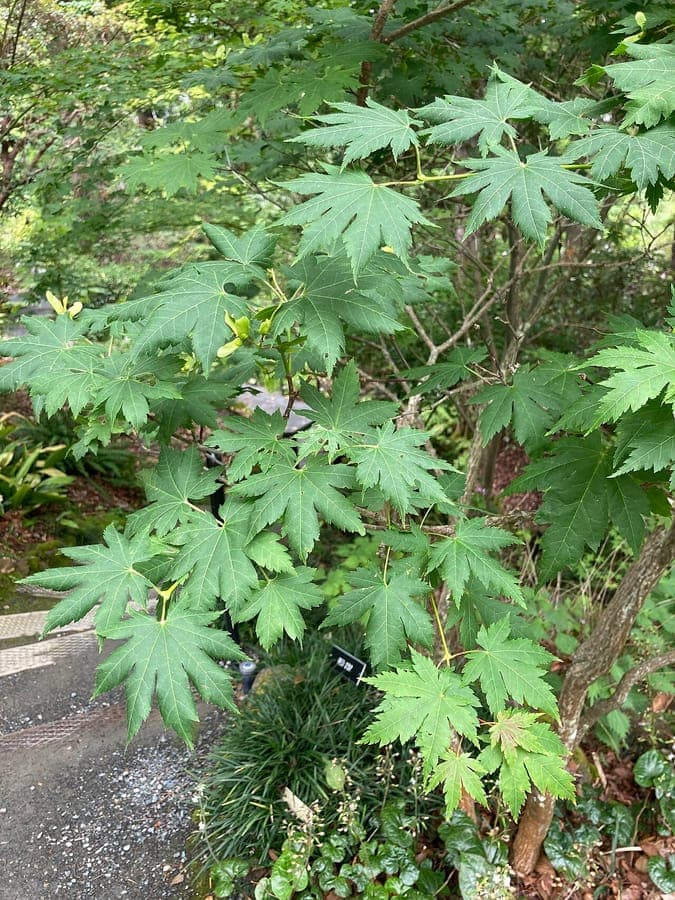
The Korean maple grows as a compact, well-branched tree reaching 10-15 meters tall. Leaves are hand-shaped with 7-13 lobes, finer than most maples, imparting delicate appearance. Young leaves break forth in red or purple-red before maturing to green in summer. Flowers are yellowish-green appearing in clusters before leaves emerge. Seeds are characteristic paired wings. Bark becomes smooth, grey-green with maturity.
Ideal Location
The Korean maple thrives in partial shade to full sun, though afternoon shade helps in hot climates. It grows best in sheltered locations where strong winds prevent leaf damage. Avoid extremely windy sites where foliage injury is likely. It is frost-hardy and thrives in cold climates provided heavy snow or ice loading is prevented.
Soil
The Korean maple prefers well-draining, moist but not waterlogged soil. A pH of 6.0-7.0 is ideal. Incorporate compost at planting for extra organic matter. The tree is adaptable to many soil types but grows best in nutrient-rich soil. Mulching around the base helps retain moisture and temperature stability.
Watering
Once established (after two growing seasons), Korean maples require regular water during growing season but tolerate drought better than many maples. During hot, dry periods, water deeply but infrequently. Young trees need more regular watering. Avoid waterlogging which causes root rot.
Diseño gratis
¿Quieres ver Korean maple: complete guide en tu jardín? Crea un diseño gratis ahora.
Pruning
Minimal pruning is required. Remove dead or diseased branches in late winter. Lightly shape young trees to promote unity. Avoid heavy pruning that distorts natural form. Maples bleed sap freely in spring so late autumn or winter pruning is preferable.
Maintenance Calendar
Spring (March-May): Growth begins, regular water for young trees, side-dressing compost application. Summer (June-August): Water during dry periods, no feeding needed after establishment. Autumn (September-October): Peak colour display, minimal watering during drying. Winter (November-February): Dormant period, prune dead branches only, no feeding.
Winter Hardiness
The Korean maple is frost-hardy to approximately minus 20 degrees Celsius. It tolerates cold climates well and grows in many USDA zones. Young trees may benefit from protected positioning against extreme winter temperatures. Mulching around base helps in very cold zones.
Companion Plants
The Korean maple combines beautifully with other shade-loving understory plants: Hostas, Astilbes, and Japanese Forest Grass. For height contrast: larger Japanese maples. In mixed borders: Hellebores, Astilbes, and Bergenia support picturesque tree vignettes.
Closing
The Korean maple offers year-round interest with refined foliage shape, seasonal colour, and graceful structure. A frost-hardy tree for temperate gardens, it thrives with minimal care once established. For refined garden design emphasizing fine detail and seasonal interest, visit gardenworld.app/en. Need help with specimen tree selection? Consult gardenworld.app/en for professional guidance.
¿Quieres ver Korean maple: complete guide en tu jardín? Crea un diseño gratis ahora.
Sube una foto, elige un estilo y obtén un diseño fotorrealista con lista de plantas en menos de un minuto.
Más de 10.000 jardines diseñados
Sin tarjeta de crédito


Plantas similares
Acer pycnanthum: complete guide
Acer pycnanthum
Acer pycnanthum, the Japanese swamp maple, is a fast-growing tree with early red flowers and brilliant autumn color, ideal for damp garden settings.
Freeman maple: complete guide
Acer × freemanii
Everything about the Freeman maple (Acer x freemanii): a fast-growing shade tree with spectacular autumn colour for large gardens.
Wild ackee: complete guide
Cupania americana
A comprehensive guide to Cupania americana, a tropical tree from the Sapindaceae family with conspicuous white flowers and brown fruits, native to tropical America.