
TeunSpaans / Public domain, via Wikimedia Commons
Acer pictum: complete guide
Acer pictum
¿Quieres ver Acer pictum: complete guide en tu jardín?
1 minuto, sin tarjeta de crédito
Overview
Acer pictum, the Painted Maple, is an elegant tree from the warmer temperate forests of Japan and Asia. The name "pictum" refers to the subtle marking on the leaves that appears to be painted. This is a tree that grows in value and beauty with age, and gives a well-managed garden considerable refinement.
This is a mid-sized maple that is perfect for larger gardens and park-like plantings. Unlike many compact Japanese maples, Acer pictum grows into a full, chestnut-like form that provides structure and shade.
Appearance and bloom
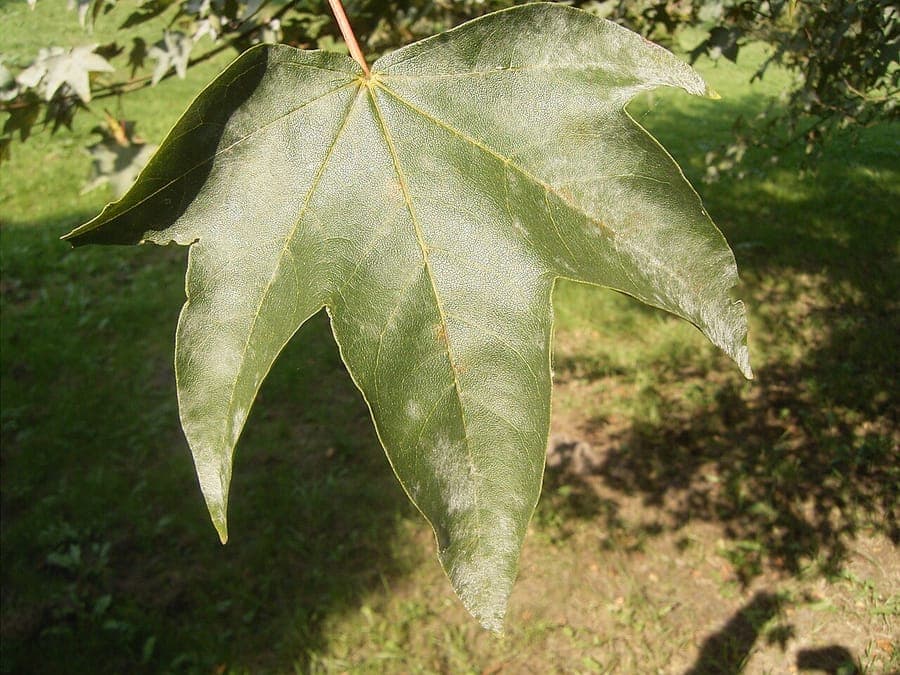
Acer pictum grows into a tree 10 to 20 meters tall with a broad, full crown. The leaves are palmately lobed (usually 5 to 7 lobes) and have a characteristic dark green color. What distinguishes this tree are the fine reddish or purple vascular lines that run across the leaf like "paintwork," especially visible when the leaves are still young.
In spring (March-April), inconspicuous, small green and red flowers appear in hanging clusters. These are not showy but form the beginning of the characteristic winged fruits (samaras) that grow in pairs and are dispersed by the wind.
The autumn foliage color is a highlight: the leaves slowly change from green to gold, orange, and red. Under optimal conditions, this color display can be very dramatic.
Ideal location
Acer pictum thrives best in partial shade to full sun. In hot climates, it tolerates some afternoon shade, which helps it avoid excess moisture stress. A minimum of 3-4 hours of direct sunlight per day is ideal.
Wind can damage this tree, so plant it in a sheltered location. The tree appreciates humid air conditions, which help prevent wilting and dry leaf edge.
The tree is hardy to about minus 20 degrees Celsius, making it suitable for most Dutch and Belgian regions. Young saplings deserve protection in their first winter.
Soil
Acer pictum prefers rich, well-draining, neutral to acidic soil. It differs from its Japanese relatives in that it tolerates slightly more moist soil, although good drainage is still essential.
Ideal mixture:
- 40% garden soil/potting soil
- 30% compost or leaf mold
- 20% sand or perlite
- 10% extra leaf mold for acidity
The pH should be between 5.5 and 7.0. Avoid heavy, compacted, or waterlogged soil.
For trees: make the planting hole at least as deep and twice as wide as the root ball. Add well-rotted compost to the planting hole.
Diseño gratis
¿Quieres ver Acer pictum: complete guide en tu jardín? Crea un diseño gratis ahora.
Watering
After planting, water regularly for the first 2 years - the root system must establish itself well. During dry periods, water deeply (10-15 cm soil penetration desired).
Under normal conditions, no additional water is needed after the second year, except during drought stress. The tree prefers regular moisture input but not waterlogged conditions.
In very hot summers, pay particular attention to watering - young foliage can wilt in extreme drought.
Pruning
Pruning is rarely necessary. The goal is to support the natural form and not drastically change it:
- Remove dead, sick, or damaged branches
- Selectively prune crossing branches
- In the young stage, careful thinning of the crown can help maintain an open form
Avoid heavy pruning - this causes excessive sap bleeding and can introduce diseases. If pruning is needed, do it in late winter/early spring.
Maintenance calendar
Spring (March-May): Season for planting. Support young trees with stakes. Begin regular watering. Add a layer of compost.
Summer (June-August): Monitor for drought. Water during periods of little rain. No pruning.
Autumn (September-October): Look at colorings - this gives insight into tree vitality. Remove leaf litter to prevent diseases.
Winter (November-February): Prune sick branches. Protection of young trees. Enjoy the star-like form of bare branches.
Winter hardiness
Acer pictum is hardy to minus 20 degrees Celsius. In the Netherlands and Belgium, it needs no special protection after the first winter.
In very cold regions and for young saplings:
- Add mulch around base
- Possibly wind breaks
- Improve drainage against wet freezes
Wet freezes (repeated freezing/thawing) are more threatening than constant cold.
Companion plants
Work well with Acer pictum:
- Other Asian maples (Acer palmatum varieties)
- Kalmia (mountain laurel)
- Euonymus species
- Hostas (for understory)
- Hellebores
- Helxine soleirolii or other groundcovers
Avoid dense competitors to protect tree roots.
Closing
Acer pictum is a refined choice for gardeners looking for something different from the overused Japanese maples. This tree grows in value and beauty with each passing season. With its elegant form, painted leaves, and golden autumn color, it gives decades of beauty to a well-placed garden.
Available at Intratuin and Gamma in the Netherlands. Plant it in your garden and enjoy years of refinement.
¿Quieres ver Acer pictum: complete guide en tu jardín? Crea un diseño gratis ahora.
Sube una foto, elige un estilo y obtén un diseño fotorrealista con lista de plantas en menos de un minuto.
Más de 10.000 jardines diseñados
Sin tarjeta de crédito


Plantas similares
Acer pycnanthum: complete guide
Acer pycnanthum
Acer pycnanthum, the Japanese swamp maple, is a fast-growing tree with early red flowers and brilliant autumn color, ideal for damp garden settings.
Freeman maple: complete guide
Acer × freemanii
Everything about the Freeman maple (Acer x freemanii): a fast-growing shade tree with spectacular autumn colour for large gardens.
Wild ackee: complete guide
Cupania americana
A comprehensive guide to Cupania americana, a tropical tree from the Sapindaceae family with conspicuous white flowers and brown fruits, native to tropical America.