
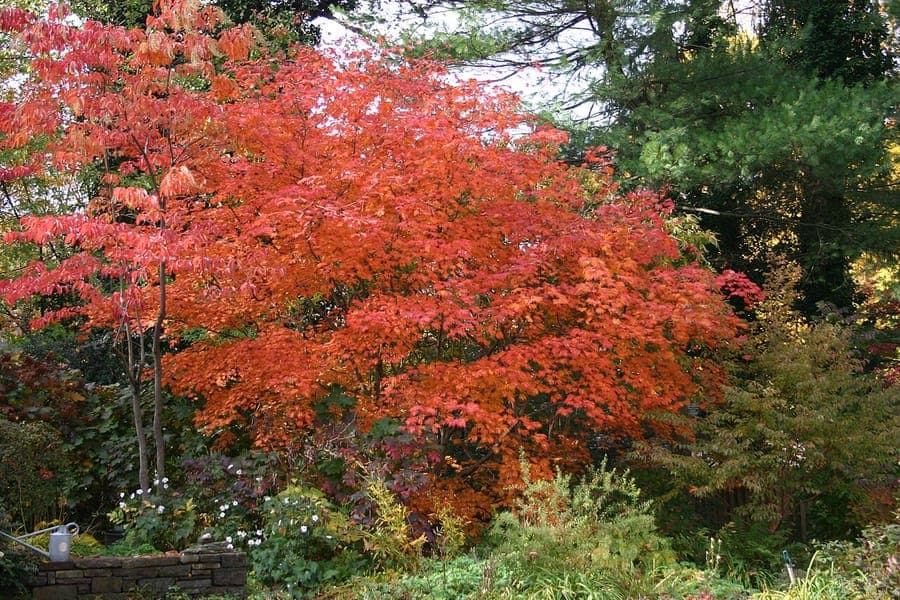
User:SB_Johnny / CC BY-SA 3.0, via Wikimedia Commons
Japanese Maple: Growing Guide & Seasonal Colour
Acer japonicum
¿Quieres ver Japanese Maple: Growing Guide & Seasonal Colour en tu jardín?
1 minuto, sin tarjeta de crédito
Overview
The Japanese maple (Acer japonicum), also known as full-moon maple, is a refined deciduous tree from the Sapindaceae family with botanical heritage from the mountainous regions of Japan and the Kurils. This elegantly proportioned tree is valued for its finely dissected leaves that transition through seasons and for its impressive autumn display of gold, orange, and deep red. Due to its moderate growth rate - typically reaching 8 to 12 metres at maturity - it is ideal for medium to large private gardens.
Appearance & Seasonal Cycle
The Japanese maple develops a compact, rounded crown with naturally symmetrical form. Leaves are characteristic: palmately lobed, divided into 7 to 11 fine pointed segments of 5-8 cm length, creating an open, jewellike canopy texture. Summer: bright green (sometimes with purple undertones). Autumn (October-November): gold, orange, or red depending on cultivar. Flowers are modest (small red clusters in April), but seeds (samaras) are ornamental winged fruits.
Ideal Location
Japanese maple is winter-hardy in USDA zones 5-8 (-23°C to 5°C). In warm climates, provide afternoon shade against hot sun; in temperate regions, full sun (4-6 hours). Shield from strong winds that damage fine foliage. Plant in sheltered locations with gentle morning sun. Avoid deep shade from large trees. Space 4-6 metres from other large shrubs.
Soil Requirements
Japanese maple grows best in acidic to neutral, well-draining, organically rich soil (pH 5.5-7.0). Heavy clay causes problems; amend with 30% composted bark. Underdraining is essential - avoid waterlogged soil around roots. Apply slow-release Japanese maple fertiliser at planting (8-8-8 or similar NPK ratio). Maintain stable soil moisture and pH throughout establishment.
Watering
After planting (first 2 years), maintain consistent moisture: soil should remain evenly moist, never waterlogged. Provide 25 litres per plant weekly during growing season (April-October) if rainfall is absent. Mature trees are drought-sensitive - during very dry summers provide supplementary watering. In autumn and winter, watering requirements are minimal; natural precipitation usually suffices. A 5-7 cm mulch layer around the root zone helps retain moisture.
Diseño gratis
¿Quieres ver Japanese Maple: Growing Guide & Seasonal Colour en tu jardín? Crea un diseño gratis ahora.
Pruning
Minimal pruning is recommended - Japanese maples grow naturally elegant. Remove only dead, diseased, or strongly crossing branches, shortly after flowering (May). Avoid heavy pruning; trees bleed profusely and recover slowly. Formative pruning is unnecessary; trees develop naturally symmetrical form. Remove immediately any sucker growth (waterspouts) from the root collar.
Maintenance Calendar
April: First leaves appear; check soil moisture. Apply mild feed. May-June: Canopy fully leafed; no further pruning needed. July-August: Monitor soil moisture during dry spells. September-October: Autumn colour change; spectacular display. November: Autumn foliage completely dropped; natural leaf fall provides soil benefit. December-March: Winter dormancy; no maintenance required.
Winter Hardiness
Acer japonicum is completely winter-hardy to zone 5b (-26°C). In northern UK and German temperate zones, no protection is needed. Young specimens may occasionally experience light leaf-margin scorching in severe frost, but recover fully in spring growth.
Companion Plants
Japanese maple combines beautifully with shade-tolerant underplanting: Japanese astilbe, hostas, and winter heather (Erica tetralix). Because it tolerates winter-flowering jasmine (Jasminum nudiflorum), companion planting creates four-season colour. In formal gardens, it stands magnificent as a specimen tree on a lawn. For inspiration on foliage design and Japanese garden elements, visit gardenworld.app where designers highlight specimen trees and seasonal palettes.
Propagation
Propagation occurs via seed or softwood cuttings in summer. Seed requires cold stratification. Take cuttings in June-July from well-ripened young wood, place in sand-perlite medium under light shade. Seedlings reach flowering size after 7-10 years; cultivars are grafted onto maple rootstocks for true-to-type reproduction.
Conclusion
The Japanese maple is an essential choice for those appreciating refined architecture and seasonal variation. This tree offers years of aesthetic value with minimal maintenance. For more information on Japanese trees and specimen plantings, visit gardenworld.app where designers develop elegant foliage architecture and colour schemes.
¿Quieres ver Japanese Maple: Growing Guide & Seasonal Colour en tu jardín? Crea un diseño gratis ahora.
Sube una foto, elige un estilo y obtén un diseño fotorrealista con lista de plantas en menos de un minuto.
Más de 10.000 jardines diseñados
Sin tarjeta de crédito


Plantas similares
Acer pycnanthum: complete guide
Acer pycnanthum
Acer pycnanthum, the Japanese swamp maple, is a fast-growing tree with early red flowers and brilliant autumn color, ideal for damp garden settings.
Freeman maple: complete guide
Acer × freemanii
Everything about the Freeman maple (Acer x freemanii): a fast-growing shade tree with spectacular autumn colour for large gardens.
Wild ackee: complete guide
Cupania americana
A comprehensive guide to Cupania americana, a tropical tree from the Sapindaceae family with conspicuous white flowers and brown fruits, native to tropical America.