
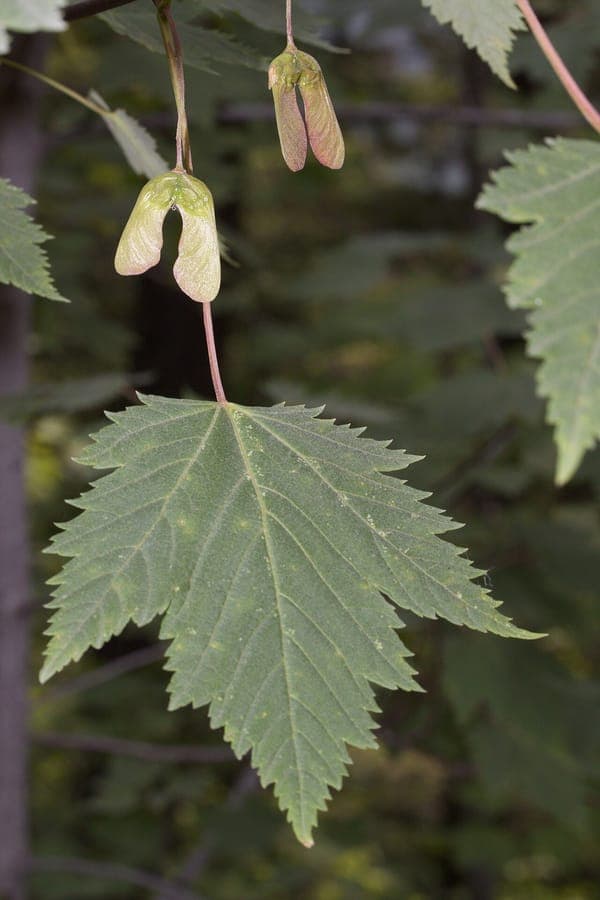
Walter Siegmund (talk) / CC BY-SA 3.0, via Wikimedia Commons
Acer glabrum: complete guide
Acer glabrum
¿Quieres ver Acer glabrum: complete guide en tu jardín?
1 minuto, sin tarjeta de crédito
Overview
Acer glabrum, commonly known as Rocky Mountain maple or Dwarf maple, is a hardy North American shrub-tree that transforms mountain gardens. This resilient species has a native range extending from Alaska through Mexico, demonstrating exceptional adaptability. The Rocky Mountain maple grows more rapidly than many other maples and ultimately reaches 5 to 8 meters in height, though garden specimens often remain smaller. It is completely winter hardy and excellent for dry, well-drained locations.
Appearance and bloom
The Rocky Mountain maple has medium-sized opposite leaves, usually 5-10 centimeters long, with three to five lobes typical of mountain maples. The leaf texture is coarse, which contrasts with the smooth stems that give the species its Latin name.
In spring, typically April and May, inconspicuous yellow-green flowers appear in small clusters. These flowers signal the coming production of yellow and red samara fruits that ripen in summer.
The bark remains smooth and green on young growth, creating winter interest. Autumn foliage transforms to bright yellow through orange, sometimes deep red, making Rocky Mountain maple a spectacular fall feature.
Ideal location
Rocky Mountain maple suits full sun to partial shade. It is actually one of the most sun-tolerant maples, distinguishing it from many other Acer species. The tree thrives on mountain terrain, rocky slopes and other sites where many trees struggle.
Suitable for small and large gardens, this is an excellent choice for hedgerow plantings where it sits alongside native species. Plant at least 1.5 to 2 meters from other large trees and 3-4 meters from buildings.
Soil
Rocky Mountain maple thrives on dry to moderately moist ground with pH between 5.8 and 7.5, tolerating a broad range. The tree accepts sandy, rocky and loamy soils as long as drainage is good. This is advantageous in gardens with difficult terrain.
Good drainage must be ensured at planting. In heavy clay, add sand or perlite. The tree tolerates poor soil and needs minimal nutrition. It actually performs better on lean soils where weed competition is limited.
Diseño gratis
¿Quieres ver Acer glabrum: complete guide en tu jardín? Crea un diseño gratis ahora.
Watering
Once established, Rocky Mountain maple is extremely drought tolerant and can go extended periods without supplemental water. This makes it ideal for water-conscious gardens. Young trees, however, require regular watering until well-established.
Water the Rocky Mountain maple when first planted, but reduce frequency significantly after the first growing season. Mulch helps moisture retention in early years, but excessive mulch can encourage disease.
Pruning
Rocky Mountain maple grows naturally in a compact, rounded form and requires minimal pruning. Remove only damaged or dead branches. The tree can even be used for natural hedges, though this requires regular pruning.
Winter is the best time for major pruning operations. If shaping is desired, this can be done in late spring after flowering.
Maintenance calendar
March/April: Check for damaged branches. Usually no feeding needed due to tolerance for poor soil.
May through July: Water young trees regularly. Once established minimal care is needed.
August: Reduce watering. The tree is ready for drought.
September/October: Enjoy spectacular autumn color. This is a garden highlight.
November/December: Minimal maintenance. Possible removal of dead branches.
January/February: Winter pruning can occur.
Winter hardiness
Rocky Mountain maple is fully hardy to at least USDA zone 4 (minimum -34 degrees C), much colder than necessary in most temperate regions. This is an extremely frost-resistant tree.
Young specimens may benefit from some protection during especially harsh winters with strong winds, but established trees are completely frost-proof.
Companion plants
Rocky Mountain maple combines beautifully with other native mountain plants. Consider dwarf hydrangeas, alpine flowers and hardy grasses. Other native trees can be planted alongside.
In smaller gardens it can stand alone as a specimen tree. In larger landscapes it works well in groups.
Closing thoughts
Rocky Mountain maple is an excellent choice for gardeners seeking robustness and autumn beauty. Its rapid growth rate and drought tolerance make it ideal for modern and small gardens. With minimal care and maximum garden enjoyment, Acer glabrum is an excellent investment.
Seek this at tree nurseries, especially those specializing in mountain plants. It will provide many years of pleasure.
¿Quieres ver Acer glabrum: complete guide en tu jardín? Crea un diseño gratis ahora.
Sube una foto, elige un estilo y obtén un diseño fotorrealista con lista de plantas en menos de un minuto.
Más de 10.000 jardines diseñados
Sin tarjeta de crédito


Plantas similares
Acer pycnanthum: complete guide
Acer pycnanthum
Acer pycnanthum, the Japanese swamp maple, is a fast-growing tree with early red flowers and brilliant autumn color, ideal for damp garden settings.
Freeman maple: complete guide
Acer × freemanii
Everything about the Freeman maple (Acer x freemanii): a fast-growing shade tree with spectacular autumn colour for large gardens.
Wild ackee: complete guide
Cupania americana
A comprehensive guide to Cupania americana, a tropical tree from the Sapindaceae family with conspicuous white flowers and brown fruits, native to tropical America.