
Wikimedia Commons / CC BY-SA 3.0, via Wikimedia Commons
Marie's fir: complete guide
Abies mariesii
¿Quieres ver Marie's fir: complete guide en tu jardín?
1 minuto, sin tarjeta de crédito
Overview
Abies mariesii, known as Marie's fir or Japanese silver fir, is a stylish conifer from Japan (Honshu island). This elegant fir grows on mountain slopes in the Japanese Alps, where it learns to tolerate conditions of snow, wind, and limited growing seasons. In gardens it offers structure, evergreen beauty, and interesting texture that unfolds slowly over time.
The plant belongs to the Pinaceae family (spruce, fir, and pine family). In its homeland it grows to 30-40 meters tall in coniferous forests. As an ornamental tree it is much more compact and reaches 10-15 meters in cultivation.
Appearance and Bloom
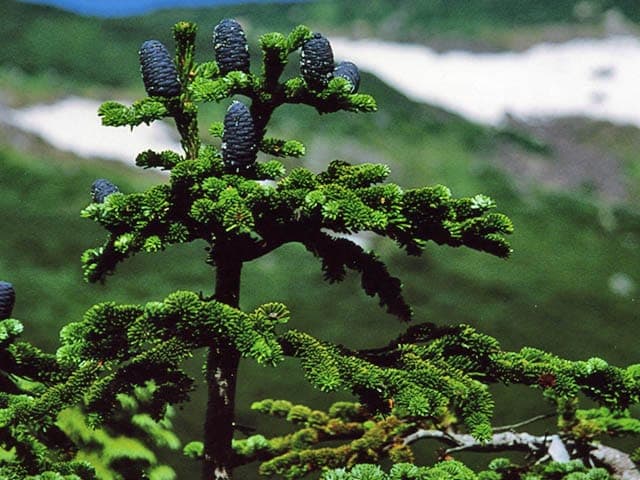
Marie's fir grows in a regular, narrow pyramidal form, ideal for small to medium gardens. The needles are short, blue-green, and about 1-2 cm long, lying tight against the branches. This gives the tree a smooth, elegant surface.
The form is the principal attraction. The tree grows slowly, approximately 10-20 cm per year, meaning planting today ensures patience for future enjoyment. Mature trees reach 10-15 meters tall and 4-6 meters wide in cultivation.
The bark is smooth and grey, becoming more wrinkled with age. Cones are upright, small and inconspicuous, about 5-7 cm long. They are rarely noticed until they disintegrate and disperse seeds.
Ideal Location
Marie's fir grows best in full sun to partial shade with at least 4-6 hours direct sunlight daily. In full shade it grows slowly and becomes irregular. A north-facing spot is acceptable, but south is better.
It grows well in mountainous regions or elevated gardens where air circulation is good. It tolerates wind better than many other firs. Don't plant it in warm, low-lying valleys where hot air stagnates.
Ideal is a location with cool mountain climate - cool in summer and snowy in winter. In warmer climates it grows slower and may become stressed.
Soil
Marie's fir grows best in well-draining, acidic soil with pH 5.5-6.5. It tolerates somewhat moist conditions well once established. Heavy clay should be amended with coarse sand and sphagnum.
The tree grows in nutrient-poor soil, so fertilizer is not essential. In rich, nutrient-rich soil it grows faster but maintains the same form.
When planting work 50-100 liters coarse compost or leaf mold into the hole. This improves drainage and allows roots to grow faster.
Watering
Once established (after 2-3 years), Marie's fir needs minimal supplemental water. It tolerates drought reasonably well thanks to a deep root system. In normal climates natural rainfall suffices.
In the first year after planting, regular watering (1-2 times weekly in dry periods) is essential until roots are deep. After year two this can be reduced to sporadic watering.
In summers with extreme drought (no rain longer than 1 month) watering is recommended. Excessive water damages more than drought.
Diseño gratis
¿Quieres ver Marie's fir: complete guide en tu jardín? Crea un diseño gratis ahora.
Pruning
Pruning is not essential. The tree grows in natural pyramidal form without intervention. Remove dead branches or needles in early spring (March) for tidiness.
Young growth can be gently pruned back if you want a compact form. Pruning is best done January-February before growth begins. Post-bloom pruning helps maintain shape.
Do not remove more than 20% of annual growth - this can weaken the tree.
Maintenance Calendar
March: inspect tree for winter damage. Remove dead needles/branches. Begin feeding with slow-release granules.
April-May: growth begins. Check for pests (caterpillars, borers). Ensure adequate drainage.
June-July: peak growth. Observe form development. Pruning not recommended now.
August-September: growth slows. Prepare for autumn. Remove fallen needles.
October-November: autumn color (stays deep green). Winter preparation. Water well until frost begins.
December-February: winter dormancy. No feeding needed. Pruning can happen now.
Winter Hardiness
Marie's fir is fairly winter hardy and grows in zones 5-7, roughly covering northern France to Poland. In the Netherlands it grows well in most areas, including the north.
It tolerates snow and ice well. Heavy snow loads can bend young branches, but they usually recover when snow melts. In extreme frost (below -30 degrees) twig tips may freeze, but tree survives.
Companion Plants
Marie's fir harmonizes well with other conifers: spruce, hemlock, and silver fir. Also pairs well with deciduous trees like beech, ash, and birch.
In understory plant woodland plants: helleborus, evergreen ferns, shade cyclamen. These prefer the same dry-shade under the tree.
For flowering contrast: azaleas, rhododendrons (less calcareous soils) and barberry bloom simultaneously.
Summary
Abies mariesii is an elegant, slow-growing conifer that offers beauty for decades. With minimal care it grows excellently in mountainous and temperate zones. It tolerates wind, snow, and drought well.
Young material is available at specialist tree nurseries in your region. Larger garden centers sometimes have specimens. Start with young stock (1-2 meters) for best establishment.
This tree is an investment for the future - plant now and enjoy the slow unfolding of elegant silhouette for decades to come. For landscape design with conifers, visit gardenworld.app and share your front yard photo for free advice!
¿Quieres ver Marie's fir: complete guide en tu jardín? Crea un diseño gratis ahora.
Sube una foto, elige un estilo y obtén un diseño fotorrealista con lista de plantas en menos de un minuto.
Más de 10.000 jardines diseñados
Sin tarjeta de crédito


Plantas similares
Abies delavayi: complete guide
Abies delavayi
Delavayi fir is an elegant, medium-sized coniferous tree from the Pinaceae family with dark green needles. This Asian evergreen is perfect for alpine gardens and large landscapes.
Taiwan fir: complete guide
Abies kawakamii
Discover the magnificent Taiwan fir, a rare evergreen conifer from Taiwan's mountain regions. Learn growth requirements, care tips, and why this beautiful tree is perfect for collectors of unique garden specimens.
Farges fir: complete guide
Abies fargesii
Discover the majestic Farges fir, an impressive conifer from China's mountains with elegant foliage and columnar form. Ideal for large gardens.