
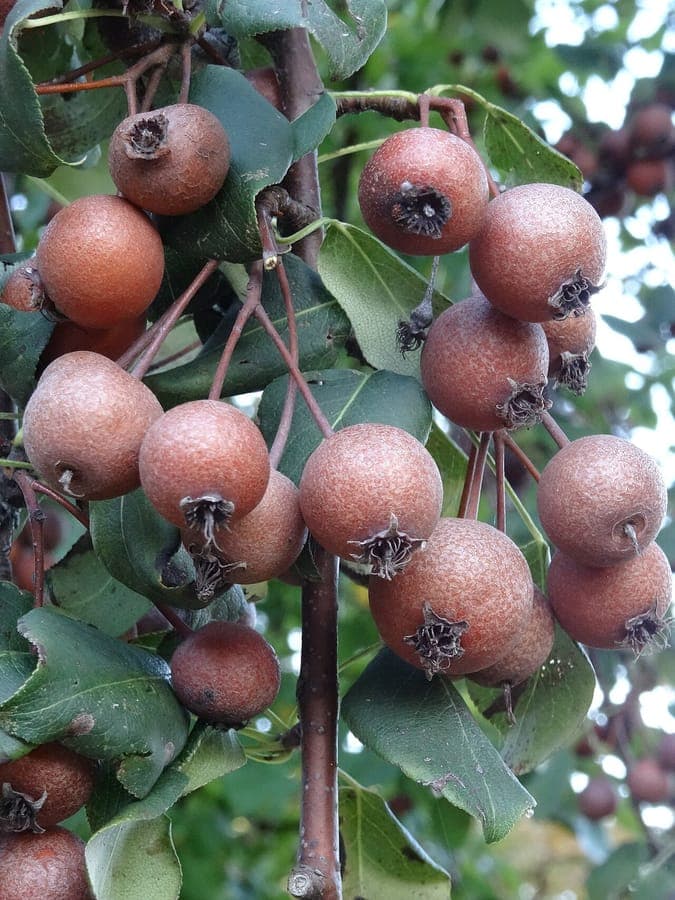
How to prune Doyenné du Comice pear: the premium table pear variety
¿Quieres ver esto en tu jardín?
1 minuto, sin tarjeta de crédito
TL;DR: Doyenné du Comice pruning
Doyenné du Comice is self-sterile - you need a pollinator (Conference, Williams, Bosc). Grows more vertically than Conference - plan for 2.5-3 m height and 2.5-3 m width at maturity. Yield decline stronger than Conference - so summer pruning (August) essential, plus hand-thinning in June. Specific: late bearer (first crop year 5-6), but pears are largest and finest of all garden varieties.
Doyenné du Comice: the luxury table pear
Doyenné du Comice is known in top restaurants worldwide as "la poire royale" - the queen's pear. And rightly so. Large (250-400g), soft as butter, sweet with hints of vanilla and light citrus. No other table pear variety reaches this level.
But Doyenné is also fussy. Self-sterile (no viable pollen), late bearer (year 5-6 for first crop, not year 4 like Conference), and very prone to yield decline: good fruit one year, almost nothing the next, good again. This makes her less suitable for small-garden owners wanting fruit each year - better for enthusiasts who wait for supreme quality.
Choosing a pollinator: essential for Doyenné
Doyenné is sterile on her own pollen. You must have a pollinator. Suitable:
- Conference (BEST) - flowering overlap (May), good pollen contact, and Conference bears heavily - so pollen abundant
- Williams (GOOD) - stronger aromatic contrast (Williams sweet, Doyenné refined), flowering well synced
- Bosc - working, but sparser bloom - less optimal
- Forelle - late flowering (after Doyenné's gone) - NOT suitable
Plant your Doyenné NO MORE than 15 m from your Conference/Williams. Bees must travel between them - they will. Conference at far end of garden? Plant Doyenné closer to it.
Forming Doyenné: more vertical than Conference
Doyenné grows narrower than Conference. Where Conference wants to expand to 3.5-4 m wide, Doyenné shoots upward to 3-3.5 m height. This requires different pruning.
Years 1-3: Basic formation with height control
Year 1 (March):
- Clear trunk to 70 cm, select 3-4 primary branches at 40-100 cm height (same as Conference)
- Head central stem 20-30 cm (same as Conference)
- DIFFERENT from Conference: actively remove all further height-competitors (vertical shoots from central laterals) at growth-point checks July-August
Doyenné wants to form a replacement central stem beside your primary branches - combat this actively. This is where Doyenné requires extra work.
Year 2 (March):
- Extend primaries 30-40 cm (same)
- Remove inward-growing laterals (same)
- DIFFERENT: if your central leader (or competitors) grows stronger than your primary branches (thicker wood, faster rise), head the central back 10-15 cm to restore balance
Year 3 (March):
- Extend primaries 20-30 cm to 2-2.5 m total
- Develop secondary branches (2-3 per primary)
- Check central balance - Doyenné can now grow toward 2.5-3 m height
Yield decline in Doyenné: more pronounced than Conference
Conference has a 2-3 year dip cycle (good, less, less, good). Doyenné has this stronger: one year LOTS of fruit (30+ kg), next year LITTLE (5-8 kg), next year LOTS. This is genetic, not solvable by pruning alone, but GREATLY REDUCED by good pruning + thinning.
Why so strong? Doyenné forms excessive fruit buds in good years - more than she can carry. This stresses the tree: next year she forms far fewer buds (nature's "you flowered heavily, now rest"). Reversing this is to halve your fruit set (hand-thin).
Preventing yield decline: the plan
Year 4: First crop (small)
- March: light heading of primaries (15 cm), remove inward-growing
- June: thin to 1 pear per 15 cm twig (remove many pears)
- August: summer prune (see below)
- Result: 5-10 kg medium pears
Year 5: Possible first heavy crop
- March: light prune (10 cm), structure maintenance
- June: AGGRESSIVE thinning to 1 pear per 20 cm twig (remove lots) - essential for next year's bearing
- August: summer prune
- Result: 15-25 kg large pears (250-350g)
Year 6: Dip year (expect)
- March: light prune (5-10 cm)
- May: heavy flower-thin (remove 50% of unfertilized flowers), because tree now wants rest
- August: summer prune
- Result: 8-12 kg (this is normal, don't panic)
Year 7+: Cycle repeats Good pruning + aggressive thinning in peak years helps flatten swings from 80% (lots/nothing) down to 40% (lots/good).
Diseño gratis
Crea tu propio diseño de jardín
Summer pruning Doyenné: essential as Conference
Summer pruning (August) is even more critical for Doyenné than Conference, because:
- Doyenné forms extra short laterals (inward-growing twiglets)
- These laterals bear poorly (lots of flowers, few fruit set)
- Summer pruning (head to 10-15 cm) forces energy toward terminal buds
August summer pruning:
- New growth > 15 cm, > 3 mm thick: cut back to 10-15 cm
- New growth < 10 cm, < 2 mm: leave it
- Inward-growing new shoots (remove completely)
- Open dense packs where you can't see light
Doyenné-specific issues
Watersprouts very likely after hard pruning
Doyenné forms watersprouts faster than other varieties. Avoid harsh winter pruning - summer pruning preferred. If you get watersprouts (thick vertical shoots after pruning), remove them as soon as visible (June-July). Repeat if needed until they stop (usually stop after 2-3 removals).
Disease susceptibility
Doyenné is more prone to fire blight (bacteria) than Conference. Not directly from pruning, but: better air circulation (summer prune dense packs) helps prevention. Also ensure:
- Remove any diseased wood immediately (don't wait)
- Disinfect pruning tool (10% bleach in water) if in doubt
- Plant away from windy spot (prevent wounds)
Russetting (skin roughness)
Doyenné forms more russetting than Conference. Usually genetic (Doyenné-variety trait), not a pruning error. Water management helps slightly (consistent, not extreme dry/wet). No pruning strategy solves this.
Step-by-step plan for Doyenné du Comice
Step 1: Choose and plant pollinator
Plant a Conference beside your Doyenné at maximum 15 m distance. Ensure Conference has healthy flowers in May (not frost-damaged). Both full sun, good drainage.
Step 2: Years 1-3 formation with height control (March each year)
Year 1: 3-4 primaries at 40-100 cm, head central 20-30 cm, remove height-competitors. Year 2: extend primaries 30-40 cm, restore height balance. Year 3: develop secondaries (2-3 per primary), aim for 2.5-3 m height.
Step 3: Years 4-5 first bearing with aggressive thinning
March: light prune (10-15 cm). June: thin to 1 pear per 15-20 cm twig (remove many). August: standard summer prune. Year 5: flower-thin in May (remove 50% unfertilized).
Step 4: Year 6+ accept and manage dip cycle
Year 6 is dip year (expect 8-12 kg vs previous 20 kg). March: minimal prune (5 cm). May: flower-thin (remove 50%). August: summer prune. Year 7 rebounds to 15-20 kg.
Step 5: Annual summer pruning
August: every year, all branches - new growth > 15 cm and > 3 mm back, inward gone, dense opened. Prevents 40% of yield-decline swings.
Frequently asked questions
Can I grow Doyenné without a pollinator?
No. Self-sterile - no pollen, no fruit. You MUST have Conference or Williams nearby. Garden is narrow? Plant them in a row side by side.
Doyenné fruits much smaller than advertised (150g vs 300g)?
Probably overloaded (too many pears per twig). Thin in June to 1 pear per 20 cm. That halves quantity but doubles pear size and next-year bearing quality.
Watersprouts from my Doyenné - what now?
Fire blight likely (also: over-pruning, or trauma). Remove watersprouts immediately when visible (June). Disinfect tool (10% bleach). If tree badly diseased (many dead branches), remove whole branch and burn (don't compost).
Doyenné stays small/won't grow?
Yes, Doyenné grows slightly slower than Conference. This is normal. Also: is your pollinator well-pollinated by bees (May)? Poor pollination = small pears + slow growth. Ensure beehives nearby or plant pollinator closer (< 10 m).
When do I harvest Doyenné?
October-November, when golden-yellow and slightly soft. Don't pick green - Doyenné doesn't ripen well after picking (unlike Conference). Ripening on tree gives best flavour.
Harvesting Doyenné and serving
Doyenné reaches maturity year 10-12, then 2.5-3 m tall, 2.5-3 m wide. Optimal planting distance 3.5 m x 3 m.
With good pruning + thinning, good years bear 25-35 kg, dip years 10-15 kg. Pears reach 250-400g, golden-yellow, softer than butter - the ultimate garden pear.
On gardenworld.app you can see how a mature Doyenné pear tree (year 10+, heavily laden golden fruit) would fit into a luxury garden design. Doyenné combines well with tall bloom structure (lavender, roses) - combine them for summer-to-autumn splendour.
Crea tu propio diseño de jardín
Sube una foto, elige un estilo y obtén un diseño fotorrealista con lista de plantas en menos de un minuto.
Más de 10.000 jardines diseñados
Sin tarjeta de crédito


Artículos relacionados
 Plantación
Planting fruit trees in your garden
From apple to cherry: learn which fruit trees suit your garden and how to plant and care for them successfully.
 Consejos estacionales
Pruning trees and shrubs: when, how and why
Learn when and how to prune trees and shrubs for healthy growth and beautiful shapes. Practical pruning tips.
 Construcción de jardines
Pruning calendar: when to prune which plant — month by month
When to prune? Spring, summer, autumn, winter — which plants prune which month? Practical pruning calendar for most-used garden plants.