
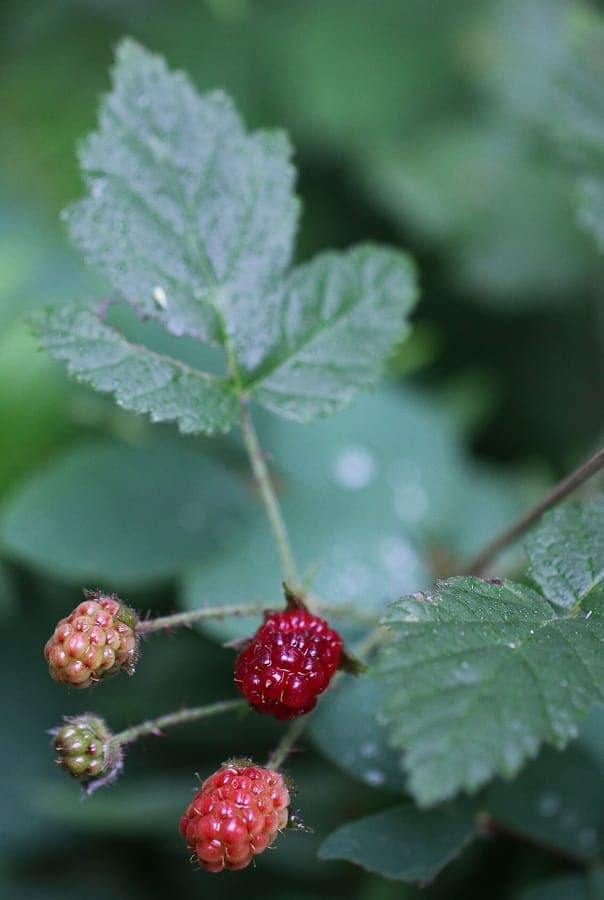
USFWS - Pacific Region / Public domain, via Wikimedia Commons
Pacific blackberry (Rubus ursinus): complete guide
Rubus ursinus
Mochten Sie Pacific blackberry (Rubus ursinus): complete guide in Ihrem Garten sehen?
1 Minute, keine Kreditkarte
Overview
Rubus ursinus, commonly called Pacific blackberry, California dewberry, Douglas-berry, or Pacific trailing blackberry, is a western North American bramble from British Columbia to Mexico. This is a sprawling trailing ranker with prickly, vigorous stems and notably coarse-textured, large leaves. Unlike passive brambles, this is an aggressive, energetic plant suitable for large wild gardens and mountain terrain.
Appearance and bloom
Trails along ground and climbs steep slopes to 3-4 metres via powerful prickly stems. Leaves are large, heavily ribbed, trifoliate, 8-15 cm long with sharp teeth. Flowers are strikingly large for a Rubus - white to pink petals, 2-3 cm across, appear March-April on coast, May-June inland. Berries ripen July-August into large black aggregate drupes, 1.5-2 cm long, edible with mildly tart-sweet profile. Spines are formidable - heavy gloves essential.
Ideal location
Grows full sun to half-shade, blooms best in full sun exposure. Ideal on steep slopes, mountain terraces, and unstructured wild garden corners. This plant demands space and freedom. Plantings on south-facing slopes and wind-exposed locations present no problems. Highly suitable for coastal wilderness gardens.
Soil
Grows on virtually all soils, from acidic to alkaline (pH 5.5-8). No special preparation needed. In poor sand, some compost helps but isn't essential. Stagnation is the only major enemy - ensure sloping drainage. Highly adaptive to rocky, debris-rich soils.
Watering
Surprisingly drought-tolerant once established (after 1-2 seasons). Initial watering important - water regularly first month. Thereafter, sporadic watering in extreme dry periods. On the coast, maritime humidity provides sufficient hydration. In continental climates with very dry summers, supplemental watering helpful.
Kostenloses Design
Mochten Sie Pacific blackberry (Rubus ursinus): complete guide in Ihrem Garten sehen? Erstellen Sie jetzt ein kostenloses Design.
Pruning
Robust pruning required. Every winter, old fruiting canes can be completely removed after harvest. This prevents disease and limits spread. Young vegetative runners can be cut back in summer to restrain growth. Without pruning, this plant grows extremely wild.
Maintenance calendar
March: Harvest late-season fruit, begin pruning. April-May: Full bloom, no intervention. June-July: Fruit set, monitor vigour. August: Harvest ripe berries, plan pruning. September-October: Prepare winter pruning. November-February: Heavy pruning, dead-wood clearance, shaping.
Winter hardiness
Rubus ursinus withstands temperatures to -15 to -18C (USDA zones 7-8). Limits use in colder climates without protection. On Pacific coast, California, and Oregon, fully winter-hardy. In continental climates, frost damage possible - protect young plants or use containers.
Companion plants
Allows free growth in semi-wild landscapes with native western shrubs (Sambucus, Rhamnus). Perfect pergola climber on sturdy metalwork. Do not plant adjacent to delicate, frost-sensitive neighbours. Birds and butterflies highly value flowers and berries. Ideal for wildlife gardens requiring minimal maintenance.
Closing
Pacific blackberry is for those rejecting classical ornamental cultivation. This is a wild brawler with size and vigour, offering rough beauty and reliable fruiting. For western North American gardens, coastal heritage gardens, and those preferring ecological wildness, this is botanical gold.
Mochten Sie Pacific blackberry (Rubus ursinus): complete guide in Ihrem Garten sehen? Erstellen Sie jetzt ein kostenloses Design.
Foto hochladen, Stil wahlen und in unter einer Minute ein fotorealistisches Design inklusive Pflanzenliste erhalten.
Schon 10.000+ Garten gestaltet
Keine Kreditkarte erforderlich


Ähnliche Pflanzen
Hastige Brombeere (Rubus hispidus): kompletter Ratgeber
Rubus hispidus
Entdecken Sie die hastige Brombeere aus dem oestlichen Nordamerika. Ein kriechender Bodendecker mit steifen Trieben, gedeiht in sauren und sumpfigen Boeden.
Behartes Zwergenhimbeerkraut (Rubus pubescens): kompletter Ratgeber
Rubus pubescens
Entdecken Sie das behaarte Zwergenhimbeerkraut aus subarktischen Nordamerika. Ein niedriger krautiger Bodendecker mit roten Fruechten und Samtlaub - winterhart bis -30 °C.
Fussblaettriges Erdbeerkraut (Rubus pedatus): kompletter Ratgeber
Rubus pedatus
Entdecken Sie die Erdbeerhimbeere aus dem Himalaya. Ein kriechender Bodendecker mit charakteristischen fuenfblattrigen Blaetern und farbwechselnden Beeren - perfekt fuer Alpingaerten.